Industry News
Creative content validation: the practical guide

Marketing and communication teams currently produce a high volume of content: visuals, videos, carousels, blog posts, or social media publications. However, in many organisations, creative content approval remains scattered across emails, shared files, and conflicting feedback. Structuring this process is becoming essential to save time, improve content quality, and streamline communication between teams.
What is creative content approval?
Definition of the approval process
Creative content approval refers to the set of steps used to review, comment on, correct, and approve content before it is published.
This process involves:
visual content, such as posters, banners, or LinkedIn carousels;
marketing or corporate videos intended for social media or internal communication;
marketing campaigns comprising several formats and variations;
digital content published on the web or in newsletters;
the approval of PDF files, sales collateral, or institutional content.
The goal is to ensure that each piece of content meets creative, editorial, and strategic expectations before distribution.
The main approval steps
The approval workflow typically follows several stages:
creation of the brief, to define the objectives, deadlines, and expectations of the project;
content production by creative teams or service providers;
internal review to perform an initial quality check;
annotations to centralise feedback directly on the content;
corrections made in response to stakeholders' comments;
final approval prior to publication;
publishing across the different communication channels.
Each stage involves different stakeholders and requires good coordination between marketing, communication, and creative teams.
When this process is poorly structured, approvals quickly become long and complex.
Why structuring approvals has become essential
An increase in the volume of content to manage
Brands now publish more content than ever before. Social media, newsletters, digital campaigns, videos, and web content require quick and frequent approvals.
This increase in content volume naturally increases the number of back-and-forth exchanges between teams.
Without a clear structure, approvals significantly slow down content production and limit the time savings expected by marketing teams.
Often scattered communication
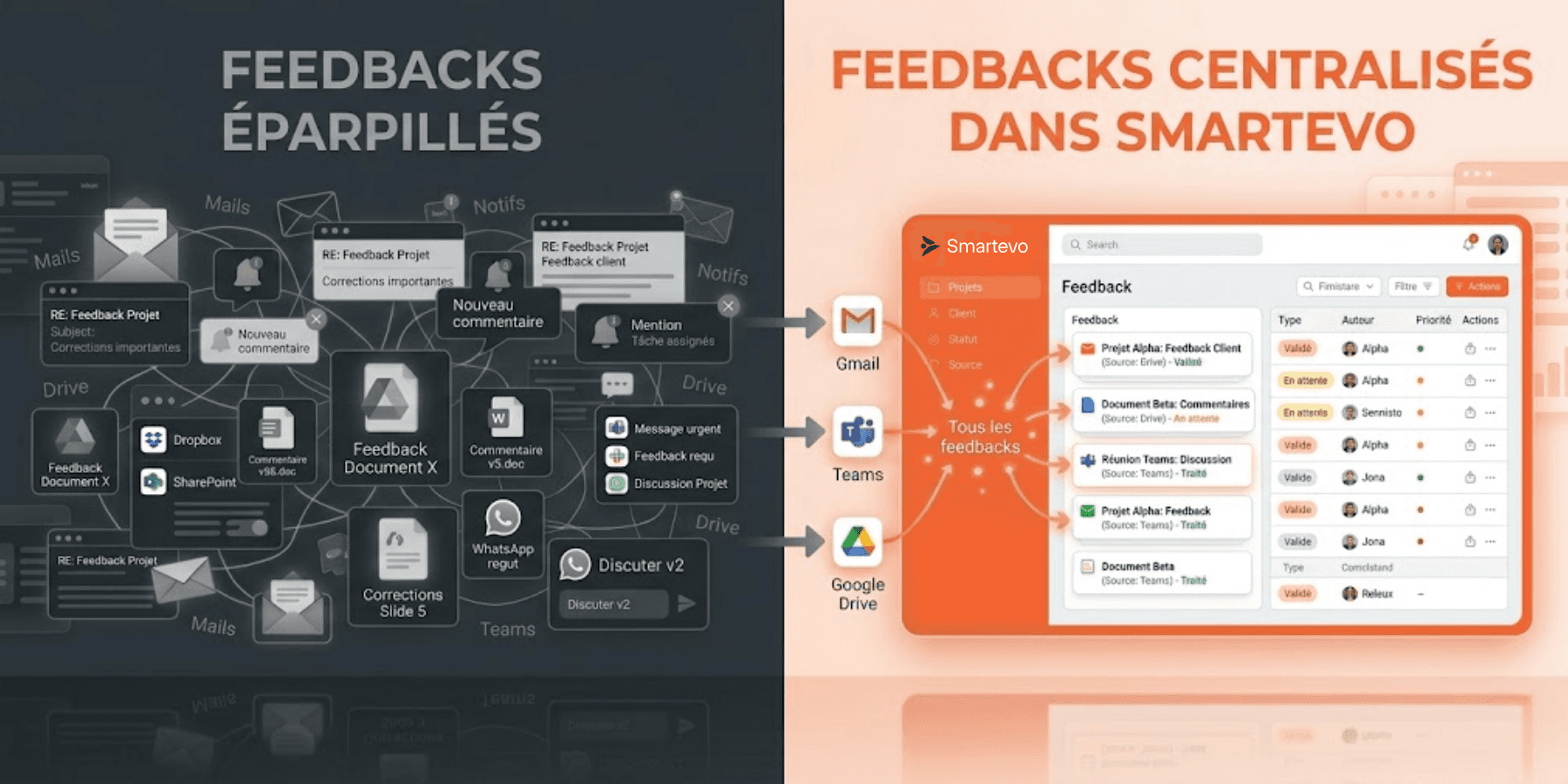
In many companies, feedback still arrives through several different tools:
emails used to send corrections or approve content;
Slack or Teams for quick exchanges between teams;
annotated PDFs sent as attachments;
meetings set up to consolidate feedback;
screenshots shared manually to point out changes.
This fragmentation makes tracking corrections and approvals much more difficult.
Teams then lose time trying to find the correct information or the latest versions of files.
A direct impact on productivity
A poorly organised approval process slows down the entire production chain.
Creatives spend more time consolidating feedback than producing content. Project managers spend their time sending reminders and checking versions.
On a large scale, this lack of organisation impacts the productivity of marketing and communication teams. It also reduces the time savings expected in creative projects.
The main challenges faced in creative approvals
Too many versions in circulation
When no centralised tool is used, multiple versions of the same content quickly circulate in parallel.
Some steering corrections can get lost or get approved on the wrong version. Teams no longer always know which file is the correct one.
This lack of visibility significantly slows down final sign-offs and document approvals.
Feedback lacks clarity
Feedback sent by email or messaging platforms often lacks precision.
Comments such as:
“the visual needs reviewing”, without a precise indication of the area concerned;
“change this part”, without detailed context;
“it’s not clear enough”, without further explanation;
remain difficult to interpret for creative teams.
Approvals then become lengthy and frustrating.
Deadlines get extended
The more scattered the exchanges, the more time approvals take.
Teams send multiple reminders to find out:
who needs to respond and when;
which corrections have been implemented;
which version needs to be approved before publication.
Marketing campaigns end up running late and teams lose operational efficiency.
Why annotation tools improve approvals
Providing more precise feedback
Annotation tools make it possible to comment directly on a specific area of a content piece.
Users can:
annotate an image to point out a graphic modification;
comment on a video at a precise moment using the timecode;
highlight a PDF to identify an element to be corrected;
add contextualised comments directly onto the content.
This level of precision significantly improves the understanding of requests.
Reducing misunderstandings
When feedback is directly visible on the content features, creative teams understand the expected corrections more quickly.
Back-and-forth loops decrease and approvals become smoother.
This method also improves the final quality of the content produced while promoting genuine time savings in creative workflows.
Centralising all exchanges
Annotations also allow all comments to be grouped in a single place.
Teams have a clear history of approvals, corrections, and decisions made on each piece of content.
This centralisation significantly improves visibility on creative projects and facilitates the approval of complex documents.
How to set up an effective validation workflow?
Structuring roles from the start
Every participant must know their role in the approval process.
Teams must define:
who produces the content;
who reviews and checks the elements;
who signs off before publication;
who publishes across the different channels.
This organisation limits confusion and speeds up decision-making.
Centralising content
All content must be gathered in a single environment to avoid a multiplication of versions.
This way, teams can easily find:
the visuals used in campaigns;
videos and their different versions;
feedback and comments from approvers;
approvals already completed;
the final files ready to be published.
This centralisation greatly streamlines production workflows and simplifies the approval of marketing and communication documents.
Automating certain steps
Modern approval tools also allow several tasks to be automated:
notifications sent automatically to approvers;
reminders to avoid delays;
changes in content status;
approval pathways tailored to team workflows.
This automation reduces manual tasks, improves team responsiveness, and supports significant daily time savings.
Why approval tools are becoming essential
Smoother workflows
Approval platforms allow the entire creative process to be structured in a single space.
Teams gain visibility on:
content currently in creation;
upcoming approvals;
feedback remaining to be processed;
marketing campaign priorities.
This organisation significantly improves the fluidity of projects.
Better collaboration
Marketing, communication, creative teams, and external providers can collaborate more easily around the content.
Comments remain centralised and accessible to all participants.
This approach sustainably improves collaboration between teams and simplifies the approval of shared documents.
Improved content quality
When approvals are clearer and better structured, the final content gains in quality.
Teams can detect more easily:
errors before publication;
graphic or editorial inconsistencies;
omissions in the content;
version issues.
Approval then becomes a true lever for editorial and creative quality.
Smartevo: centralising and streamlining creative approvals
A single space for content and approvals
Smartevo allows you to centralise content, annotations, versions, and approvals in a single environment.
Teams can annotate:
videos using time-coded comments;
marketing and advertising visuals;
PDFs to facilitate corrections;
marketing content destined for social media or the web.
This centralisation significantly simplifies communication, reduces back-and-forth loops, and improves time savings in creative projects.

Workflows tailored to marketing and communication teams
Approval workflows are fully customizable according to team needs.
Each organisation can define:
its approval steps;
its user roles;
its approval pathways;
its custom statuses.
This flexibility helps to adapt the platform to the different types of content produced.
Better visibility on projects
Smartevo also offers an overall view of content in production and approval stages.
Marketing and communication managers can track:
content progress;
blocked approvals;
team priorities;
overall workload.
This visibility sustainably improves the management of creative projects and facilitates daily document approval.
Structuring creative content approval saves time, streamlines exchanges, and improves the quality of marketing and communication outputs. By centralising content, annotations, and approvals in a single space, teams reduce back-and-forth loops and collaborate more effectively. With tailored tools like Smartevo, creative workflows become simpler, faster, and better organised.
