Pro Tips
How do you repurpose your content into multiple formats?

Creating content takes time, especially when you have to feed multiple social networks every week. Yet, many teams still publish an article, a video or a post just once before moving on to the next. Repurposing your content into several formats, however, allows you to save time and improve your content strategy without starting from scratch with each publication.
Why repurpose your content into multiple formats?
Save time in your content creation
Creating content daily represents a significant burden for community managers and marketing teams. Between writing, visuals, approvals and publications, the creation process quickly becomes time-consuming.
Reusing existing content allows you to produce more without multiplying your efforts. A single idea can thus feed several publications across different communication channels.
This approach greatly improves the organisation of digital content creation and facilitates the management of the editorial calendar.
Increase the lifespan of content
Content published only once quickly loses visibility. Yet, a blog post, a video or a webinar can continue to generate engagement several weeks after their creation.
Repurposing your content helps to extend the lifespan of content and to reach different audiences depending on the platforms used. Each content format meets different consumption habits.
This strategy also helps to reinforce the brand presence on social media and search engines.
Adapt content to platforms
Each platform has its own codes. A format that performs well on LinkedIn will not necessarily work on Instagram or TikTok.
Repurposing your content allows you to adapt content according to:
the tone;
the format;
the length;
the visual;
the consumption pace.
This adaptation improves content performance and reinforces the effectiveness of the content strategy.
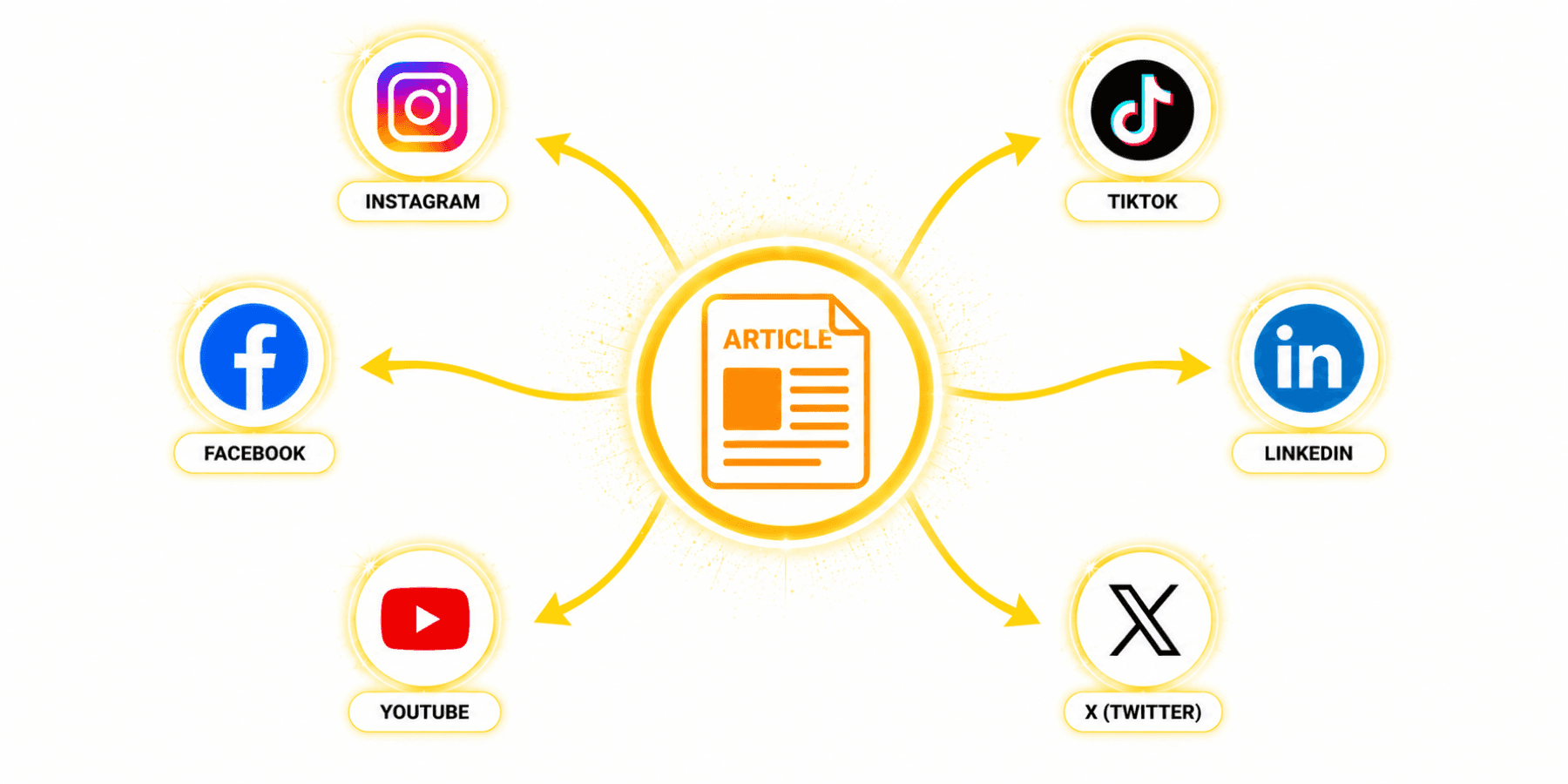
1. Turn a blog post into a LinkedIn carousel
Highlight key points
The LinkedIn carousel has become an essential format in social media. It allows a complex subject to be summarised in an easy-to-read and highly visual format.
Each slide must highlight a strong idea with minimal text. The objective is to simplify information while maintaining relevant content.
This type of content works particularly well for:
tips;
key figures;
trends;
feedback and case studies.
Strengthen your brand image
Carousels also allow you to create a consistent visual identity. Teams can use a reusable template to harmonise their publications.
This consistency improves brand recognition and strengthens the content marketing strategy on LinkedIn.
Content creators also save time in the graphic design of future content.
2. Turn content into a Reel or a Short
Focus on short-form video
Short-form video formats dominate social media today. Instagram Reels, YouTube Shorts or TikToks allow you to quickly capture the attention of users.
From a blog article or longer content, it is possible to extract:
a strong idea;
a piece of advice;
a statistic;
a pain point.
These elements can then be transformed into a short video of a few seconds.
Create an engaging teaser
The goal is not to repeat all the initial content, but to make an engaging teaser that makes viewers want to go further.
This type of video content strongly improves the visibility of social media campaigns and helps to reach a new target audience.
Short formats are also highly effective for strengthening the online presence of brands.
3. Create an engaging LinkedIn post
Adapt content to the news feed
Not all users take the time to read a full article. Some prefer to consume short content directly in their news feed.
An article can thus be transformed into a LinkedIn post with:
a strong hook;
a few main ideas;
an open question.
This method makes it easier to generate engagement and comments.
Highlight your expertise
Posts also allow you to share your expertise without necessarily redirecting users to an external link immediately.
This approach is particularly effective in digital marketing and social media communication strategies.
It also helps to create more natural content tailored to the usage of the platforms.
4. Turn content into a newsletter or a Story
Summarise important information
Newsletters and Stories allow for the distribution of shorter, more direct content.
Teams can repurpose:
tips;
key figures;
summaries;
news.
These formats are particularly effective for maintaining a regular connection with your community.
Create an editorial appointment
Stories and newsletters also make it possible to structure a real editorial strategy for the long term.
Brands can thus create regular appointments with their audience and strengthen their digital communication.
This approach helps to better organise content and smooth out the publication dates of campaigns.
5. Turn an article into a podcast or audio content
Diversify content types
The audio format continues to grow in social media strategies and content marketing. Turning an article into a podcast allows you to reach users who prefer to listen to content rather than read it.
This approach allows you to vary content types while reusing existing content.
The audio content can then be shared on Spotify, LinkedIn or other specialised platforms.
Reach a new audience
Podcasts allow you to reach users during their commute or travel time.
This type of content effectively complements a multi-format content creation strategy and improves the overall visibility of marketing campaigns.
Content creators can thus diversify their presence across different communication channels.
Organise an editorial calendar around a single piece of content
Plan variations over several days
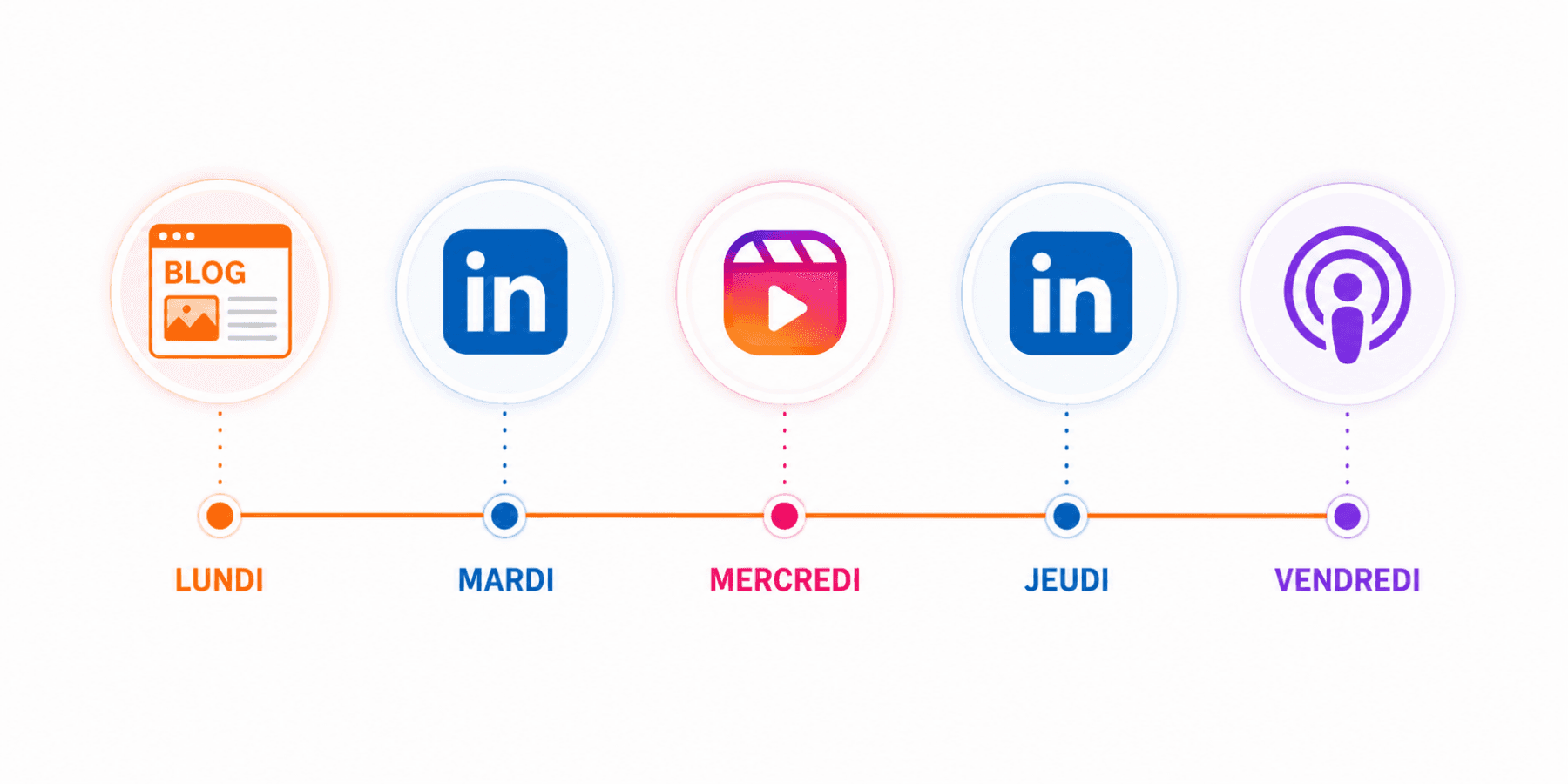
The same content can be distributed over several days to maximise its reach.
For example:
Monday: publication of the blog post;
Tuesday: LinkedIn carousel;
Wednesday: Instagram Reel;
Thursday: LinkedIn post;
Friday: podcast.
This organisation greatly improves the visibility of content without creating excessive repetition.
Produce more efficiently
This method also allows for better distribution of the workload for marketing and communication teams.
Content is anticipated more easily and campaigns become easier to manage.
Content production then becomes more consistent and more structured over the long term.
How does Smartevo help to repurpose content?
Centralise all content
Smartevo allows you to centralise content, visuals, videos and approvals in one single space.
Teams can quickly find already produced content in order to recycle content or reuse it across multiple formats and social networks.
This centralisation greatly facilitates digital content creation and campaign tracking.
Organise production workflows
The production, approval and publication workflows are gathered within the platform.
Marketing and communication teams gain visibility over the content to be produced and the upcoming publications to prepare.
This organisation improves project fluidity and simplifies the work of community managers.
Facilitate editorial planning
Smartevo also helps teams better structure their editorial calendar and their social media campaigns.
Content can be planned, adapted and then published more easily according to each platform and each targeted audience.
This approach allows you to produce content more efficiently while strengthening the overall consistency of the editorial strategy.
Repurposing your content into multiple formats saves time, extends the lifespan of your content and strengthens your presence on social media. By centralising content and structuring production workflows, Smartevo helps marketing and communication teams produce more efficiently and better organise their content strategy.
