Industry News
Approval workflow: 5 steps for your teams

Today, marketing and communication teams produce a large volume of content and documents that require approval: visuals, videos, contracts, sales materials, or digital campaigns. However, in many organisations, approvals are still scattered across emails, meetings, and shared files. The result: delays, version errors, and a loss of visibility on projects. Structuring an approval workflow then becomes essential to streamline exchanges, improve project management, and increase efficiency.
What is an approval workflow?
An approval workflow refers to all the steps used to organise, track, and secure approvals within a company. It is also known as an approval process or validation workflow.
The objective is simple: to allow the right people to approve content, a document, or a decision at the right time, in a defined order.
The approval workflow can involve:
document approval;
marketing content;
contracts;
purchasing;
HR requests;
communication campaigns;
creative content.
Thanks to the digitisation of workflows, businesses gain visibility over their processes and improve their daily project management.
Why structure an approval workflow?
Reduce back-and-forth communication
In many companies, approvals still go through:
email chains;
shared files;
Slack or Teams messages;
meetings;
scattered annotations.
This organisation significantly slows down approvals and complicates decision-tracking.
A structured workflow makes it possible to centralise discussions in a single space and ensure better management of content and documents.
Secure approvals
An approval workflow also helps to secure procedures.
Teams know:
who needs to approve;
in what order;
at which step;
on which version of the document.
This traceability reduces the risk of errors, omissions, or incorrect approval, while avoiding version errors that slow down projects.
Save time
When approval workflows are clear, teams spend less time chasing approvers or searching for information.
Projects progress faster and decision-making becomes more fluid.
The time saved becomes particularly significant in multi-team or multi-project organisations where project management requires constant coordination.
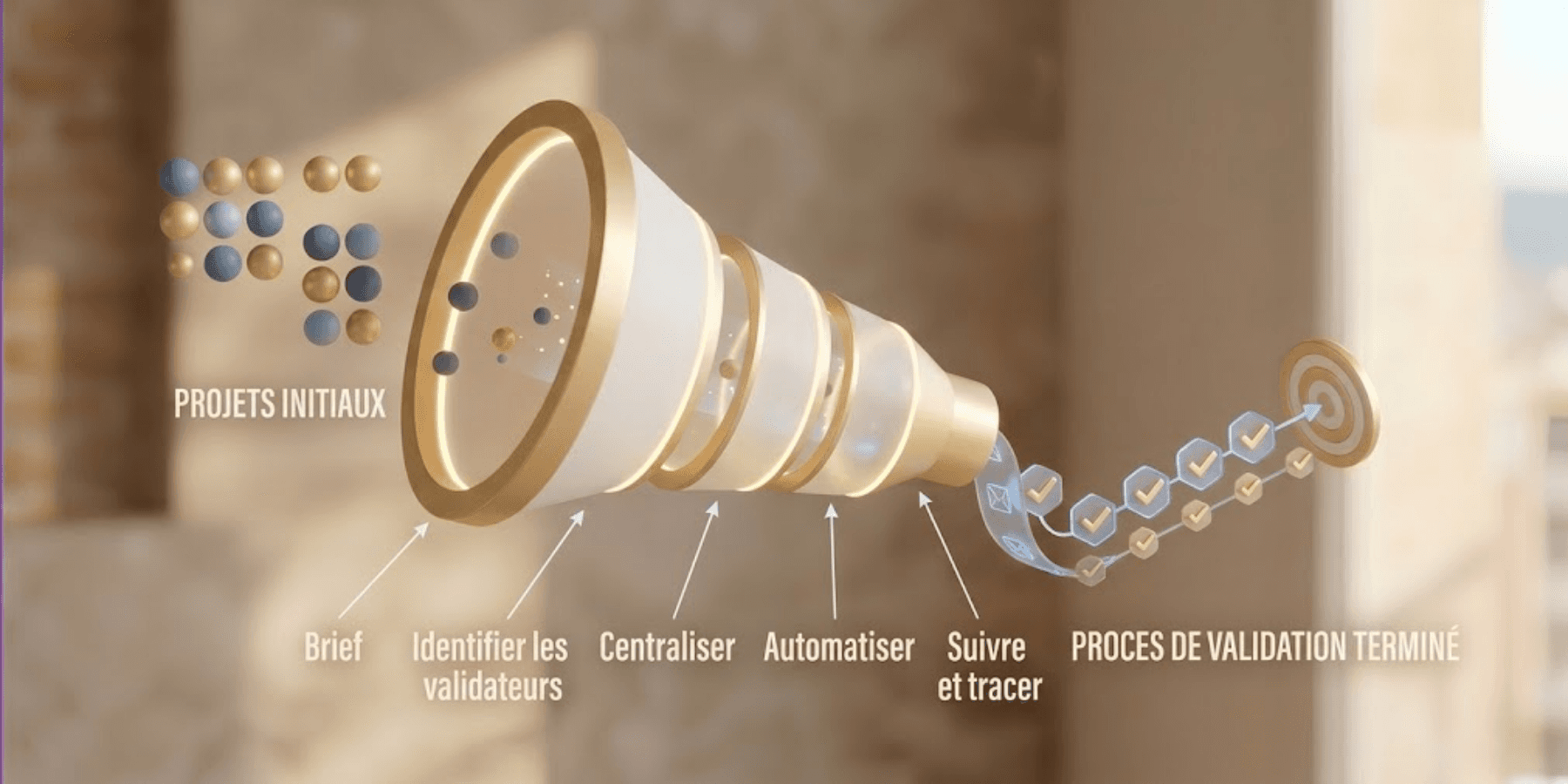
The 5 steps to create an effective approval workflow
1. Formalise the request from the start
Every effective approval workflow starts with a clear and structured request.
The brief or document must contain:
objectives;
deadlines;
the people involved;
any potential constraints;
the content to be approved.
This first step of the approval process avoids a lot of back-and-forth during the project.
When information is incomplete from the outset, approvals often become longer and more confusing.
2. Identify the approvers
Once the request is created, the people responsible for approvals must be defined.
Depending on the project, several profiles may get involved:
managers;
management;
legal teams;
marketing;
communication;
purchasing;
HR.
Each contributor must know precisely their role in the workflow.
This organisation prevents blocked approvals or overly complex workflows and improves the approval phases.
3. Centralise documents and exchanges
One of the main issues with approval processes remains the dispersion of information.
Teams often work with:
several versions of a file;
comments in different tools;
approvals sent by email;
uncentralised annotations.
Grouping content and feedback in a single environment significantly improves visibility on projects.
Teams immediately know:
which version is the correct one;
what feedback has been given;
which approvals are still pending.
This centralisation facilitates project management and streamlines the entire approval process.
4. Automate reminders and steps
Modern workflows now make it possible to automate several actions:
notifications;
reminders;
status changes;
task assignment;
approval workflows.
This automation considerably reduces manual tasks.
Teams become more responsive and approvals progress faster.
Automation also helps to limit oversights and delays, and improves the approval steps within teams.
5. Track and log approvals
A good approval workflow must offer complete visibility on the progress of requests.
Teams must be able to track:
completed approvals;
blocked stages;
comments;
modifications made;
decision history.
This traceability improves the quality of processes and facilitates audits or internal verifications.
It also helps to identify bottlenecks in order to continually improve workflows and ensure better project management.
The benefits of a digitalised approval workflow
Better collaboration
Digitalised workflows significantly improve collaboration between teams.
Each contributor accesses the same information in a shared space.
Exchanges become more fluid and approvals faster.
Better quality of content and documents
Approvals are clearer and better structured.
Teams can easily detect:
errors;
inconsistencies;
omissions;
version issues.
The quality of content and documents improves sustainably, notably thanks to better-organised validation processes.
Better productivity
Approval workflows help to reduce:
delays;
manual tasks;
reminders;
processing errors.
Teams save time and can focus more on high-value tasks.
This organisation also contributes to better management of priorities and projects.
Which departments can use an approval workflow?
Marketing and communication teams
Approval workflows are particularly useful for:
marketing campaigns;
creative content;
video approvals;
social media posts;
communication materials.
Teams gain visibility on current content and streamline their approvals.
Human Resources
HR departments use approval workflows for:
employment contracts;
administrative requests;
recruitment;
internal approvals.
Processes become faster and better tracked.
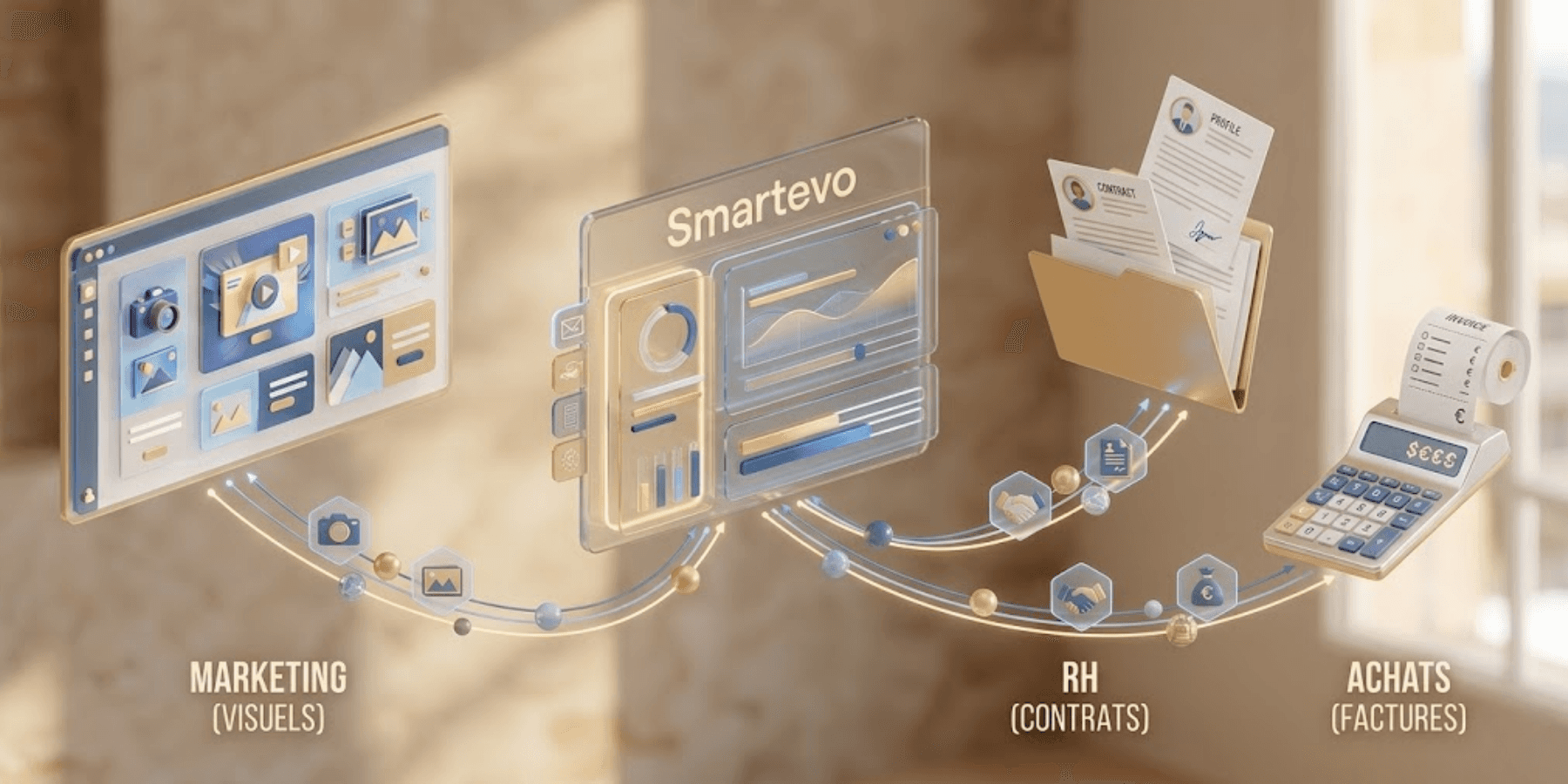
Purchasing and finance departments
Approval workflows also help to secure:
orders;
invoices;
expenses;
budget approvals.
Workflows limit errors and speed up decision-making.
Smartevo: structure your approval workflows
Smartevo allows you to centralise content, documents, and approvals in a single environment.
Teams can:
structure their workflows;
assign approvers;
annotate content;
track versions;
automate certain steps;
centralise feedback.
The platform improves visibility on projects and streamlines approvals between marketing, communication, and business teams.
Thanks to customisable workflows, Smartevo adapts to the needs of multi-team and multi-project organisations.
Setting up an approval workflow helps to streamline exchanges, secure processes, and speed up decision-making. By centralising documents, content, and approvals in a single space, teams gain visibility and efficiency. With suitable tools like Smartevo, workflows become simpler, faster, and more reliable on a day-to-day basis, while sustainably improving project management and validation processes.
