Industry News
Optimising content management: from brief to delivery

Producing content is no longer just about creating a visual or writing an article. Today, marketing and communication teams must coordinate teams, manage multiple content formats, and oversee the entire content creation process. To avoid back-and-forth communication, it has become essential to rely on tools capable of structuring projects and workflows.
Why Content Management Has Become Strategic
Content Management That Covers the Entire Production Cycle
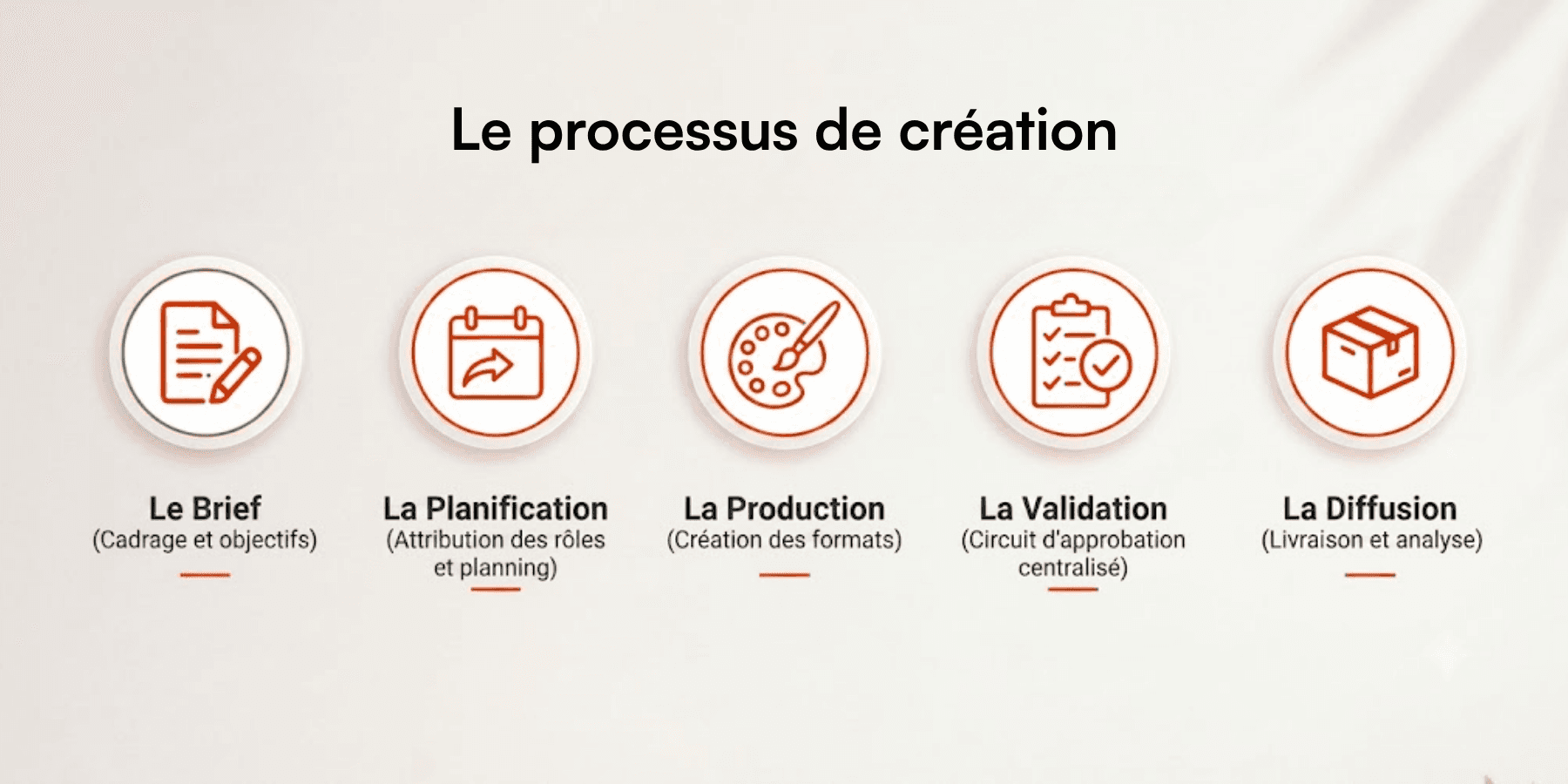
Digital content management is not limited to content creation. It encompasses the entire lifecycle of content: briefing, planning, production, approval, distribution, and results analysis.
For marketing and communication teams, this approach makes it possible to better manage content, improve workflows, and ensure better consistency across all communication channels.
Content Is at the Heart of Digital Marketing
Today, companies communicate continuously through multiple formats: blog posts, videos, social media, newsletters, podcasts, or even white papers.
Content creation has become an essential lever for developing visibility, generating commercial opportunities (leads), and strengthening brand image.
Constantly Increasing Volumes of Content
Marketing teams must produce more content than they did a few years ago in order to feed all of their communication channels.
This increase in volumes requires structured digital content management. It helps to maintain good organisation. It also makes it possible to maintain the quality of deliverables.
Why Structure Your Content Management?
The Multiplication of Content Complicates Organisation
Companies now produce blog posts, videos, publications aimed at social media, newsletters, podcasts, or even sales materials. This diversity of formats makes coordination more complex.
Without a structured process, teams lose time searching for information, finding the right version of a file, or chasing up different contributors.
Effective content management is not just about storing files. It aims to manage content throughout its lifecycle, from its creation to its publication.
Today, companies rely on various management tools and sometimes on a Content Management System (CMS) to centralise their content.
Better Visibility on Projects
Organised content management allows to track the progress of projects at each stage. Marketing managers have a global view of ongoing tasks, deadlines, and approvals to be carried out.
Thanks to centralised dashboards, teams can track content progress in real time. This visibility facilitates decision-making and makes it possible to anticipate potential delays before they impact the project.
Reduce Production Lead Times
When roles are clearly defined and processes are framed, content moves forward more quickly. Approvals are streamlined and the risk of error is reduced.
Teams thus save valuable time throughout the production cycle.

The Limits of Unstructured Content Management
A Waste of Time on a Daily Basis
When content is scattered across multiple tools, teams spend a lot of time searching for files or information.
This waste of time directly impacts team productivity and slows down projects.
Higher Risks of Errors
Without a clear process, several versions of the same content can circulate simultaneously.
Teams then risk working on the wrong document or publishing an unapproved version.
More Difficult Collaboration
Exchanges quickly become complex when comments and approvals are scattered.
Teams lose visibility and decision-making is slowed down.
Step 1: Build a Clear and Complete Brief
The Brief, the Foundation of Any Content Project
The brief is the starting point for every project. It aligns all stakeholders around common goals.
A well-structured brief must specify:
the goals of the content;
the targeted audience;
the expected formats;
the deadlines;
any potential constraints;
the distribution channels.
The more precise the brief, the smoother the production will be.
Avoid Misunderstandings
Many delays stem from an incomplete or poorly formulated brief. Creative teams are then forced to multiply exchanges to obtain clarifications.
A structured brief significantly reduces back-and-forth communication and improves the quality of deliverables.
Step 2: Frame and Plan the Project
Define Responsibilities
Once the brief is approved, it is necessary to determine who takes action at each stage.
Roles must be clearly identified: project manager, graphic designer, copywriter, videographer, marketing manager, or approvers.
This organisation facilitates collaboration and limits uncertainties.
Build a Realistic Schedule
Planning makes it possible to anticipate deadlines and avoid bottlenecks.
Each task must be associated with a owner and a delivery date in order to guarantee compliance with deadlines.
This project management phase is essential for organising resources, allocating responsibilities, and securing deadlines.
Step 3: Produce the Content
Create the Different Deliverables
The production phase is when the content takes shape.
Depending on the needs, teams can produce blog posts, visuals, videos, social media posts, newsletters, or sales collateral.
Each deliverable must respect the objectives defined in the initial brief.
Increasingly Specialised Jobs
Content creation now mobilises many roles: writers, graphic designers, videographers, community managers, or SEO experts.
Each contributor helps to produce content tailored to the expectations of the target audience and the requirements of search engines.
Centralise Resources
Centralising content in a single space facilitates collaborative work.
Teams easily access documents, versions, and comments without multiplying tools or email exchanges.
This approach improves digital content management and contributes to a reduction in costs associated with errors, duplication, and production delays.
Step 4: Organise Approvals
Streamline Approval Workflows
Approvals are often one of the main sources of delay in marketing projects.
When feedback is scattered across multiple tools, teams lose time and risk working on the wrong version.
Setting up a structured approval workflow secures exchanges and speeds up decisions.
Centralise Feedback
Annotations directly on the content make it easier to understand the requested corrections.
Teams can quickly find comments, changes, approvals, and the history of exchanges.
This centralisation improves content quality while reducing lead times.
Why Centralise Content?
Simplified Access to Information
Centralisation allows each collaborator to quickly access the content they need.
Information is gathered in a single space, easily accessible to all teams.
Better Content Governance
Centralisation also facilitates the tracking of versions, approvals, and access rights.
Organizations thus maintain better control over their content.
Step 5: Deliver and Distribute Content
Prepare for Publication
Once approved, the content is ready to be distributed across the various communication channels.
Delivery can concern a website, social media, an emailing campaign, a video platform, or internal assets.
Depending on the organization, distribution can be done from a Content Management System, a social media platform, or a specialised tool.
Measure Performance
Delivery does not mark the end of the project.
Performance tracking allows to analyse the results obtained and identify areas for improvement for future productions.
The metrics tracked can relate to traffic, engagement, downloads, conversions, or interactions.
The Role of AI in Content Management
Automate Certain Repetitive Tasks
Artificial intelligence now makes it possible to automate part of the administrative work related to content.
It can help structure a brief, generate metadata, or prepare publications.
Facilitate Content Creation
Teams can also rely on AI to speed up certain stages of content creation.
The goal is not to replace creators but to allow them to focus more on added value and strategy.
How Smartevo Optimises Content Management?
Smartevo centralises the entire production cycle in a single platform.
Teams can create and structure their briefs, plan projects, produce and centralise content, annotate files, organise approvals, and prepare publications.
This centralisation reduces back-and-forth communication, improves visibility over projects, and allows marketing and communication teams to gain up to 30% in productivity.
Optimising content management consists of structuring each stage of the project, from brief to distribution. By centralising content, approvals, and workflows, teams gain efficiency, visibility, and quality. With Smartevo, digital content management becomes simpler, collaborative, and more efficient.
