Industry News
Media projects: how to avoid team fragmentation

A media team is constantly juggling various formats, multiple channels and numerous interlocutors. This richness is a strength, but it also creates fertile ground for dispersion: briefs that circulate poorly, delayed approvals and a proliferation of different versions. Avoiding this dispersion does not require more resources; it requires a sturdier framework.
What makes media projects particularly vulnerable to dispersion
Multi-format and multi-channel content production
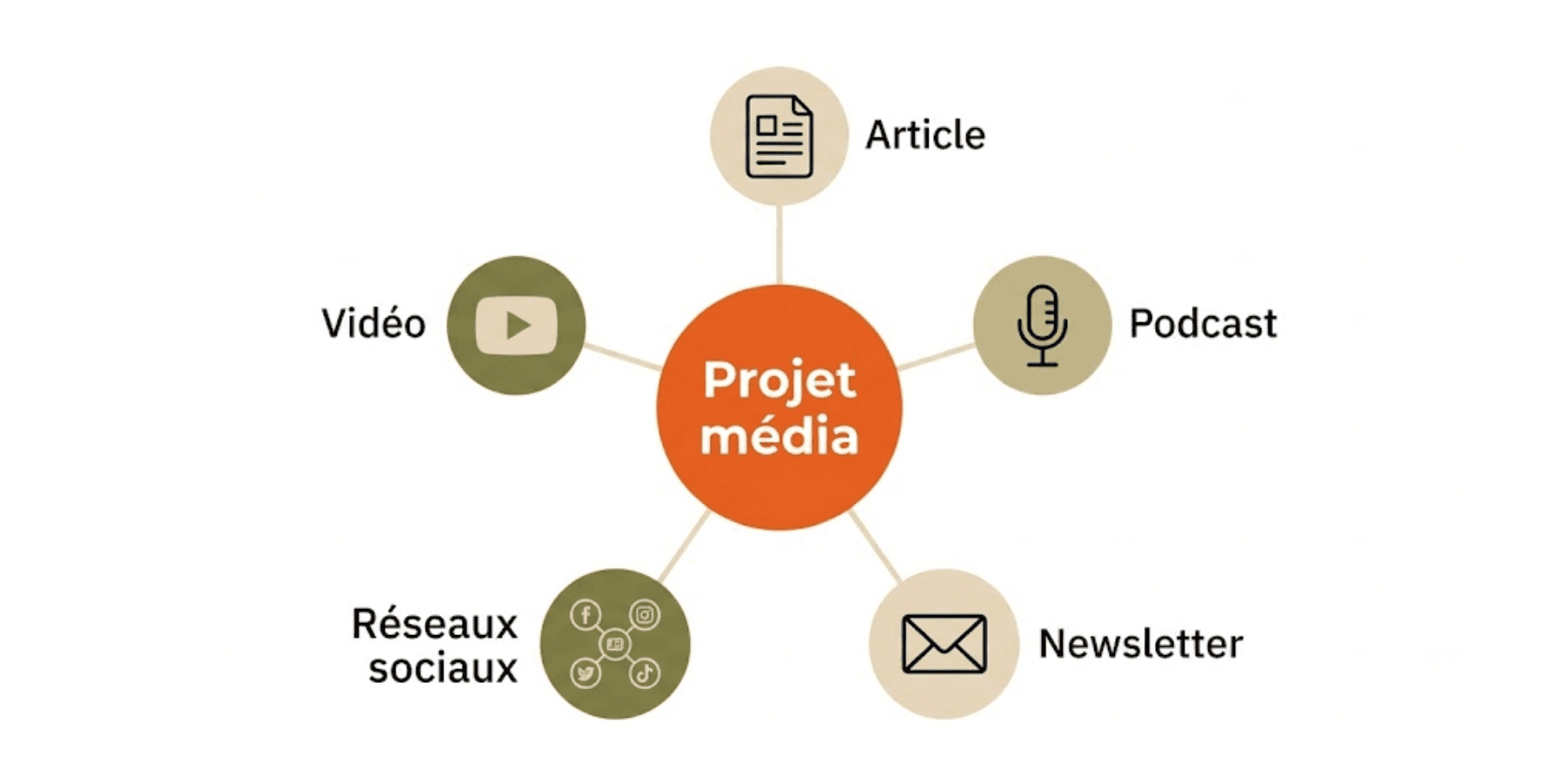
A media team rarely produces just one type of content. Articles, videos, podcasts, newsletters, social media content: each format has its own production constraints, its own deadlines and often its own contributors. This multiplicity of simultaneous formats naturally makes coordination more complex than in a team focusing on a single type of content.
Without rigorous organisation, media projects tend to spread across several tools and workspace areas in parallel. Each format follows its own logic, lacking an overall vision that would allow for the coherent management of global production.
Teams often made up of highly diverse profiles
Journalists, videographers, graphic designers, social media managers, copywriters: a media organisation brings together professions that do not share the same working habits or reference tools. This diversity of profiles is an editorial asset, but it complicates the implementation of a common process that everyone naturally adopts.
Dispersion often sets in by default: each profile works in their usual environment, with their own communication channels, without a shared reference system to unite all contributors around a common framework.
Production deadlines that are often short and non-negotiable
The news does not wait. In media teams, production deadlines are often tight and driven by external constraints: a publication date, an event to cover, or a trend to be quickly seized upon. This time pressure leaves little room to absorb organisational friction.
When dispersion is combined with urgency, the result is predictable: rushed content production, incomplete briefs passed on in haste, and sign-offs rushed through without a truly formalised process. What could have been anticipated becomes an emergency to be managed in the final hours before publication.
The concrete consequences of a dispersed organisation
Editorial inconsistencies between formats
When each format is produced independently, without a common editorial reference point, inconsistencies appear: a key message phrased differently in the article and the video, an angle that shifts between the newsletter and the social media post, or a graphic charter applied unevenly depending on the contributor.
These inconsistencies damage brand consistency and create confusion in the minds of readers or viewers. They are rarely intentional; they simply result from a lack of coordination between teams working in silos.
A loss of traceability on editorial decisions
In a dispersed media team, editorial decisions are made in meetings, via messaging, or during informal exchanges, without being formalised or accessible to all contributors. An angle approved verbally in a meeting may not reach the writer working remotely, leading to production going off in the wrong direction.
This lack of traceability forces teams to reconstruct the context of each decision with every new brief, rather than building upon a history that is accessible and shared by everyone.
How to structure a media project to prevent dispersion
Centralise briefs and editorial resources
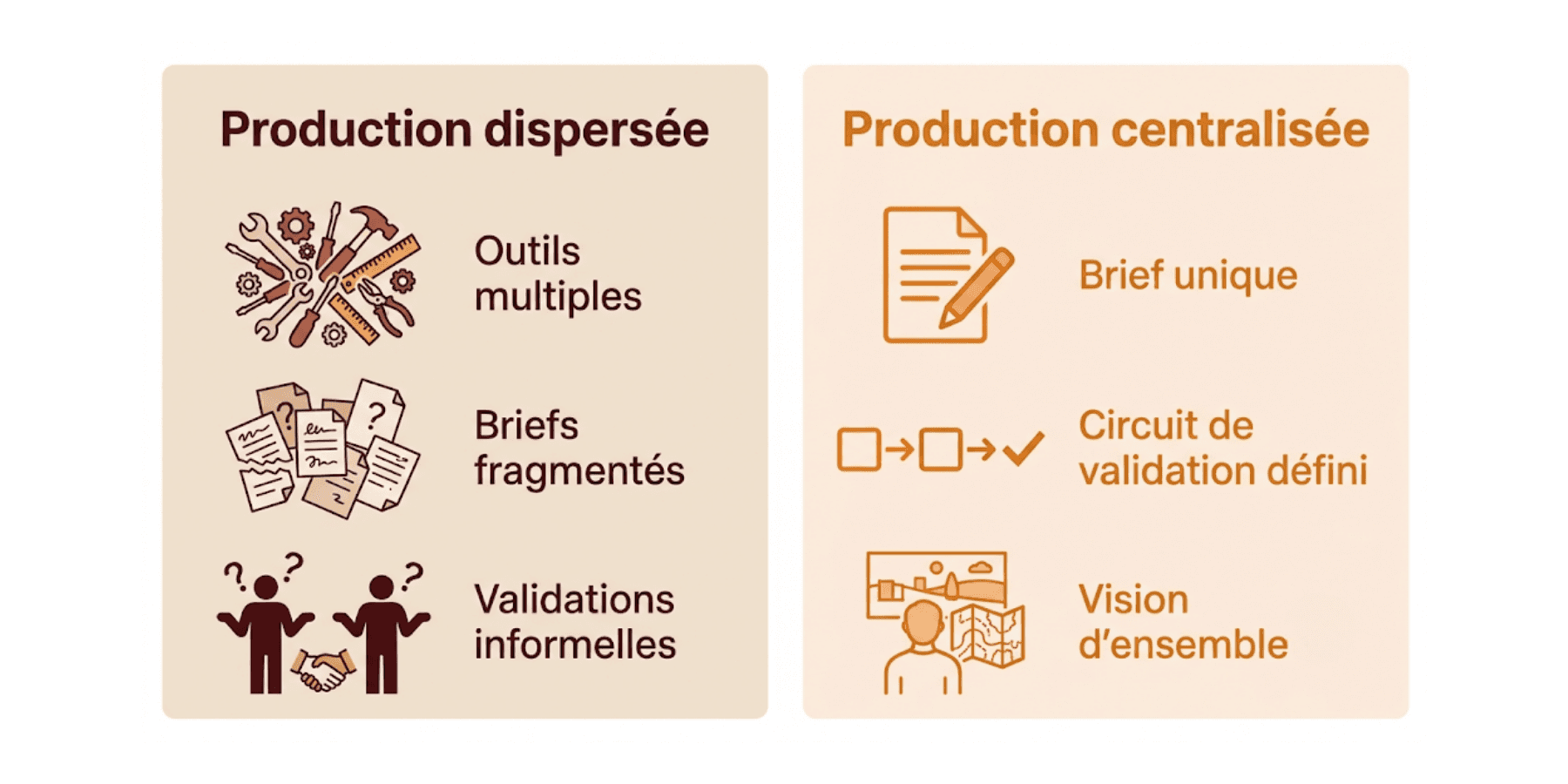
The first step is to centralise all the information required for production in a single place: editorial brief, graphic resources, technical constraints, deadlines, and identified contributors. A centralised brief accessible to all profiles involved in production ensures that everyone is working with the same version of information, regardless of their specialty.
This centralisation does not slow down production; it accelerates it. Less time is spent searching for information scattered across multiple tools, fewer back-and-forth exchanges are needed to clarify instructions that should have been specified from the start, and there is a smoother media team coordination at every stage of the project.
Define a validation approval workflow tailored to each type of content
Not all content requires the same level of approval. A social media post does not involve the same process as a long-form editorial piece or a brand video. Defining validation workflows tailored to each type of content allows you to calibrate the level of control without unnecessarily burdening the production of formats that can be published swiftly.
These workflows must be known to all contributors before production begins. A copywriter who knows who approves their article, within what timeframe and by what criteria, can organise their work accordingly and anticipate potential bottlenecks rather than suffering them.
Maintain an overview of production progress
In a team producing multiple formats across several channels simultaneously, it is easy to lose the big picture. A centralised tracking board, indicating the status of each piece of content in production, allows the project manager or editor-in-chief to steer media project management without having to prompt each individual contributor for progress updates.
This shared visibility also facilitates the reallocation of resources in real time: if a piece of content is stuck in approval, the team can anticipate the delay and adjust priorities before the bottleneck becomes critical.
Smartevo: a common framework for media teams
Centralise briefs and content in a single environment
Smartevo allows media teams to centralise their entire production in a single environment: structured briefs, shared resources, annotations and approvals all in the same place. Every contributor, whatever their profile, has immediate access to the information they need without having to look for it across multiple tools.
This centralisation is particularly valuable in media organisations with diverse profiles and different working habits. It creates a common framework that everyone can adopt without having to abandon their professional expertise.
Structure validation workflows for each format
Smartevo allows you to define distinct validation workflows depending on the type of content produced. A short approval path for quick formats, a more structured workflow for high-stakes productions: each piece of content progresses according to a process adapted to its constraints, without the rigour of some slowing down the reactivity of others.
This flexibility allows media teams to maintain their ability to react quickly to news, whilst ensuring that high-stakes content benefits from a rigorous validation process prior to publication.
Dispersion in media teams is not inevitable: it is the result of an organisation that is insufficiently structured to face the complexity inherent in this type of production. A centralised brief, tailored validation workflows and a shared vision of progress are often enough to transform a dispersed production into a smooth and coherent one.
