Industry News
Marketing campaign review: the complete guide

A marketing campaign rarely ends with a true marketing campaign review. We look at a few figures, share them in a meeting, and move on to the next project without having really analysed what worked or didn't. Yet, it is precisely this reporting work that allows for a sustainable improvement in the performance of future actions.
Why the campaign review is often neglected
The quick transition to the next project
Once a campaign is launched and completed, marketing teams generally move straight on to the next project without taking the time to formalise a structured feedback. This haste is explained by the constant workload, but it deprives the team of valuable insights for future campaigns.
Without a formalised review, the same mistakes are repeated from one campaign to another, due to the lack of a dedicated time for analysis. What could have been corrected after a first campaign reappears identically on the next, generating a cumulative loss of efficiency that is difficult to measure but very real.
Ill-defined indicators from the start
Analysing a campaign requires knowing what we are trying to measure. However, in many teams, success indicators are only defined once the campaign is over, which leads to analysing available data rather than data that is actually relevant to the initial objectives.
This reversed approach biases the analysis of the campaign outcome. Without measurable objectives defined upstream, it becomes difficult to judge objectively whether a campaign was a success or a failure, and the review often boils down to a collection of figures without any real strategic interpretation.
An poorly anticipated workload
Producing a marketing campaign review requires dedicated time: extracting data, formatting it, interpreting it, and drawing recommendations from it. In teams that are already under pressure, this time is rarely budgeted upfront and ends up being sacrificed in favour of tasks deemed more urgent.
This lack of planning for the time dedicated to the review largely explains why this stage remains so often neglected, even though teams generally recognise its utility when directly questioned on the subject.
What a complete campaign review must contain
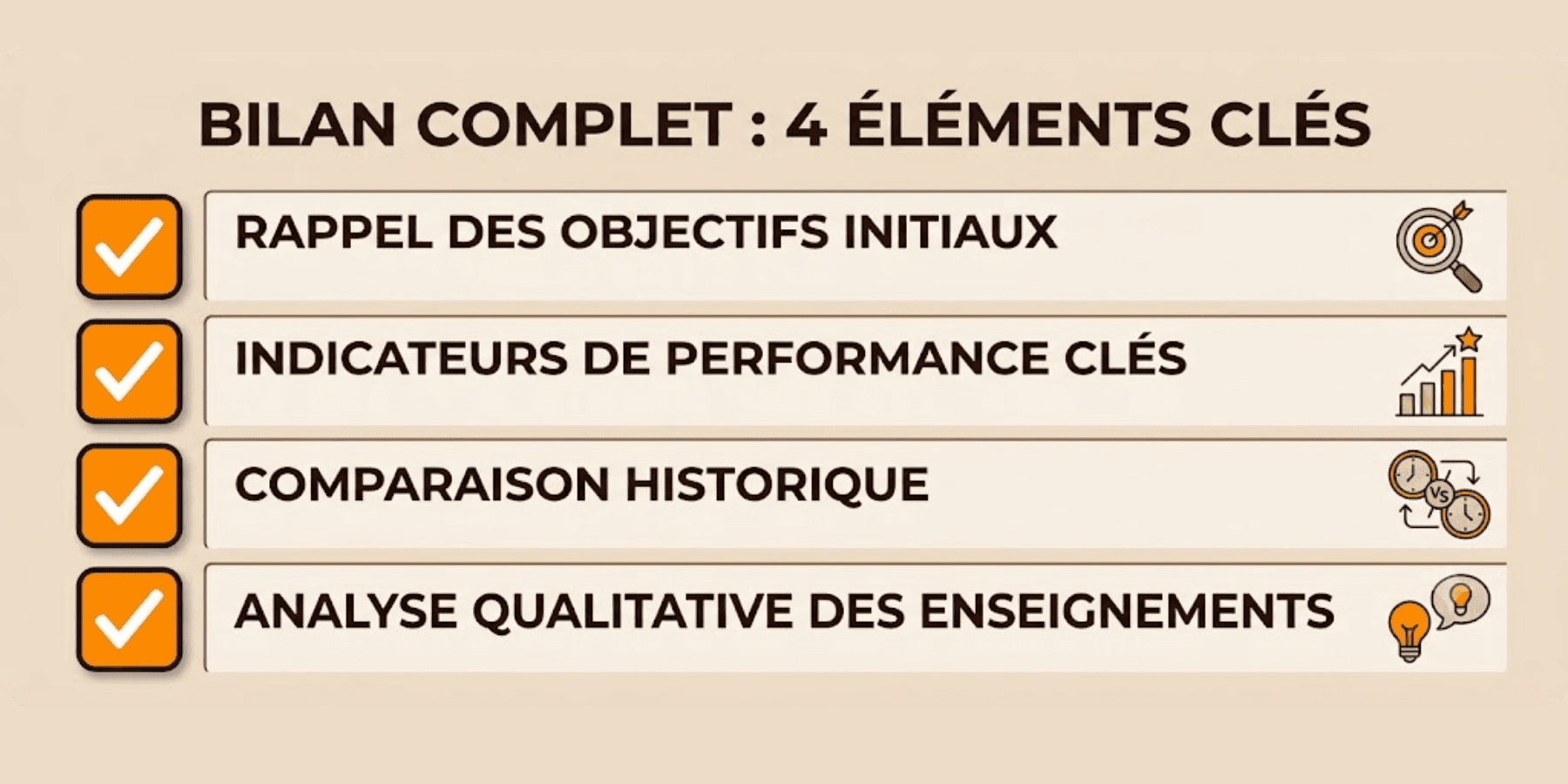
Recalling the initial objectives
A good review always starts with a precise recall of the objectives set before the launch of the campaign. Lead generation, brand awareness, engagement, conversion: each type of objective requires specific indicators and a different reading grid.
This recall is not an administrative formality. It allows to recontextualise the results obtained and avoid a purely quantitative analysis disconnected from the strategic intentions that had motivated the campaign in the first place.
Key performance indicators
The review must present the relevant indicators with regard to the objectives: engagement rate, cost per lead, conversion rate, return on ad spend. These indicators must be presented with their evolution over time and, ideally, compared to similar previous campaigns.
This historical comparison is what transforms a simple collection of figures into a true campaign analysis. It allows to identify trends, detect progress or regressions, and contextualise performance beyond an isolated figure.
The qualitative analysis of key findings
Beyond the figures, a complete marketing campaign review must integrate a qualitative analysis: which messages resonated best, which formats underperformed, which targets responded differently from initial expectations. This qualitative dimension is often absent from reviews, even though it is essential to understand the causes behind the numerical results.
This analysis makes it possible to transform raw data into actionable insights for future campaigns, rather than limiting oneself to a statement of performance without drawing concrete operational conclusions.
Building a repeatable review process
Standardising the review format
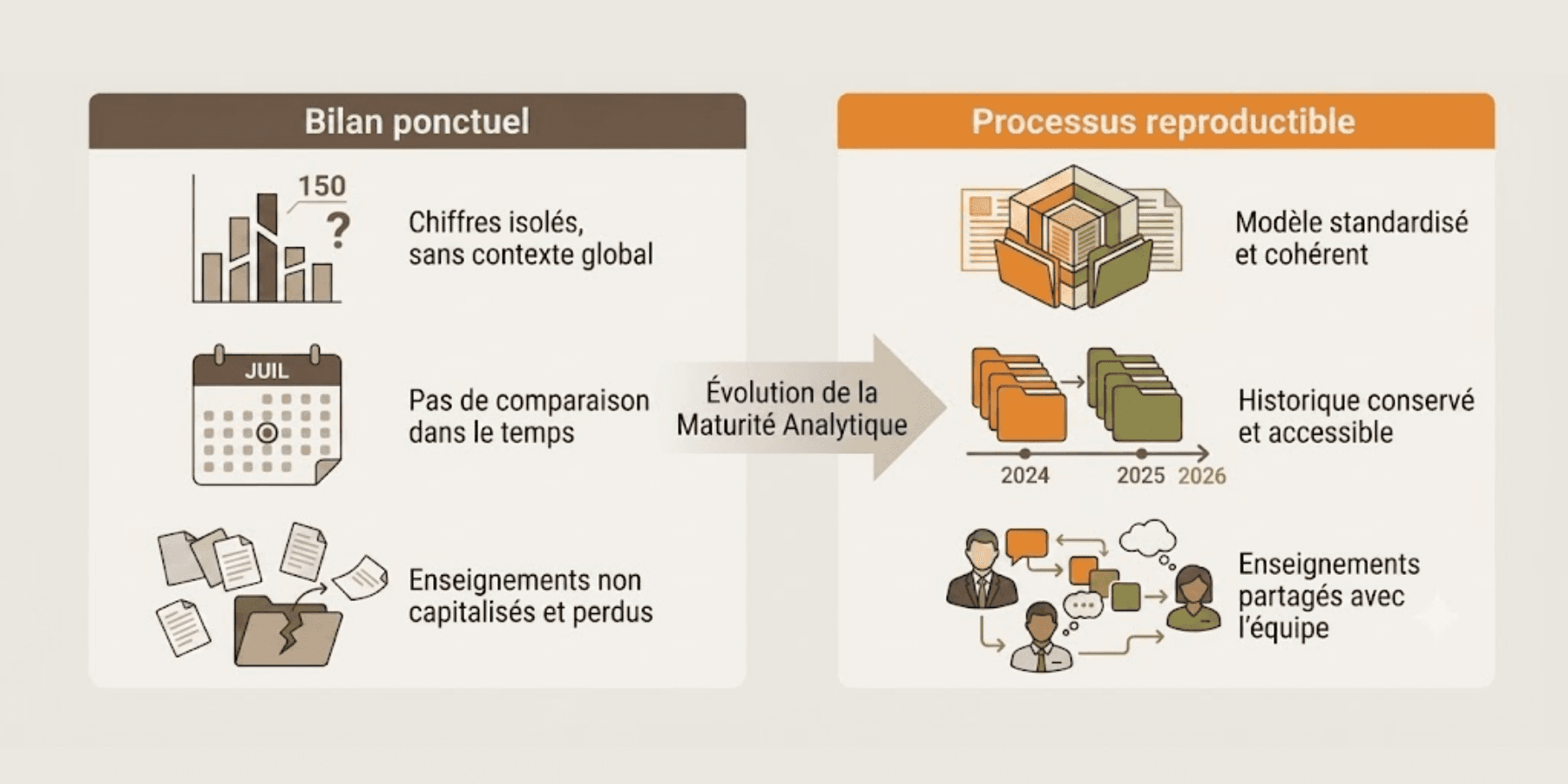
Rather than reinventing the structure of the review for every campaign, it is more efficient to define a repeatable template: objectives, key indicators, historical comparison, qualitative findings, recommendations for the future. This marketing campaign reporting model guarantees a consistent and comprehensive analysis for each campaign.
This standardisation also facilitates comparisons between campaigns over time, since the same information is systematically collected and presented in the same way, regardless of who is in charge of the reporting.
Scheduling the review right from the campaign launch
The best way to prevent a review from never being completed is to schedule it as soon as the campaign is launched, just like the other stages of the project. Setting a review date and identifying a responsible person ensures that this step will not be indefinitely postponed in favour of the next project.
This anticipation transforms the review into a structural step of the marketing production cycle, rather than an optional task carried out only when time permits, which is rarely the case in teams already called upon on multiple fronts.
Sharing findings with the entire team
A review that remains confined to the person who produced it loses much of its value. The findings drawn from a campaign must be shared with the whole team, including those profiles who were not directly involved, so that the learning benefits all future marketing actions.
This sharing can take the form of a short summary accessible to all, rather than a long document that no one will take the time to read. The goal is for the learnings to actually circulate and influence the decisions of future campaigns.
Smartevo: structuring the review of each campaign
Centralising objectives and indicators from the start
Smartevo allows you to define the objectives and success indicators of a campaign as early as its launch phase, directly in the initial brief. This centralisation ensures that the final review is based on criteria defined upfront, and not reconstructed after the event.
Each participant thus has a clear vision of expectations from the beginning of the project, which facilitates the collection of relevant data throughout the campaign rather than at the time of the review.
Keeping campaign history to facilitate comparison
Smartevo keeps a history of projects and campaigns conducted, which facilitates comparisons between current and past performance. This traceability simplifies the production of regular and consistent reviews, without having to manually reconstruct the history of previous results.
This permanent access to past data also makes it possible to spot underlying trends between several campaigns more quickly, rather than drawing hasty conclusions from a single isolated result.
A well-structured marketing campaign review is not an administrative formality: it is a tool for continuous improvement. Standardising the format, planning the analysis right from the launch, and integrating a qualitative dimension alongside the figures make it possible to transform each campaign into a learning experience for the next.
