Industry News
Are you using too many marketing tools? Take stock

At least six tools, sometimes ten or more: this is the reality of the marketing stack for most teams today. One to plan, one to store, one to communicate, one to validate, one to publish. Each meets a specific need, but together they create fragmentation that costs much more than we think.
How the marketing stack got heavier without anyone really deciding it
An tool added for every new need
The marketing stack is not built in a day. It accumulates gradually, one tool at a time, as needs emerge. A new team member who recommends their usual tool. A project that requires a feature missing from existing tools. A free trial that is hard to refuse. Without a clear tooling policy, the stack builds up naturally, without anyone making a conscious decision to centralise everything.
The problem is not the tool itself: it is the accumulation. Each addition seems individually justified, but together they end up creating an unmanageable ecosystem where no one really has a clear view of what is being used, by whom, and for what.
Tools that don't talk to each other
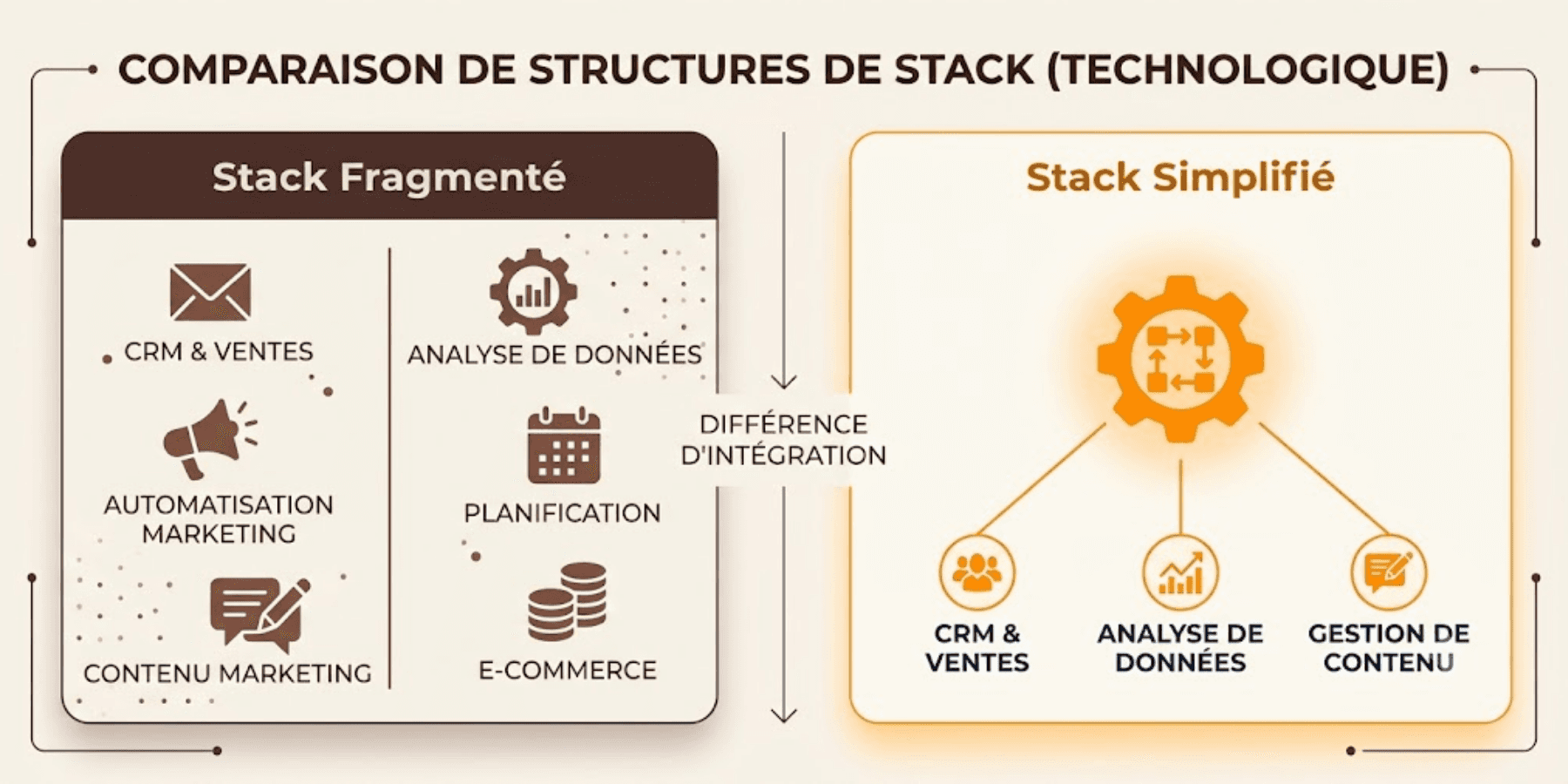
Beyond the sheer number, it is the lack of integration between tools that causes issues. A brief written in one tool, assets stored in another, feedback coming through email, validations done via messaging: when team marketing tools do not communicate with each other, it is the team that has to handle coordination manually.
This invisible coordination work is time-consuming and prone to errors. Information gets lost between tools, versions multiply, and the context of a decision made in one tool is not accessible in another. Stack fragmentation directly translates into work fragmentation.
A real cost that is difficult to measure
The cost of an overloaded marketing stack is not just about subscriptions. You must also add the training time for each new tool, the coordination time between tools that do not integrate, and the cost of errors generated by information scattered across multiple siloed environments.
This cost is rarely calculated as a whole, which explains why it is so often underestimated. A tool costing £30 a month may seem negligible, but if using it generates two hours of extra coordination per week for the entire team, the real cost is disproportionately higher than the subscription price.
The warning signs that you have too many tools
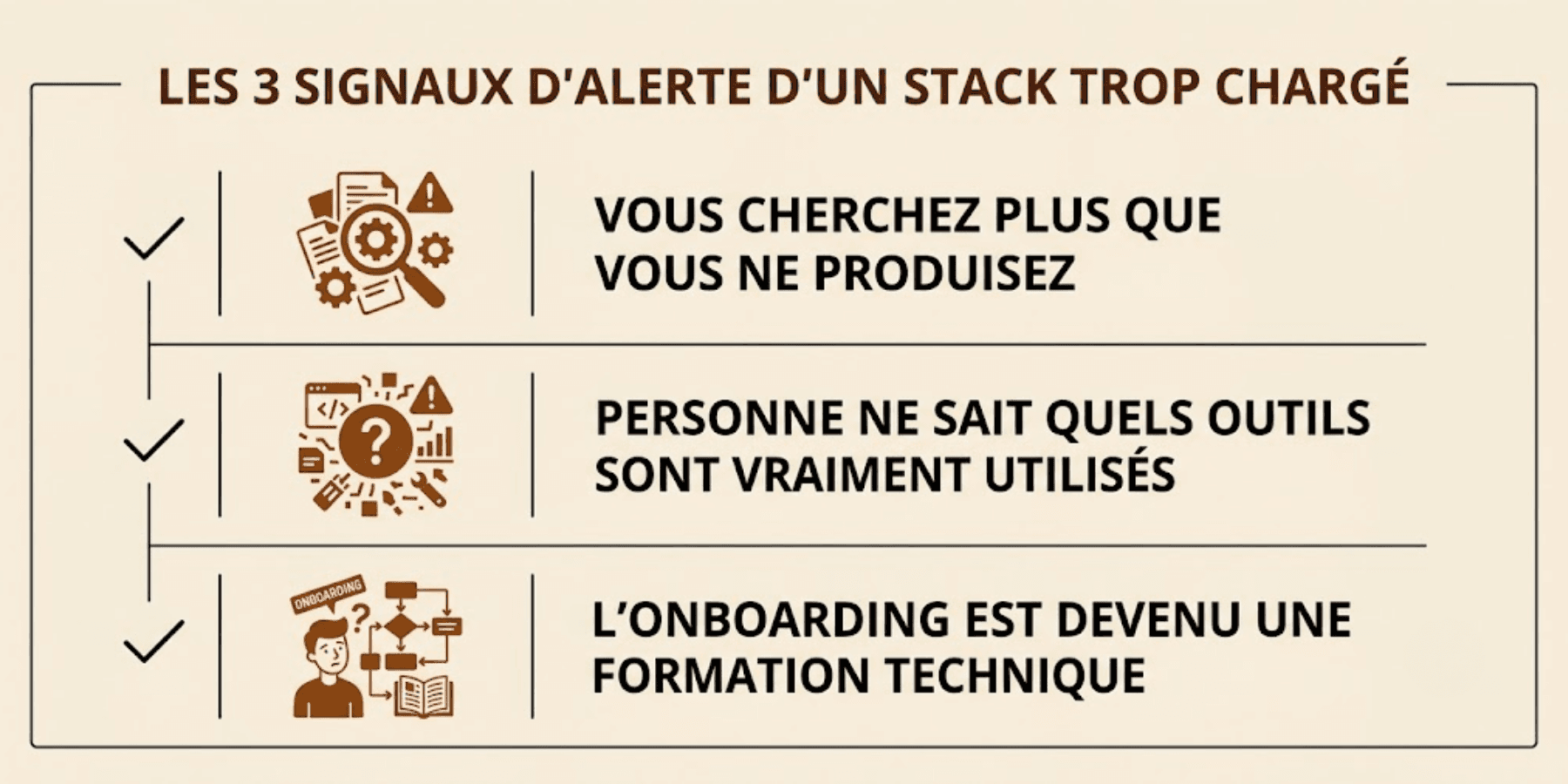
You spend more time searching than producing
This is the most visible sign: your team spends a significant portion of its time searching for information, files, or decisions that should be accessible in a few seconds. Where is the latest version of the creative? In which tool was this copy validated? Who has access to this account?
These questions seem harmless, but they reveal a structural problem: your information is scattered across too many different places to be found easily. This time spent searching is time lost for creating.
No one really knows which tools are being used
If you asked each member of your team to list all the tools they use during their working week, the answers would probably all be different. Some tools are used by only a few people, while others are officially in the stack but not really used in practice anymore.
This lack of visibility on actual usage is a sign that the marketing stack has developed without clear governance. Tools continue to be paid for and to fragment the organisation without anyone questioning their actual daily utility.
Your onboardings have turned into technical training sessions
When a new team member joins, how much time do they spend learning the tools before they can actually start working? If the answer is several days, or even several weeks, it means your stack is probably too complex for what it delivers.
An onboarding process that turns into a technical training journey represents a direct cost, but also an indirect signal: if the tool is difficult to learn, it is probably difficult for the whole team to use on a daily basis.
How to simplify your marketing stack without revolutionising everything
Audit what is actually used
The first step is an honest audit of the tools in place. For each tool, ask yourself three questions: is it used regularly by the whole team, does it meet a need that could not be covered by an existing tool, and would its absence create a genuine bottleneck in production?
This audit generally reveals that several tools in the stack are redundant or underutilised. Removing or consolidating them reduces fragmentation without affecting production capacity, and often frees up budget to invest more effectively in tools that actually add value.
Prioritise platforms that cover multiple needs
Rather than stacking specialised tools, it is often more efficient to invest in an all-in-one marketing platform that covers multiple needs within a single environment. Briefs, project management, feedback, validations: grouping these functions into a single tool reduces coordination friction without sacrificing process quality.
This is not about saving money on tools: it is about collective efficiency. Less time spent moving from one tool to another, less information lost along the way, and a team that can focus on production rather than coordination.
Smartevo: simplifying without oversimplifying
A single environment for briefs, projects, and validations
Smartevo centralises in a single environment the functions that require the most different tools in marketing teams: brief management, creative project tracking, and feedback and validation flows. This targeted centralisation reduces fragmentation where it costs the most, without pretending to replace every single tool in the stack.
The goal is not to do everything with a single tool, but to eliminate the coordination friction that arises when closely related functions are scattered across tools that do not communicate.
Reduce the coordination burden to focus on creation
By centralising discussions, briefs, and validations, Smartevo reduces the time marketing teams spend on coordinating between tools. Less time spent searching for information, fewer back-and-forths to piece together the context of a project, and shared visibility on progress that avoids unnecessary sync meetings.
It is this reduction in coordination overhead that allows teams to reclaim time for creation, without needing to increase headcount or radically change their working habits.
Having too many marketing tools is not inevitable: indeed, it is the result of an organisation that has grown without clear governance over its stack. Auditing, consolidating, and centralising the functions that generate the most friction is what allows you to regain efficiency without revolutionising your entire setup.
