Industry News
Producing your content in-house: how much does it cost?

The cost of producing content in-house is rarely what we think it is. Between the human time mobilised, organisational barriers and revisions due to poorly structured briefs, the losses are often far greater than what appears in budgets.
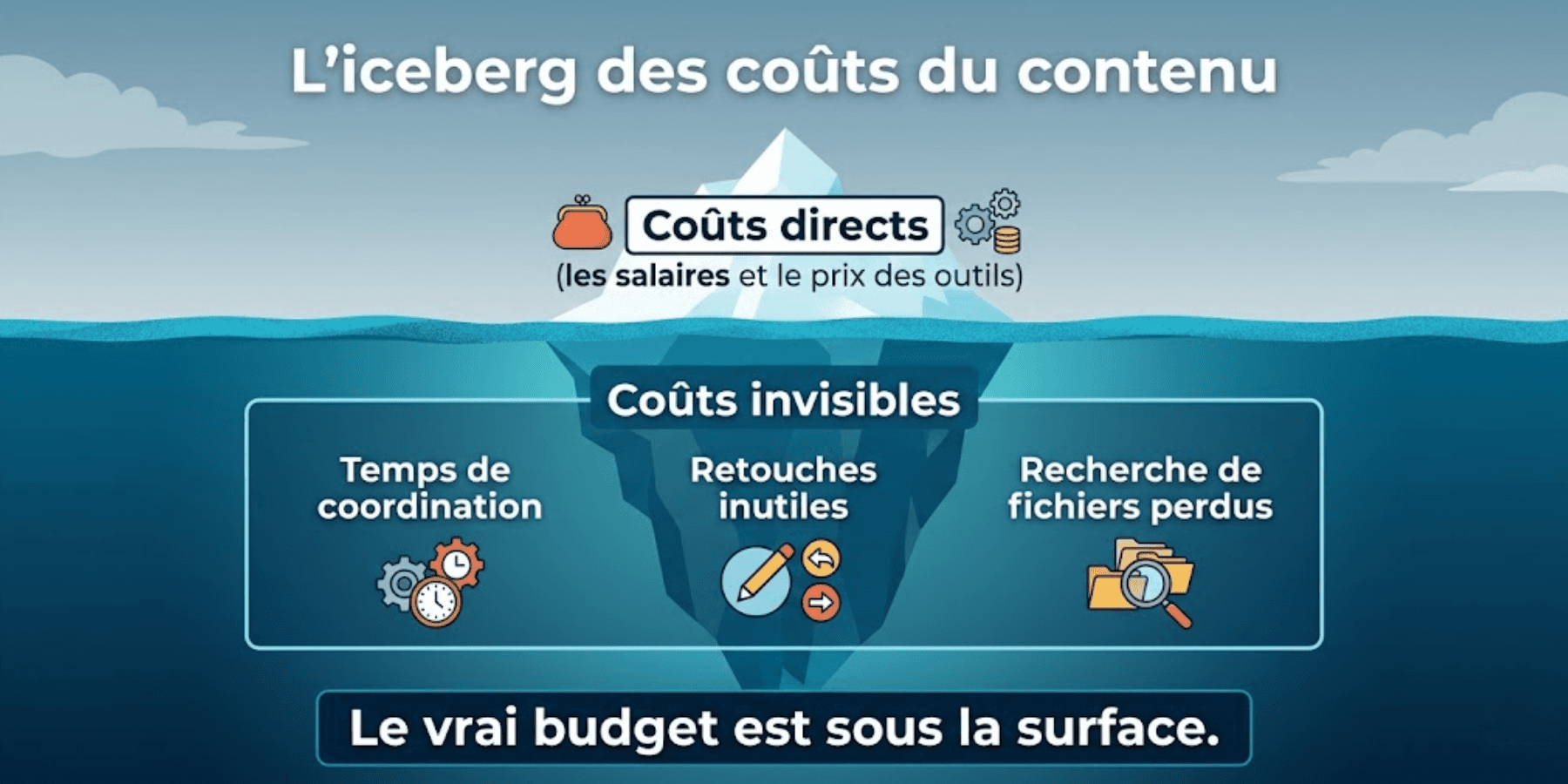
Direct costs: what appears in budgets
Human time mobilised
A standard content marketing team generally includes a writer or communication officer and often a Social Media Manager, part of whose time is dedicated to production. These resources represent the most visible cost item but also the easiest to underestimate, as their time is rarely allocated 100% to content production.
To these human resources are added employer contributions, which significantly increase the real cost compared to the gross salary shown. It is often this incomplete calculation that leads to underestimating the actual budget of an in-house content team.
Tools and training
A properly equipped content team needs a suite of tools: an SEO tool, planning and publishing platform, creative suite, data analysis tool and sometimes a project management platform. The annual bill varies depending on the size of the team and the level of tooling, and is often undervalued in initial budgets.
Maintaining the skills required for content creation also represents a regular investment: content marketing evolves quickly with algorithms, formats, AI tools and SEO best practices. Certifications, e-learning subscriptions and industry conferences are items that are often sacrificed during budget constraints, to the detriment of long-term performance.
Hidden costs: what is not seen in budgets
Coordination time
Producing a blog post, a newsletter or an email campaign is not just about writing or designing. There is the brief meeting, back-and-forth discussions to validate the angle, content proofreading, layout adjustments and final sign-off. Depending on the level of organisation, a single piece of content can mobilise several people over several days.
This time does not appear anywhere in the content budget: it is one of the most difficult invisible costs to factor into a ROI calculation. According to a Gartner study, employees spend nearly 20% of their week searching for internal information rather than producing. In a poorly organised content team, this figure rises even higher.
The cost of poorly integrated tools
Many teams use one tool for planning, another for storing files, a third for communicating and a fourth for approvals. When these tools do not talk to each other, coordination relies entirely on people: files get lost, versions multiply and feedback arrives outside of any centralised system.
This way of working generates an opportunity cost that is difficult to quantify precisely but easy to observe daily. One hour wasted searching for a file or reconstructing the history of a decision is one hour producing nothing.
The cost of unnecessary revisions
When briefs are vague or approval processes poorly structured, creative teams end up doing the same work multiple times. According to the Gartner Marketing Technology Survey 2024, 56% of CMOs cite inadequate briefs as one of the primary obstacles to marketing efficiency.
The opportunity cost of management
In small and medium-sized teams, it is often the marketing manager or the business owner himself who spends part of his time supervising content creation: proofreading, correcting, approving, prioritising. This managerial time is one of the most underestimated hidden costs, as it never appears in the content budget.
A few hours of proofreading per week can, over the year, add up to a significant amount of time spent on a task that could be delegated or better structured. It is less time for strategy, business development or client relations.
In-house, outsourced or hybrid: what it really changes
What weighs in favour of in-house production
Knowledge of the product, brand and customers is difficult to transfer to an external provider. Content that requires high familiarity with the business: case studies, customer testimonials, expert newsletters or "thought leadership" content are generally better produced in-house.
In-house is also more reactive for topical content or short formats that require quick release. This agility is a real competitive advantage, provided that the internal organisation can keep up.
What weighs in favour of outsourcing
Advanced graphic design, video, complex formats or occasional production peaks are often more cost-effective when outsourced. A freelancer represents a fixed and controlled cost: no payroll taxes, no long onboarding and no daily management.
The majority of high-performing teams combine both: they keep strategy and editorial management in-house and outsource high-volume production or specialised expertise. This hybrid model offers the best cost control without sacrificing quality or brand consistency.
Where to act to reduce costs without reducing quality
Structure briefs and approval processes
Here are the levers that have the greatest impact on actual costs:
Structure briefs: a clear brief dramatically reduces back-and-forth loops. Defining the angle, target audience, tone, keywords and expected format before starting prevents the majority of revisions.
Centralise feedback: one single place for comments, regardless of who writes them. Feedback scattered across emails, Slack and meetings is a primary source of unnecessary revisions.
Formalise validation workflows: define who signs off on what, in what order and by what deadline. This single adjustment can reduce the production cycle by several days.
Reduce the number of disconnected tools: every extra tool adds friction. A platform that centralises planning, production and monitoring reduces coordination time and improves traceability.
These adjustments do not require hiring or reducing headcount. They allow you to produce better with the same budget by eliminating organisational losses.
Measure to better optimise
It is impossible to optimise what you do not measure. Tracking time spent by content type and stage allows you to quickly identify where losses accumulate and prioritise corrective actions.
This measurement does not need to be complex: even a simple timesheet shared by the whole team makes inefficiencies visible that previously went unnoticed in budgets.
Smartevo: reducing the hidden costs of marketing production
Centralise briefs and content production
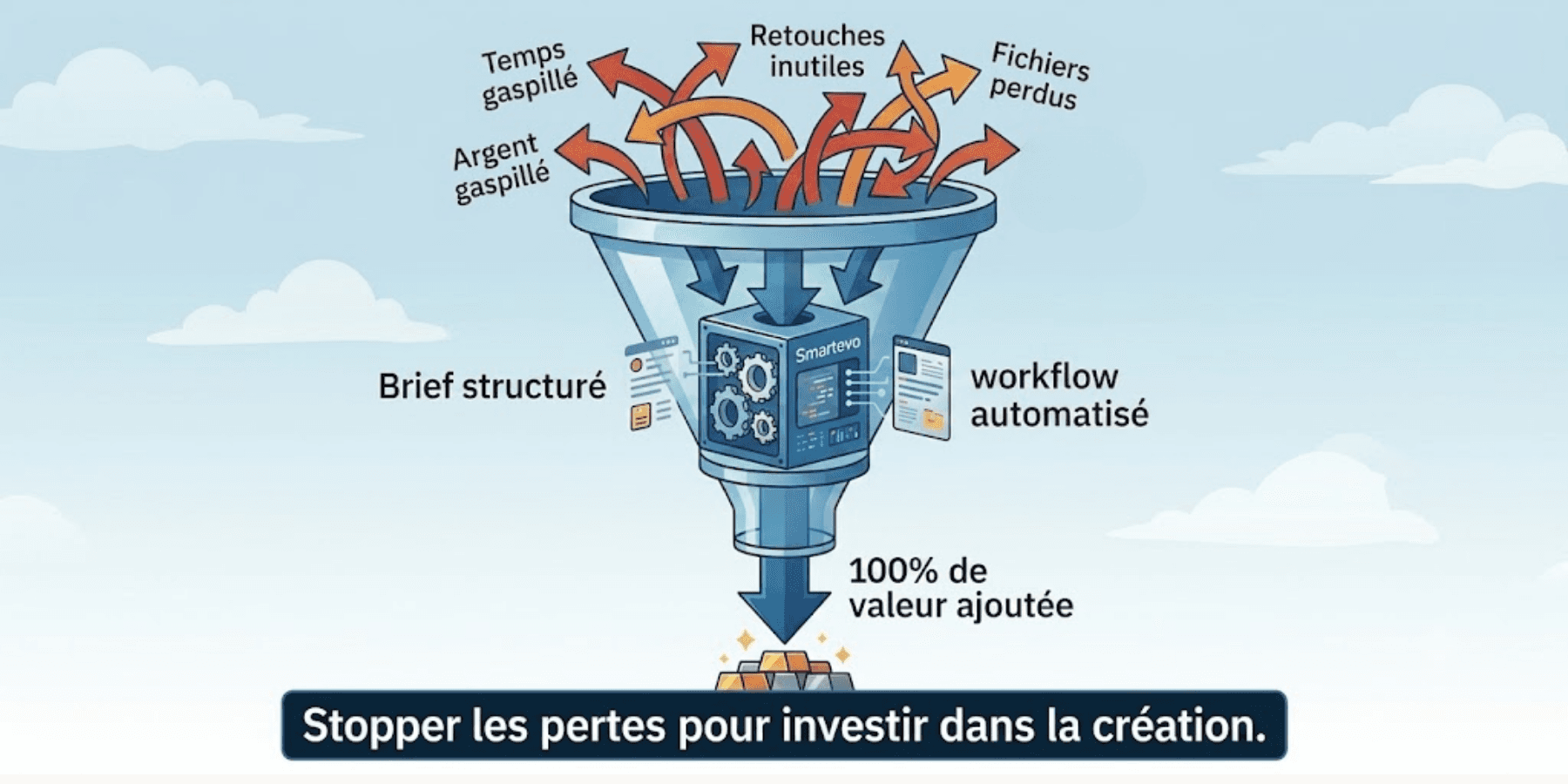
Smartevo starts from a simple observation: the majority of hidden costs arise from a poorly structured brief or information scattered across several tools. The platform centralises brief creation and tracking in a single environment accessible to the whole team right from project launch.
By starting with a comprehensive and shared brief, teams avoid unnecessary back-and-forth, reduce the number of revisions and gain clarity on priorities and deadlines.
Structure approval workflows and project management
Smartevo structures annotation and validation loops, as well as project steering and tracking. Each piece of content progresses according to a defined process: who signs off on what, at what stage and within what deadline.
Producing your content in-house is not free, far from it. But with the right processes, the right tools and a clear organisation, it is often the most efficient choice. The question is not about spending less: it is about producing better, with the same budget.
