Industry News
DAM, CMS, project management: should you centralise?

Marketing teams are accumulating tools: a DAM to store, a CMS to publish, a project management tool to coordinate. The result: lost files, multiplying versions, and time wasted syncing rather than creating. What if the real problem wasn't the number of tools, but the lack of structure between them?
DAM, CMS, project tool: what are we talking about?
The DAM (Digital Asset Management)
A DAM is an intelligent digital library whose role is to store, organise, find and distribute a brand's creative assets: images, videos, logos, templates and campaign files. It ensures that everyone is working from the right files, in the right versions and with the correct usage rights.
It is the go-to tool for teams that produce a large volume of content and need to share it across multiple departments, agencies or markets. But a DAM stores; it does not orchestrate production.
The CMS (Content Management System)
A CMS is a content management system used to publish and manage content on one or several digital channels: website, blog or landing pages. It is the interface between content production and going live, represented by platforms like WordPress, Webflow or HubSpot.
The CMS answers a specific question: how to ensure easy content management without going through a developer for every update? It publishes: it does not manage the production chain that precedes this publication.
The project management tool
A project management tool organises work by structuring tasks, deadlines and responsibilities. It lets you know who is doing what, by when and with what resources.
It is the team's operational conductor. But it doesn't natively speak the language of content: it doesn't know where the validation of a visual stands, nor if the brief was properly understood by the partner agency.
Why fragmenting your marketing stack is expensive
Time wasted searching
On average, a marketer spends one hour a day finding files or information. When assets are in a Drive folder, feedback is in an email and briefs are in a project management tool, this friction accumulates and slows down all production.
This lost time is not trivial: for a team of five people, it's an entire day of work that evaporates each week in searches that would not have to happen with a better-structured environment.
Version errors
Without a single source of truth, it is common for two team members to work on different versions of the same file. The problem is not ill-will: it is the lack of a shared repository.
These errors have a direct cost: redoing work, late deliveries and, in the worst cases, the publishing of unapproved content. Every additional tool in the chain multiplies the risk of falling out of sync.
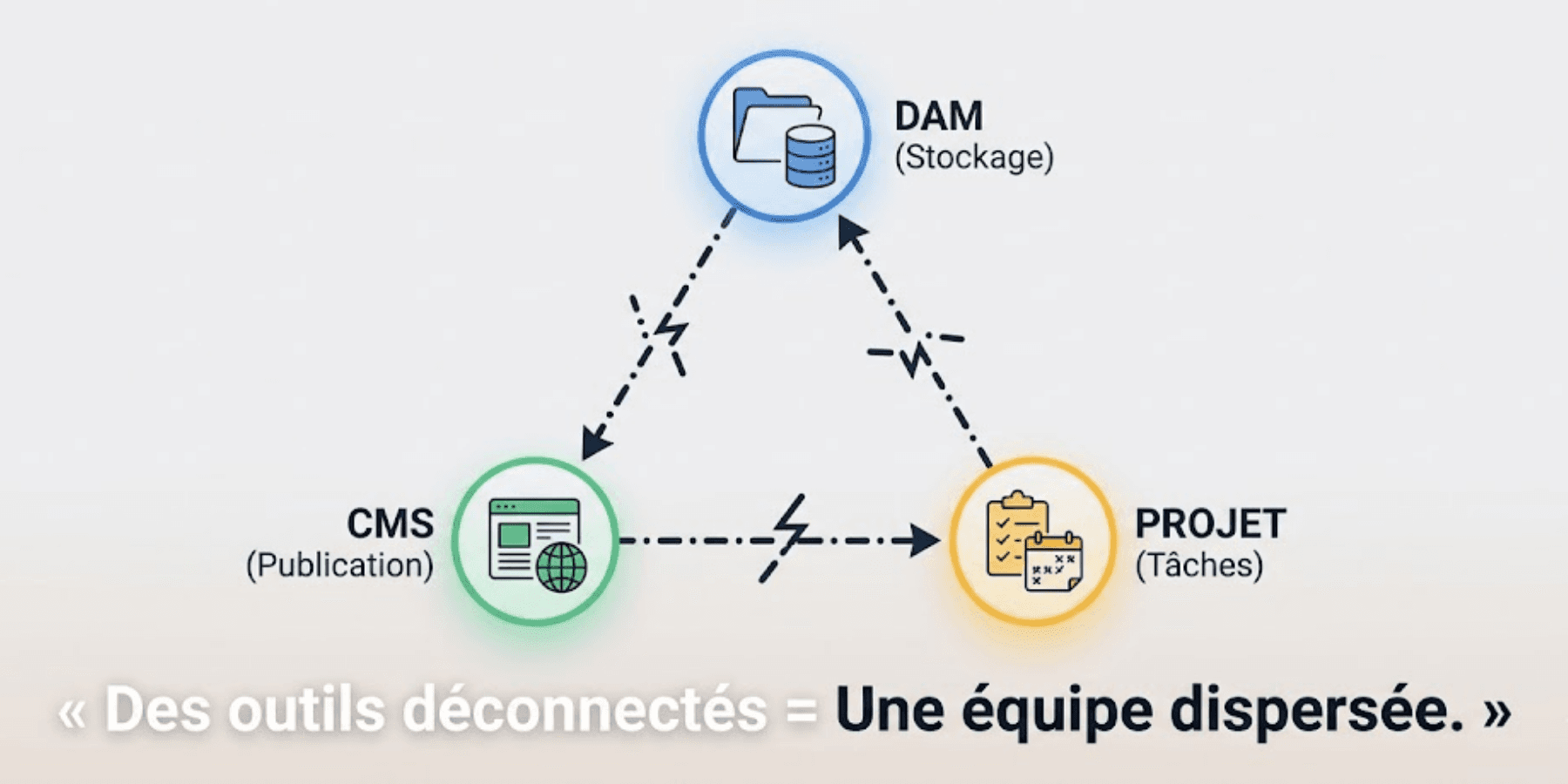
A loss of context at every handoff
When a project moves from one tool to another with no connection between them, context is lost along the way. Decisions made in meetings are not tracked, feedback from stakeholders evaporates between Slack and emails, and trade-offs regularly have to be redone.
This lack of traceability harms the quality of deliverables as much as the peace of mind of the teams. It creates confusion over priorities and forces everyone to mentally reconstruct the progress of a project at every new interaction.
Complicated onboarding
Each new starter has to learn multiple tools in parallel and understand what logic is used in each. This is wasted time and an additional source of errors, particularly during the first few weeks when productivity is already reduced.
The invisible cost of fragmentation often outweighs the benefit of specialising each tool. It is not a question of software budget, but a question of collective efficiency.
Should you centralise everything in an all-in-one marketing platform?
When fragmentation is acceptable
Certain combinations of tools work well if they are correctly integrated. For a small business with a limited production volume, a CMS connected to a DAM via API allows teams to publish directly from the asset library without changing their interface. In this case, technical integration compensates for the multiplicity of tools.
The issue is not the number of tools but the level of fluidity between them. If data flows well from one tool to another and teams do not have to re-enter information manually, the fragmentation remains manageable.
When centralisation becomes essential
Beyond a certain volume of production, multiple campaigns in parallel, multiple markets or multiple agencies involved: fragmentation becomes unmanageable. It is at this stage that the real problem emerges: it's not the file storage that is stuck, it's the structuring of workflows.
Who validates what? At which stage? On which version? Generalist tools have no answer to these questions. This is where a platform designed for the marketing profession makes the difference.
How to choose your marketing tools: the right questions
Diagnosing your current stack
Before changing tools, you need to identify where things are actually getting stuck. Here are the questions to ask yourself:
How much time do my teams spend searching for files or info each week?
Do content reviews arrive in the same place or are they scattered across email, Slack and project tools?
Does everyone know what the valid version of a file is at any given moment?
Do my current tools really integrate with each other, or am I copying and pasting information from one tool to another?
Is my validation workflow clearly defined, or does every project reinvent it?
If several of these answers raise flags, it is not a people problem. It is a tool architecture problem.
What this diagnosis reveals
The real question is not "which tool to choose?" but "how do my tools work together and where is it getting stuck?". Once this diagnosis is established, two paths open up: better integrate what exists or adopt a platform that natively structures marketing production workflows.
In both cases, the objective is the same: for teams to spend their time creating rather than coordinating tools that do not talk to each other.
The trend of all-in-one marketing business platforms
From storage to workflow structuring
In recent years, the market has clearly evolved: marketing teams are no longer looking to stack niche, isolated tools. They are looking for platforms that cover multiple needs by having them communicate natively: project management, collaboration on content, approval and distribution.
The true evolution goes beyond centralising storage. It is about structuring the entire creative production chain: from writing the brief to final validation, including back-and-forth annotations and progress tracking.
A competitiveness challenge for B2B teams
For B2B teams producing large volumes of marketing content (campaigns, communications or sales collateral), this approach reduces friction, shortens delays and improves traceability at every stage.
Le cost of coordination between disconnected tools has become higher than the benefit of their respective specialisation. Adopting a business platform means choosing collective efficiency rather than stacking isolated solutions.
Smartevo: a platform dedicated to the marketing profession
Centralising briefs and content production
Smartevo starts from a simple observation: the brief is the starting point of all marketing production. When it is poorly structured or dispersed across several tools, the entire chain suffers. The platform centralises the creation and tracking of briefs in a single environment accessible to the whole team.
Starting from the brief, Smartevo ensures that every project kicks off with a clear framework: objectives, scope, resources and deadlines are defined in the same place before production even begins.
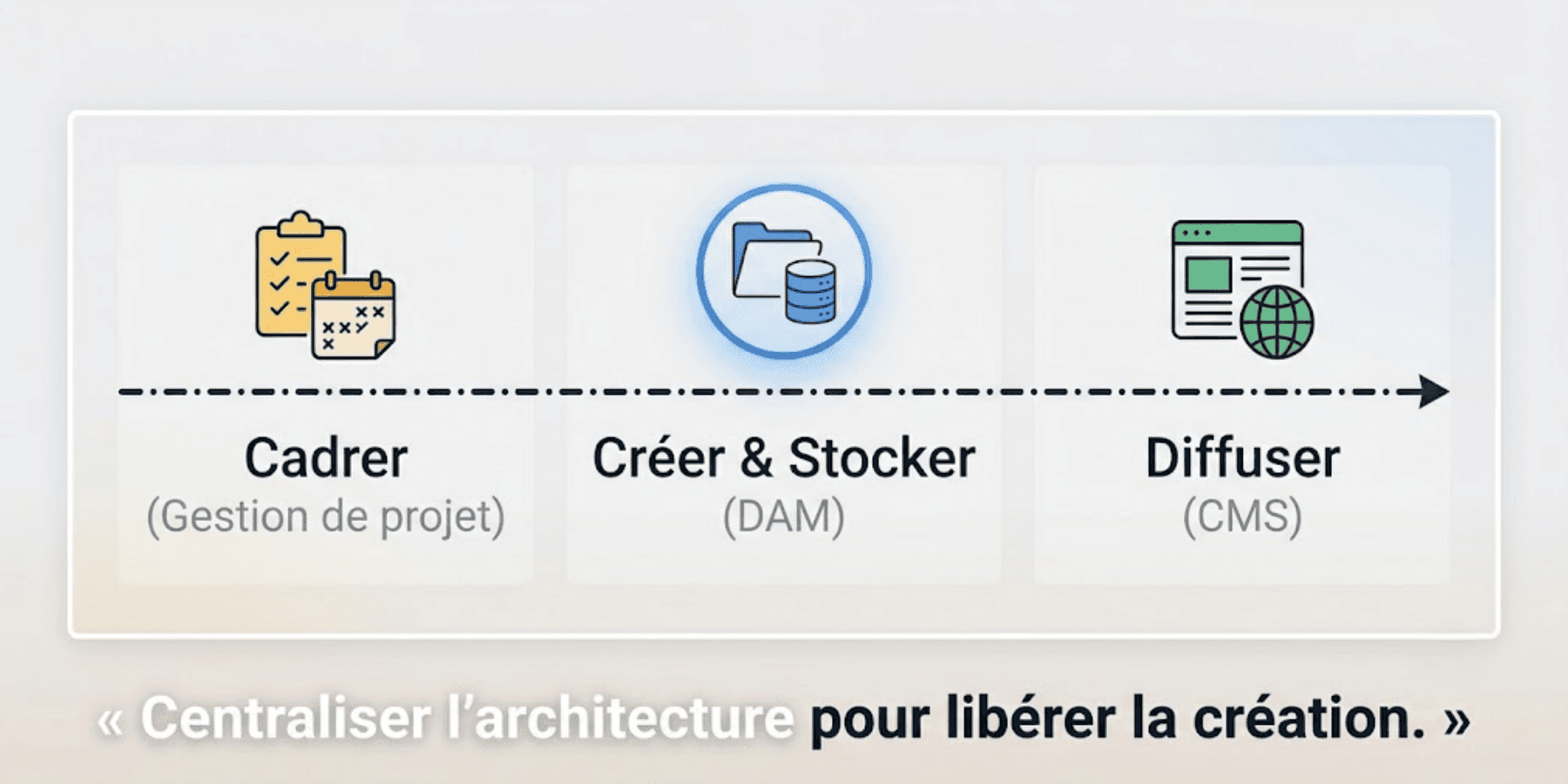
Structuring validation workflows and project steering
Beyond storage, Smartevo structures annotation and validation workflows, as well as project management and tracking.
The objective is to meet the practical needs of marketing teams: knowing who needs to do what, at what stage, and on which version of the content.
It is this workflow structure, and not simple file storage, that allows teams to increase efficiency, reduce unnecessary back-and-forth, and deliver approved contents on time.
