Industry News
Marketing project: the mistakes that make you miss deadlines

The deadline had been written in the calendar for weeks, all stakeholders were aware of it, and yet, at D-2, the campaign is still not ready. This scenario is familiar to the vast majority of marketing teams: delays do not occur unpredictably, they accumulate silently...
Error #1: the brief that leaves too much room for interpretation
Why an imprecise or incomplete brief weakens the entire production chain
Every marketing project relies on a brief. When this document is insufficiently framed, each contributor develops their own interpretation: the designer conceptualises a visual universe that the copywriter did not anticipate, the marketing manager validates a strategic angle that management will disapprove of in final validation.
A poorly structured brief in the early stages generates on average two to three additional review cycles, adding up to delays accumulated on the final deadline.
When the first version of a deliverable is systematically far from expectations, the failure rarely comes from the creative. It comes from the brief.
Standardising the brief to reduce back-and-forth
Formalising the brief with mandatory structuring fields: content objective, target audience, expected tone, format, technical constraints, and delivery date constitutes the first lever of operational efficiency.
Ten minutes dedicated to a rigorous brief saves several hours of revisions and aligns all contributors even before production has started.
This standardisation does not represent an additional constraint: it is an investment with an immediate return. Teams that institutionalise it quickly observe a reduction in back-and-forth on the first versions of their marketing campaigns.
Error #2: deadlines built on optimism
The planning fallacy, a source of chronic slippage
"We should be able to deliver this in three days." This phrase systematically comes up in kick-off meetings: ignoring uncertainties, absences, and stakeholder feedback times.
The APA Dictionary of Psychology defines the planning fallacy as the tendency to underestimate the duration and costs of future tasks, regardless of the individual's level of experience.
In marketing projects, this cognitive bias is amplified by the multiplicity of stakeholders: each additional validation loop constitutes a potential delay that the initial schedule did not integrate.
Planning backwards to secure your deadlines
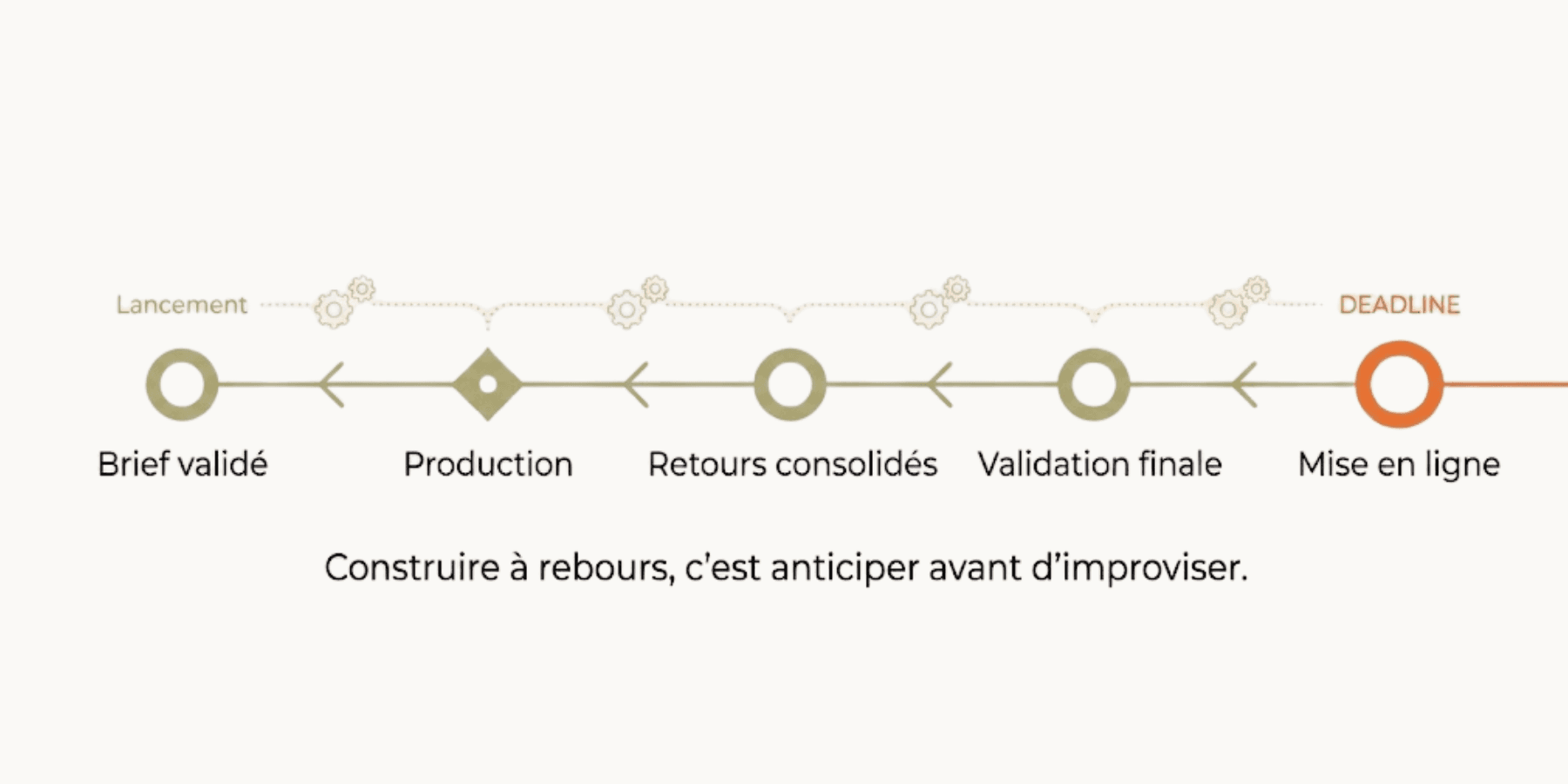
The approach consists of starting from the deadline. Then, you trace back in time by setting milestones.
You add clear buffer periods to each milestone. If the launch is set for the 15th, the final validation must be completed on the 12th. If validation must be completed on the 12th, feedback must reach the team before the 10th.
This reasoning is one of the founding practices of marketing project management: it forces a confrontation with the reality of the calendar long before the first difficulties arise and makes it possible to identify risk areas from the launch.
Error #3: unclear responsibilities
Role ambiguity, a source of organisational failures
-"Who is handling final validation?"
- "I thought it was you."
This confusion is one of the most frequent causes of unexecuted or duplicated tasks in marketing projects.
The mission of the marketing project manager is precisely to prevent these blind spots by explicitly assigning each stage to one or more identified owners.
When multiple contributors believe they are simultaneously responsible for the same task, or when none of them is, the project reveals a failure of governance, not a lack of resources.
Formalising roles from the project launch
The solution is to designate a single owner for each task and to make a rigorous distinction between those who need to be consulted and those whose formal validation is required. This structural adjustment eliminates the majority of ambiguities during production.
A RACI matrix (Responsible, Approver, Consulted, Informed) is a simple and proven tool to formalise these assignments right from the launch. It is one of the structuring features of any high-performing marketing management tool.
Error #4: feedback arriving from everywhere
The fragmentation of feedback channels, the main obstacle to fluidity
An email from management, a comment made in a meeting, an annotation on a printed PDF, a Slack message, a note in Google Docs: when feedback travels through heterogeneous channels, the marketing project manager finds themselves piecing together a puzzle of contradictory information. Which request is a priority? Which version integrates all the required changes? Who decides when two opinions clash?
This way of working is not only inefficient, it is structurally risky. Critical changes are omitted, and the deadline shifts while the team tries to reconstruct the completeness of the requests made.
Centralising feedback on a single and structured channel
The solution is to impose a single reference point for all comments, regardless of the stakeholder's status. A shared document is enough to start with; the sophistication of the management tool matters less than the rigour of its collective adoption. The essential thing is that each contributor knows where to leave their feedback and that the creative team has a single reference point to consult.
This principle of centralisation reduces information conflicts, eliminates parasitic versions, and mechanically compresses the validation cycles across all marketing campaigns.
Error #5: the lack of visibility on progress
Management by intuition, an underestimated risk factor
"Where is the campaign at?" When answering this question requires sending an email or organizing a sync meeting, it means the monitoring system is insufficient.
In the absence of centralised tracking, blockages are only identified when they materialise into actual delays — often too late to correct them without compromising on quality.
An approver who hasn't opened the file for three days, a task blocked due to an undelivered asset — these warning signs remain invisible in any organisation managing its projects without a dedicated dashboard.
Deploying real-time tracking accessible to the whole team
A synthetic dashboard is enough: for each task or deliverable, an updated status (yet to start, in progress, awaiting validation, completed) and an identified owner. This is the foundation of any rigorous operational marketing strategy; this level of transparency allows teams to anticipate blockages before they become critical and to resolve them without urgent mobilisations.
The more the tracking is shared and visible on the marketing platforms used by the team, the less time is spent evaluating progress and the more is dedicated to execution.
Error #6: scope creep during the process
Scope creep, a silent drift with major consequences
"While we're at it, we could integrate an adaptation for Instagram Stories." These requests seem harmless in isolation, but their accumulation in the course of a project constitutes what the PMI refers to as scope creep: an uncontrolled drift from the initial scope that increases the workload without changing the agreed delivery date.
According to the PMI's Pulse of the Profession, 52% of projects are affected by scope creep. In digital marketing, where last-minute requests proliferate on marketing campaigns, this rate is likely higher.
Securing the scope from the initialisation phase
The solution is to have the scope formally approved at the beginning of the project by all stakeholders and to establish a process for handling out-of-scope requests. Not to reject them systematically, but to document them, assess them, and, when they are accepted, reflect their impact on the schedule.
This setup protects the team from self-generated emergencies and gives stakeholders precise visibility on the operational implications of each additional request, a structuring practice of any rigorously managed marketing strategy.
What these errors have in common
A structural failure, not a human failure
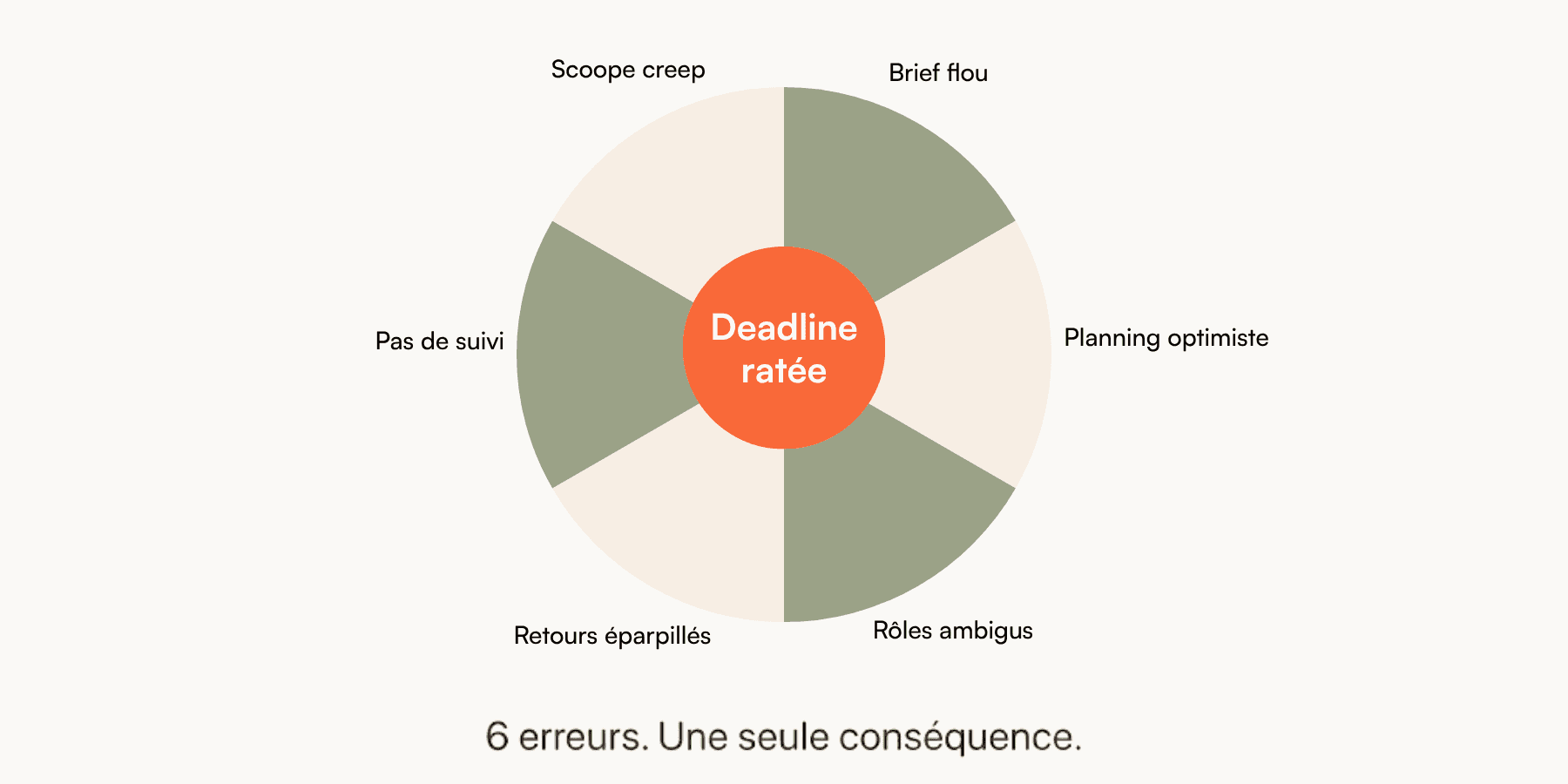
A cross-analysis of these six errors reveals a constant: they do not stem from a lack of skills or commitment. They stem from a lack of structure. Inadequate briefs, ambiguous assignments, fragmented feedback, insufficient visibility: these dysfunctions relate to the process, not the individuals. And process failures are solved by processes.
The most successful digital marketing teams are not necessarily the fastest. They are the ones whose operational framework is robust enough for projects to progress without relying on the exceptional commitment of individuals or last-minute follow-ups.
The launch checklist to secure each project
Before starting production, submit your project to these six questions:
Is the brief comprehensive: objective, target audience, tone, format, technical constraints, and delivery deadline?
Has the schedule been built backwards from the deadline with formalised intermediate milestones?
Does each task have a clearly designated owner?
Have you defined a single channel to centralise all feedback?
Does a tracking system allow everyone to visualise progress in real time?
Has the project scope been validated by all stakeholders?
If you answer negatively to at least two of these questions, your next project presents an identified risk of missing its deadline.
Smartevo: structuring your marketing projects from A to Z
Formalising briefs and clarifying assignments from launch
Smartevo is a marketing project management tool that structures each initiative starting from its initialisation phase: formalised briefs, explicitly assigned responsibilities, and a validated scope before production begins. Each contributor has precise visibility on their tasks, deadlines, and applicable validation loops.
This early structuring is the lever that allows teams to meet their commitments across all of their marketing campaigns without resorting to follow-ups or catch-up meetings.
Centralising validations and managing progress in real time
Smartevo centralises validation workflows and progress tracking in a unified environment. Feedback is left in the right place, blockages are identifiable in real time, and all content progresses according to a defined process, whether it involves one-off digital marketing projects or recurring productions integrated into a long-term marketing strategy.
Missed deadlines are never a real surprise: the warning signs were identifiable right from the launch. Inadequate brief, over-optimistic schedule, ambiguous assignments: these failures are detectable and correctable before the delay is finalised.
