Industry News
Content marketing: retaining rather than conquering

Most content strategies focus on acquisition: attracting new prospects, generating leads, and expanding the audience. Yet, churn marketing reveals a frequently overlooked reality: retaining an existing customer is generally cheaper than acquiring a new one. Content marketing has a direct role to play in this equation, provided you do not stop at the conquest phase.
Why does content marketing focus too much on acquisition?
A conquest logic inherited from commercial objectives
The majority of key performance indicators tracked by marketing teams relate to acquisition: traffic, leads generated, and conversion rates. This approach is understandable, but it often leaves aside what happens once the customer is acquired. Content designed to support existing customers generally receives fewer resources and less strategic attention than acquisition content.
This focus is not a deliberate choice: it is often the result of organizational structure. Marketing teams are historically evaluated on their ability to generate new prospects, rarely on their contribution to customer marketing retention, which traditionally falls under customer service or customer success. This division of responsibilities creates a blind spot where no one genuinely drivers post-purchase content with the same rigour as acquisition content.
A loyalty content that is often under-invested in
Informative newsletters lacking real added value, product support content that is never updated, post-purchase communications limited to sales follow-ups: content aimed at existing customers is frequently produced to a bare minimum, without the same editorial standards as acquisition content.
This difference in treatment incurs a hidden cost: a customer who no longer receives relevant content after their purchase gradually disengages from the brand, eventually becoming a high-risk target for churn. Investing in loyalty content marketing is not an ancillary expense; it is a retention lever in its own right, just like actions carried out by sales teams or customer service.
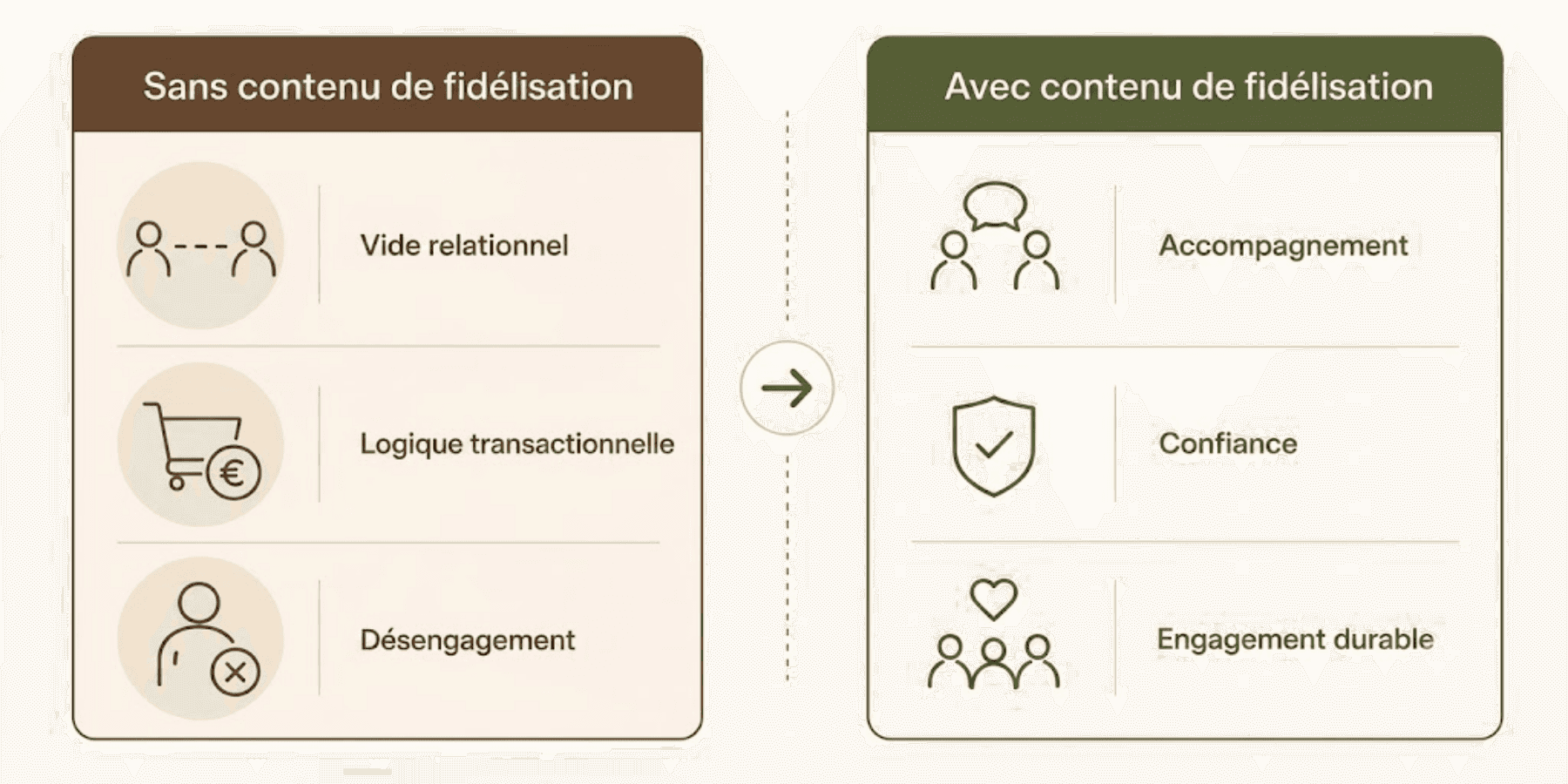
How content marketing influences churn
The role of content in perceived value
A customer does not judge a product or service solely on its technical features. They also evaluate the quality of the relationship that the brand maintains with them after the purchase. Relevant, regular, and useful content reinforces the feeling of support and the perception of the product or service's added value.
Conversely, the absence of relevant content creates a relational vacuum that competitors can exploit. If a brand stops communicating in a useful way once the sale is concluded, the customer has no specific reason to remain loyal, and the risk of marketing churn mechanically increases over time.
Content as a tool for continuous engagement
Content marketing can play a supporting role throughout the customer lifecycle: user tutorials, inspiring case studies, educational content on new features, and feedback from other customers. This type of content maintains an active link between the brand and its audience, long after the initial conversion.
This continuous engagement reduces the risk of churn by regularly reminding them of the product or service's value. A customer who understands what they bought better, and who sees how others benefit from it, is statistically more likely to remain loyal than a customer left without post-purchase support.
The impact of absent or unsuitable content
Conversely, a customer who only receives commercial solicitations after their purchase eventually associates the brand with a purely transactional logic. This perception harms long-term attachment and weakens the relationship at the slightest negative signal, whether it is a technical incident or an attractive competitor offer.
Content plays a buffering role here: a well-supported customer forgives a one-off incident more easily than a customer who has no pre-existing relationship of trust with the brand. This is one of the less visible, yet most decisive, aspects of churn reduction through content.
Building a loyalty-oriented content strategy
Identifying key moments in the customer lifecycle
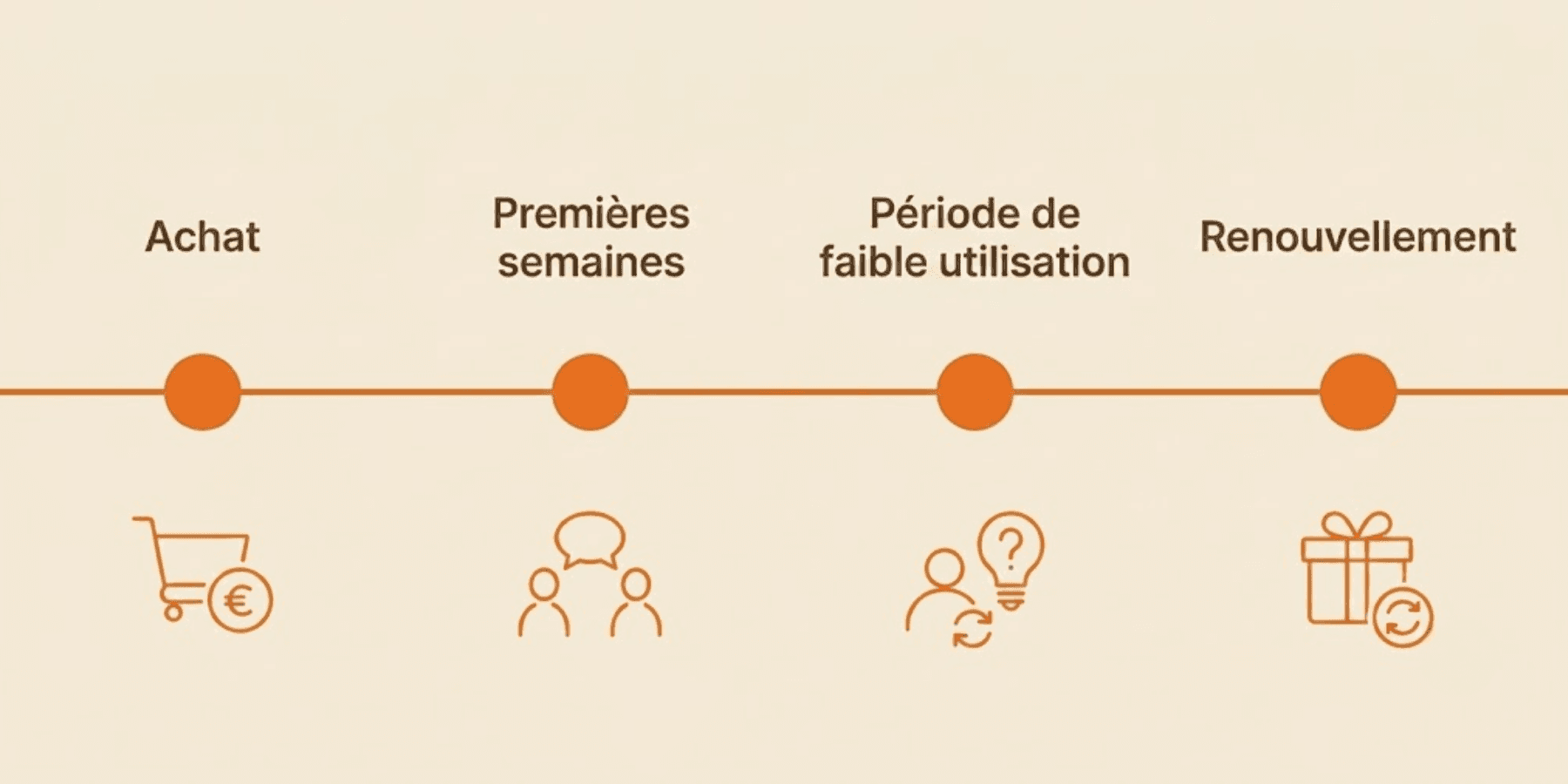
An effective content strategy for retention identifies the critical moments when the customer is most likely to disengage: the first few weeks following the purchase, periods of low usage, and renewal deadlines. Each of these moments calls for specific content, tailored to the customer's mindset at that exact instant.
Mapping these key moments allows for content to be produced at the right time rather than broadcasting generic communications without considering the actual customer lifecycle. This approach transforms content into a genuine tool for reducing churn, rather than just simple sporadic communication support disconnected from the customer's actual journey.
Maintaining the same editorial standards as in acquisition
Loyalty content deserves the same rigour as acquisition content: a tone consistent with the brand identity, a polished editorial quality, and real added value for the reader. Too often, post-purchase content is produced quickly, without the same level of attention as content aimed at convincing new prospects.
This difference in treatment is discernible to customers and can reinforce the feeling of being neglected once the sale is completed. Applying the same editorial standards across the entire customer lifecycle strengthens brand consistency and the perceived quality of the relationship, well beyond the mere acquisition phase.
Smartevo: structuring content production designed for longevity
Centralizing acquisition and loyalty content production
Smartevo allows you to centralize your entire marketing content production in a single environment, whether it is acquisition content or content designed to support existing customers. This centralization facilitates coordination between the teams responsible for these two aspects, which are often managed separately.
Having an overall view of content production allows for a better balance of resources allocated between acquisition and retention, rather than letting acquisition systematically absorb the majority of available means, as is often the case in organizations that do not manage this aspect in a structured way.
Maintaining editorial quality throughout the customer lifecycle
The validation workflows offered by Smartevo apply equally to acquisition and loyalty content, ensuring the same level of standards across all production. Structured briefs, annotation and validation circuits: each type of content benefits from the same rigorous process.
This homogeneity of treatment prevents post-purchase content from becoming a rushed adjustment variable during periods of high workload, and guarantees a consistent brand experience across the entire customer lifecycle.
Marketing content does not end with acquisition: it has a decisive role to play in retaining existing customers. Investing in relevant content throughout the customer lifecycle, with the same standard as in acquisition, is one of the most under-utilized levers for reducing churn.
