Industry News
Internal team or agency: how to coordinate both?

Working with an agency alongside an in-house team is a common marketing practice. Yet, marketing agency management rarely runs as smoothly as hoped: endless back-and-forth, context lost from one conversation to another, and validation deadlines that drag on. These points of friction do not stem from a lack of skills, but from the lack of a shared framework between the two teams.
Why in-house/agency coordination is tricky
Different working methods
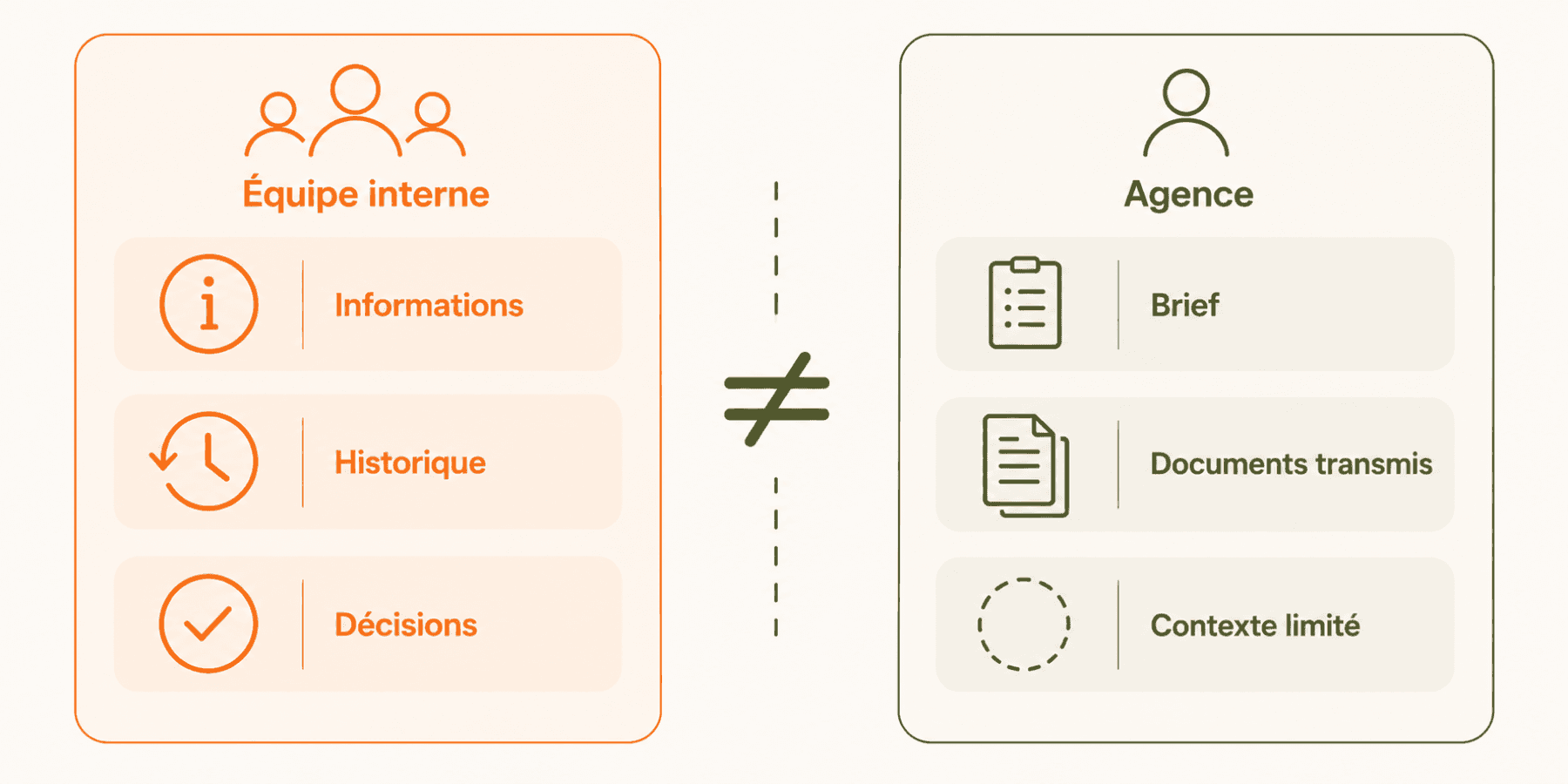
An in-house team and an agency do not have the same habits or constraints. The in-house team intimately knows the brand, the products and the internal challenges. They have access to implicit information, shared during meetings and informal discussions, which is never written down.
The agency, for its part, brings an external perspective and specific expertise, but generally discovers the brand's context only through the documents provided to them. This information asymmetry is not a problem in itself, but it becomes a source of friction if left unmanaged. Without a shared framework, each side applies its own working logic, which complicates supplier management and creates discrepancies in expectations and deliverables.
A brief that doesn't travel well
The brief sent to an external agency often loses precision compared to one distributed in-house. Implicit information, obvious to an in-house team familiar with the context, is not obvious to an external service provider discovering the project for the first time.
This loss of information almost always results in additional back-and-forth. The agency produces a first version consistent with what they understood, the in-house team identifies gaps that are obvious to them but invisible in the initial brief, and the revision cycle begins. An incomplete brief sent to an agency generally costs more in lost time than an incomplete brief managed in-house, because every clarification requires another exchange between two separate entities.
A loss of context between the two teams
Over the course of a project, decisions are made, adjustments are validated, and priorities change. When these developments are not systematically communicated to the agency, they continue working on an outdated version of the project, leading to work that has to be redone.
This gap in context is one of the main sources of misunderstanding between in-house teams and agencies. It does not result from a lack of goodwill, but from a communication channel that is not sufficiently structured to convey project updates in real time. The longer the project runs, the more this gap tends to widen, in the absence of a shared and systematically updated point of reference.
What defines good marketing agency management
A single and shared brief
The basis of effective collaboration is a complete brief, written with the same level of care as if it were for the in-house team. Context, objectives, target audience, technical constraints, deadlines: nothing should be left to interpretation, even elements that seem obvious in-house.
This brief must remain accessible and editable throughout the project, rather than being frozen in an email sent just once at launch. The agency must be able to refer to it at any time and see any updates. A living brief, updated with every significant project change, prevents the agency from working with obsolete information.
Clearly defined roles
Who signs off on deliverables on the in-house side? Who sends feedback to the agency? Who makes decisions in case of a disagreement? Without clear answers to these questions, the agency often ends up receiving contradictory feedback from multiple in-house contacts.
Designating a single point of contact on the in-house side, responsible for centralising and consolidating feedback before sending it, significantly streamlines communication and prevents the agency from having to adjudicate between inconsistent requests. This point-of-contact role also simplifies daily supplier management, providing the agency with a single communication channel rather than multiple contacts with sometimes diverging priorities.
Managed sign-off deadlines
An agency typically works on several accounts simultaneously, with a tight production schedule. When in-house sign-off deadlines are not met, the agency's entire schedule is disrupted, with direct consequences on the quality or delivery times.
Setting clear response times, known to both parties from the project launch, allows the agency to organize its workload accordingly and avoid bottlenecks while waiting for overdue sign-offs. These deadlines must be realistic in light of internal constraints, otherwise they will never be met and will lose all value as commitments.
Smartevo: a meeting point for in-house and external teams
An environment accessible to both teams
Smartevo allows you to create a shared workspace between the in-house team and the agency, where the brief, resources, and communication are centralised in a single environment. No more forwarding documents by email or piecing together a project's history for an external supplier.
This centralisation ensures that the agency is always working with the most up-to-date version of the project, with no context gaps or missing information. Every update to the brief or schedule is instantly visible to all stakeholders, both in-house and external.
Approval loops that include the agency
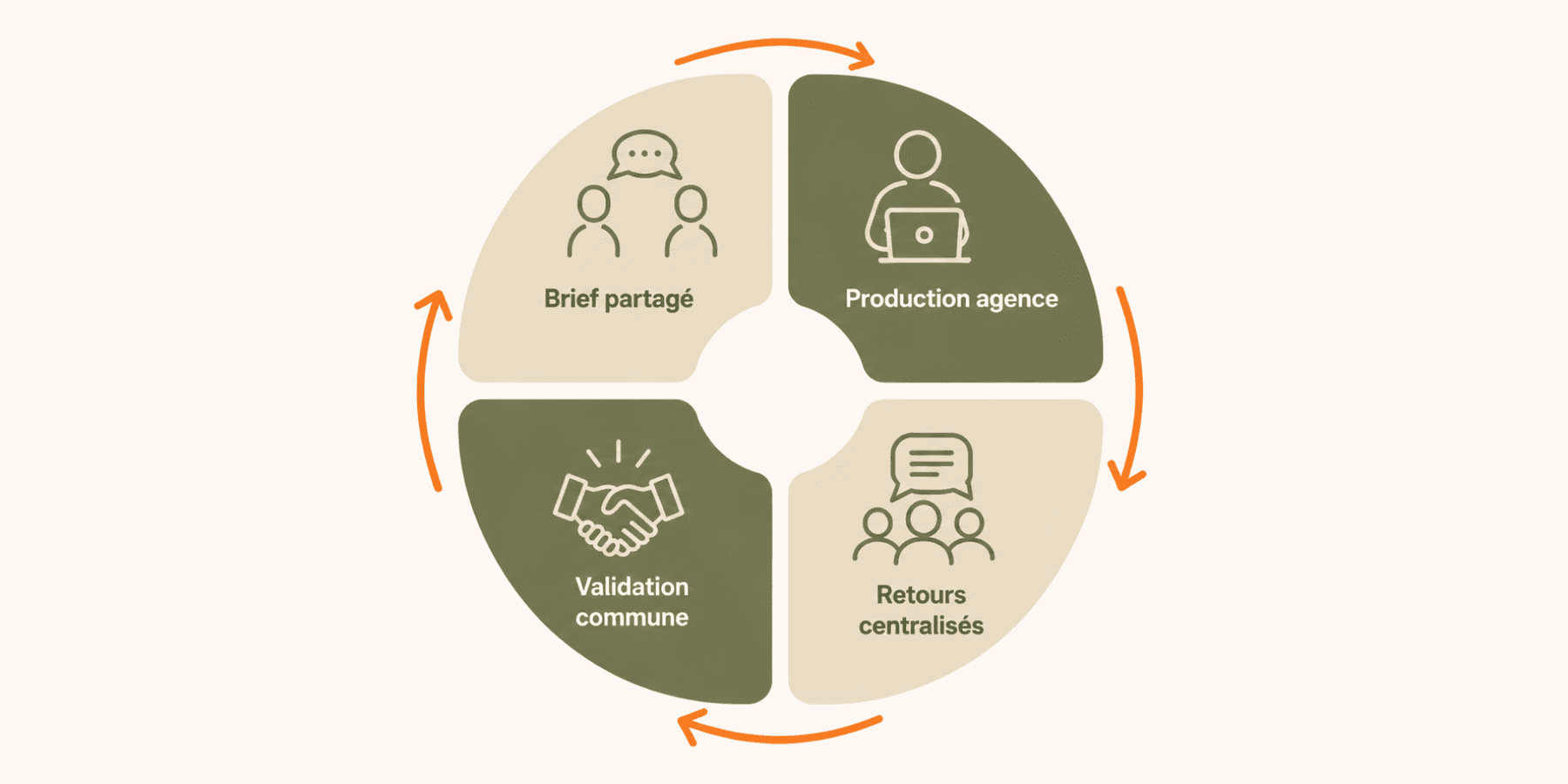
Smartevo allows you to define approval workflows that include both in-house contacts and the agency, with clearly formalised roles and deadlines. Each party knows exactly at which stage they intervene and how long they have to respond.
This structure reduces contradictory feedback and speeds up sign-off cycles, saving the agency from having to interpret instructions scattered across multiple contacts. The approval workflow becomes a shared framework, understood and respected by both organizations.
Shared visibility on progress
Both the agency and the in-house team can track project progress in real time within Smartevo: deliverable status, pending feedback, upcoming deadlines. This transparency eliminates unnecessary catch-up meetings and follow-up emails that slow down collaboration.
This shared visibility also builds trust between both parties. The agency no longer needs to chase the in-house team to find out where an approval stands, and the in-house team can see actual production progress without waiting for a formal status update.
Coordinating an in-house team and an agency is not easy, but it is not an impossible task either. A shared brief, clearly defined roles, and well-managed approval deadlines are often all it takes to turn a laborious collaboration into a smooth and productive partnership.
