Industry News
Events: organising a project without scattering everything

An event project mobilises a multitude of stakeholders in just a few weeks: technical service providers, agencies, internal teams, partners. This density of actors over often short periods of time makes event management one of the areas most prone to dispersion. However, the most effective teams are not those that manage the most things at once: they are those that structure a common framework for everyone.
Why event project management is prone to dispersion
A multiplicity of internal and external stakeholders
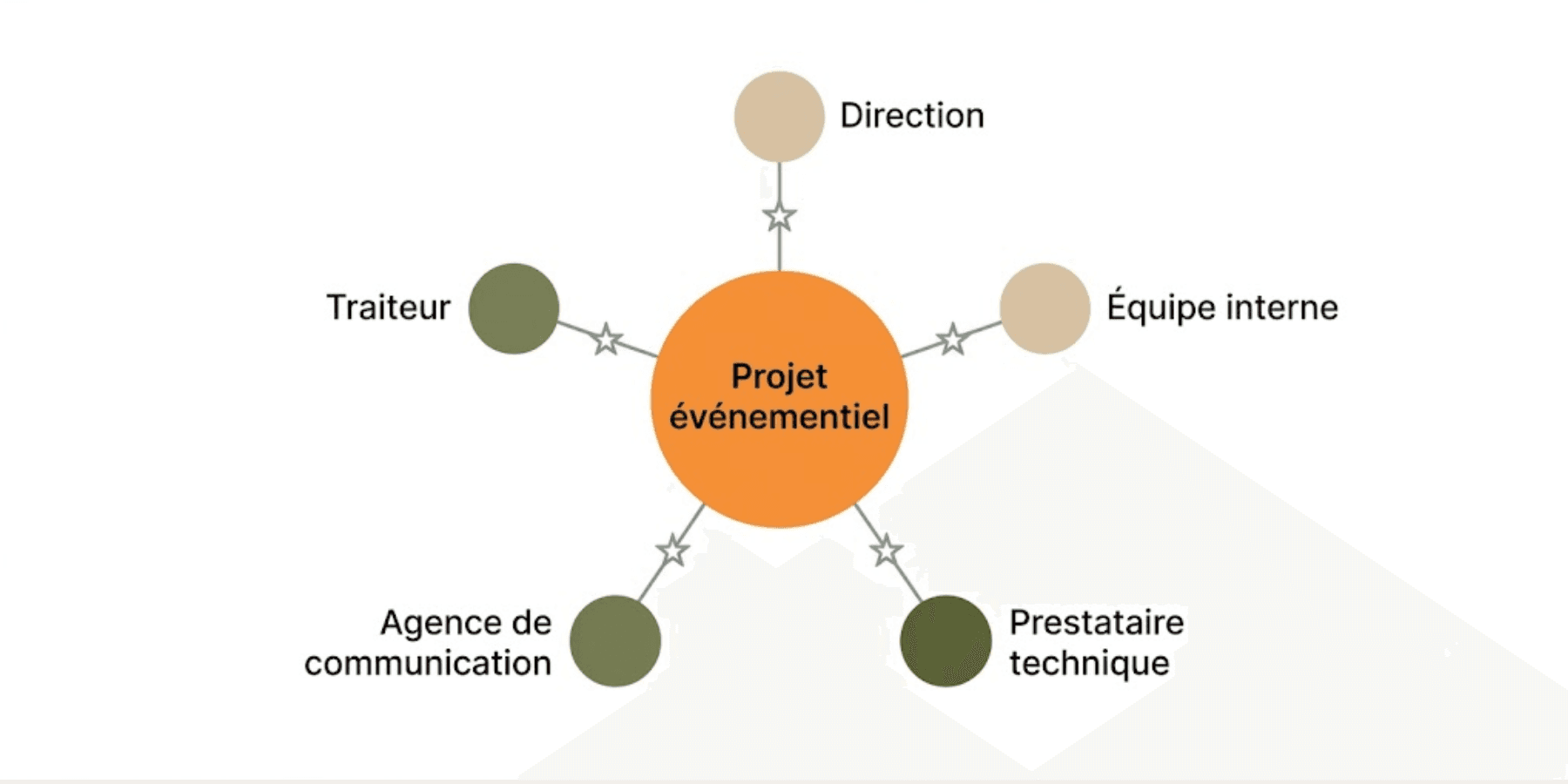
Organising a marketing event rarely involves a single team. Caterer, scenographer, technical service provider, communication agency, internal marketing team, management: each stakeholder has their own communication channels, their own working habits and sometimes their own tools.
This multiplicity of actors makes coordination naturally complex. Without a common framework, each contact person receives different information, at different times, in different formats. Dispersion is not an accident: it is structurally built-in to the very nature of event projects.
Short lead times and non-negotiable deadlines
Unlike marketing content which can sometimes be pushed back by a few days, planning an event involves dealing with a fixed date that does not move. This incompressible time constraint changes the nature of the risk: a delay on a task cannot be absorbed as it might be on another type of project.
This time pressure leaves little room to correct coordination errors. A poorly sent brief or a late approval takes on disproportionate importance as the big day approaches, whereas on a classic project it could have been absorbed by additional time.
Multiple assets to coordinate simultaneously
An event generally generates many assets in parallel: invitations, signage, presentation materials, content for social media, press kit, on-site welcome materials. Each of these assets may be produced by a different person or team.
This simultaneous production of varied content multiplies the necessary coordination points. If each asset follows its own approval workflow, without overall consistency, the risk of inconsistency between messages increases sharply.
Where dispersion hides in an event project
Briefs sent differently to each service provider
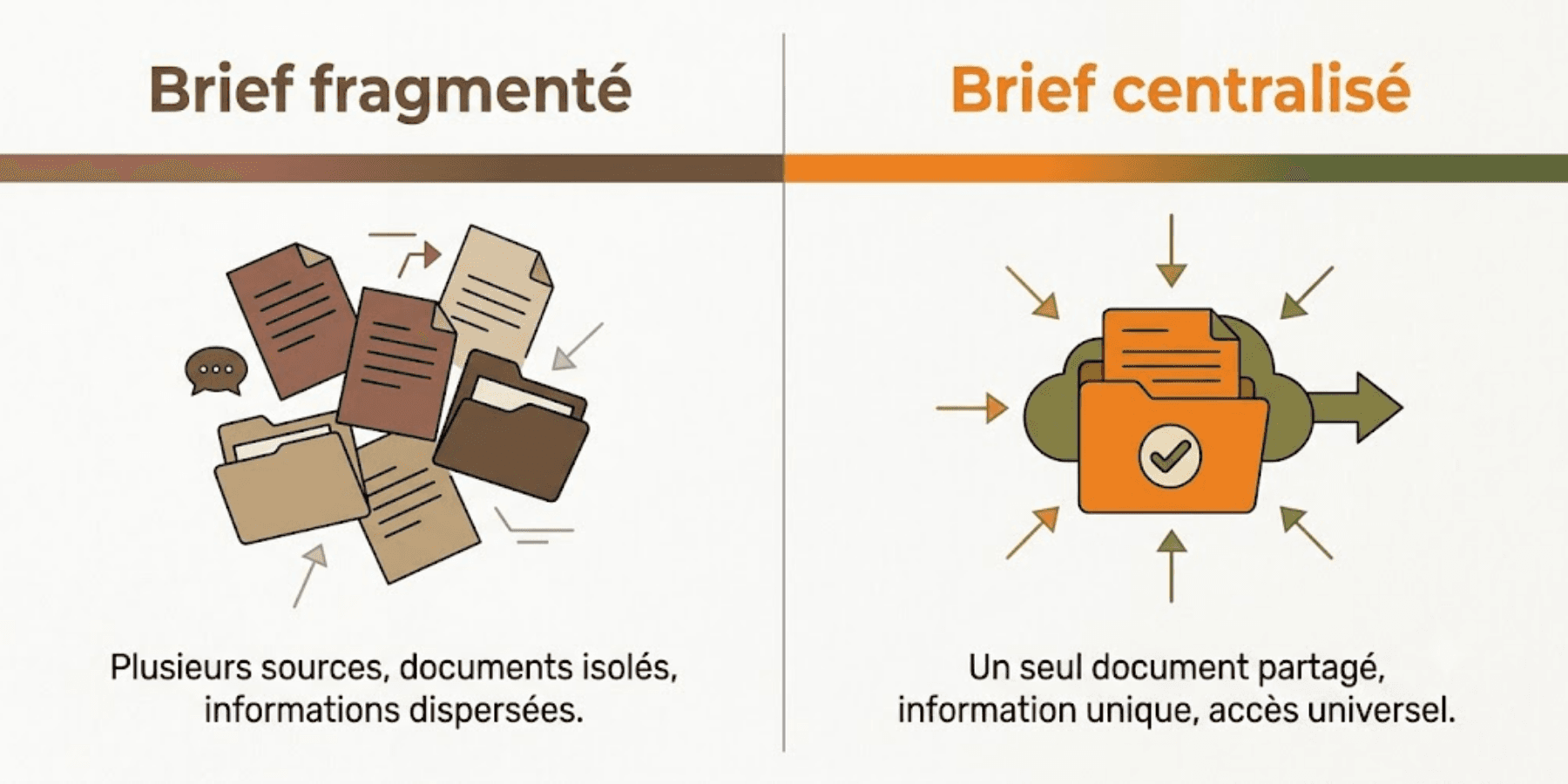
It is common for the brief sent to the caterer to be different from the one sent to the communication agency, which is in turn different from the one sent to the technical team. Each receives a partial or adapted version of the information, sometimes shared verbally, sometimes by email, rarely in a consistent manner.
This fragmentation of the initial brief is one of the main sources of dispersion. Providers work with different information for the same event, which generates inconsistencies that are hard to detect before they become visible on-site.
Approvals scattered across multiple contacts
Who approves the invitation design? Who approves the opening speech? Who approves the day's schedule? In many projects, the event project manager must deal with approvals distributed among several people without central coordination, which slows down each step and multiplies back-and-forth communication.
This lack of a single approval workflow creates bottlenecks at critical moments of the project, often in the final days before the event, when the time available for corrections is most limited.
The consequences of a dispersed organisation
Inconsistencies between assets and messages
When each asset is produced with slightly different information, inconsistencies appear: a key message that changes wording between the invitation and the press kit, a date or time that differs between two documents, a brand identity applied inconsistently.
These inconsistencies, even minor ones, harm the credibility of the event and create confusion among attendees. They are almost always avoidable with a single source of information shared by all stakeholders.
A loss of valuable time just days before the event
Organisational dispersion has a cumulative effect: the closer the event gets, the more last-minute corrections pile up. What could have been anticipated several weeks in advance becomes an emergency to deal with in the final days, at the moment when the team has the least room to manoeuvre.
This time lost at the final stages is rarely necessary. It is the direct consequence of a lack of structuring earlier in the project, not a lack of competence or investment by the teams.
Growing tension between teams as the big day approaches
The weeks preceding an event are already tense by nature. When coordination is also failing, this tension intensifies: teams shift responsibility for delays to one another, providers are chased in a rush, and the working climate deteriorates at the moment when collaboration should be the smoothest.
This deterioration of the atmosphere is often avoidable. It rarely results from a human problem: it is the direct consequence of organisational dispersion that could have been anticipated right from the project launch.
How to structure effective event project management
Centralise the brief for all stakeholders
The first step of solid event project management consists of producing a single, complete brief accessible to all stakeholders, both internal and external. This brief must contain all structuring information: event objectives, key messages, brand guidelines, logistical constraints, intermediate dates and deadlines.
A centralised brief eliminates differences in interpretation between different providers and guarantees that everyone works from the same version of reality, from the caterer to the communication team.
Define a single approval workflow
Rather than letting each asset follow its own approval workflow, it is more effective to designate a primary approver who consolidates all feedback before sending it on. This single point of contact avoids contradictions and speeds up approval cycles.
This workflow must be defined before launching the project, with clear deadlines for each step. The closer the deadline gets, the more this workflow must be strictly respected to avoid last-minute blockages.
Smartevo: a common framework for all stakeholders
A shared brief between internal teams and providers
Smartevo allows you to centralise the event brief in an environment accessible to all stakeholders, whether internal or external to the company. Each provider has the same information, updated in real time.
This centralisation considerably reduces the risk of inconsistency between assets and ensures that any change in the brief is immediately visible to all stakeholders concerned.
A single progress tracking until the big day
Smartevo allows you to track the progress of all deliverables for an event project in a single dashboard, right up to the day of the event. Each stakeholder knows their role, their deadlines and the status of other tasks in the project, which reduces unnecessary chasing and areas of uncertainty.
This level of visibility is particularly valuable in the final days before the event, when every minute counts. Rather than multiplying phone calls or chase-up emails, the team can see at a glance what remains to be finalised and focus their energy on genuine blockages.
Event organisation concentrates all the risks of dispersion in a short span of time: multiplicity of stakeholders, fixed deadlines, multiple assets. Centralising the brief and unifying the approval workflow: this is what allows this type of project to move forward without every detail becoming a source of tension.
