Industry News
Internal communication: organising it to improve production

Internal communication: organising it to produce better
Poor internal communication isn't always immediately obvious. It manifests itself in other ways: consecutive meetings with no results, decisions made in meetings but never formalised, creative teams receiving contradictory information. It is these invisible frictions that slow down production and exhaust teams far more than the workload itself.
Why internal communication holds back production
Information that doesn't flow at the right time
In many teams, the information required for production flows in a haphazard way. A brief is delivered verbally in a meeting but never written down. A strategic decision is made by management but only reaches the creative team several days later, when production is already heading in the wrong direction.
This lag between when information is produced and when it reaches the right people is one of the most common causes of unnecessary rework. The right information, at the right time and to the right people: this is the foundation of effective internal communication.
Decisions made without being formalised
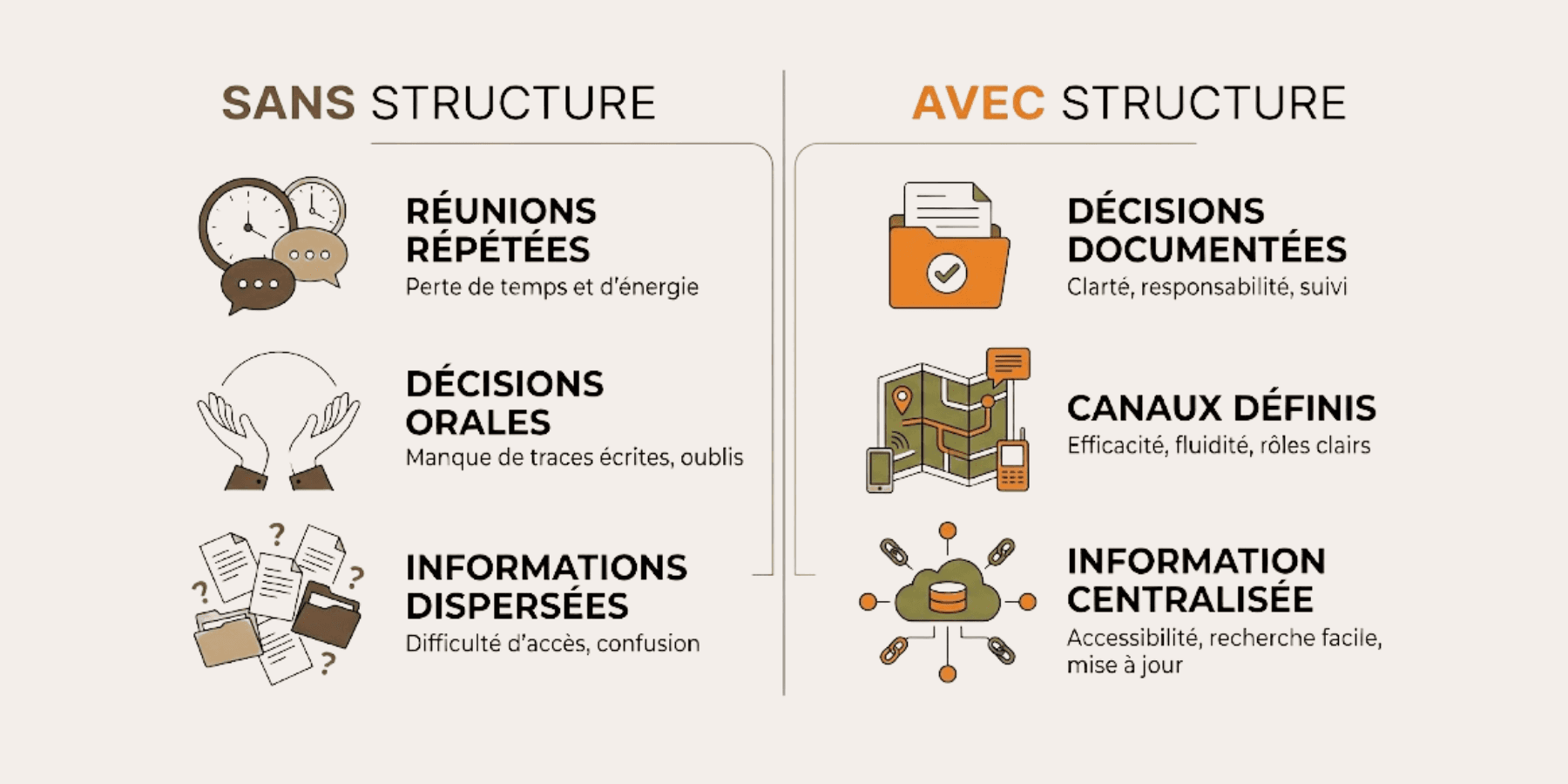
How many decisions are made each week in your team without being documented? A decision on the angle of an article, a change of priority on a campaign, a modification to the scope of a project: these decisions exist, but they leave no trace accessible to all those involved.
Without formalisation, these decisions have to be recalled, re-explained and sometimes re-decided. They generate uncertainty, misunderstandings and corrections that could have been avoided if everyone had access to the same level of information.
The symptoms of poorly organised communication
Meetings replacing processes
When communication processes are inadequate, meetings become the only way to sync teams up. A meeting is organised to find out how the project is progressing, another to sign off on content, and a third to unlock a situation that could have been resolved with a simple, well-structured message.
These meetings carry a real cost: they tie up several people at the same time and interrupt ongoing production. A team that spends more time syncing than producing has a communication problem, not a resource problem.
Misunderstandings that lead to rework
A misunderstanding about content expectations, target audience or the tone to adopt always results in rework. The creative team produces something consistent with what they understood, the approver expected something else and the corrections stack up.
These misunderstandings are not a sign of a lack of professionalism: they are a sign of insufficiently structured communication. When information is shared verbally, informally and without a written record, interpretations inevitably diverge.
How to organise your internal communication
Distingishing channels according to usage
Not all types of communication warrant the same channel. An important decision on a project should not be sent via instant messaging, where it will get drowned out by other messages. A brief should not be shared verbally in a meeting without being formalised in writing afterwards.
Defining which channel is used for which type of information helps to reduce noise and ensure that important information is accessible in the right place at the right time. Instant messaging for informal exchanges, a shared document for briefs and decisions, and a project management tool for tracking tasks.
Documenting decisions and briefs
Any decision that impacts production must be documented and accessible to all involved parties. This is not a bureaucratic constraint: it is a prerequisite for everyone to work with the same information and to keep misunderstandings to a minimum.
Documentation doesn't need to be complex. A short note summarising the decision, the people involved and the date is enough to create a shared record that anyone can consult if in doubt.
Internal communication and creative production
Aligning teams before producing
Effective creative production starts with aligning all stakeholders on the objectives, expectations and constraints of the project. This alignment doesn't happen in a meeting: it happens through a structured brief, shared and agreed upon by all stakeholders before production begins.
The stronger this alignment is upfront, the less need there is for corrective communication during production. Creative teams know exactly what they need to produce, and approvers know exactly what they need to evaluate.
Reducing interruptions during production
Every interruption during production has a cost. A question about content expectations, a request for clarification on a technical constraint, a reminder to get expected feedback: these interruptions fragment work time and reduce the quality of production.
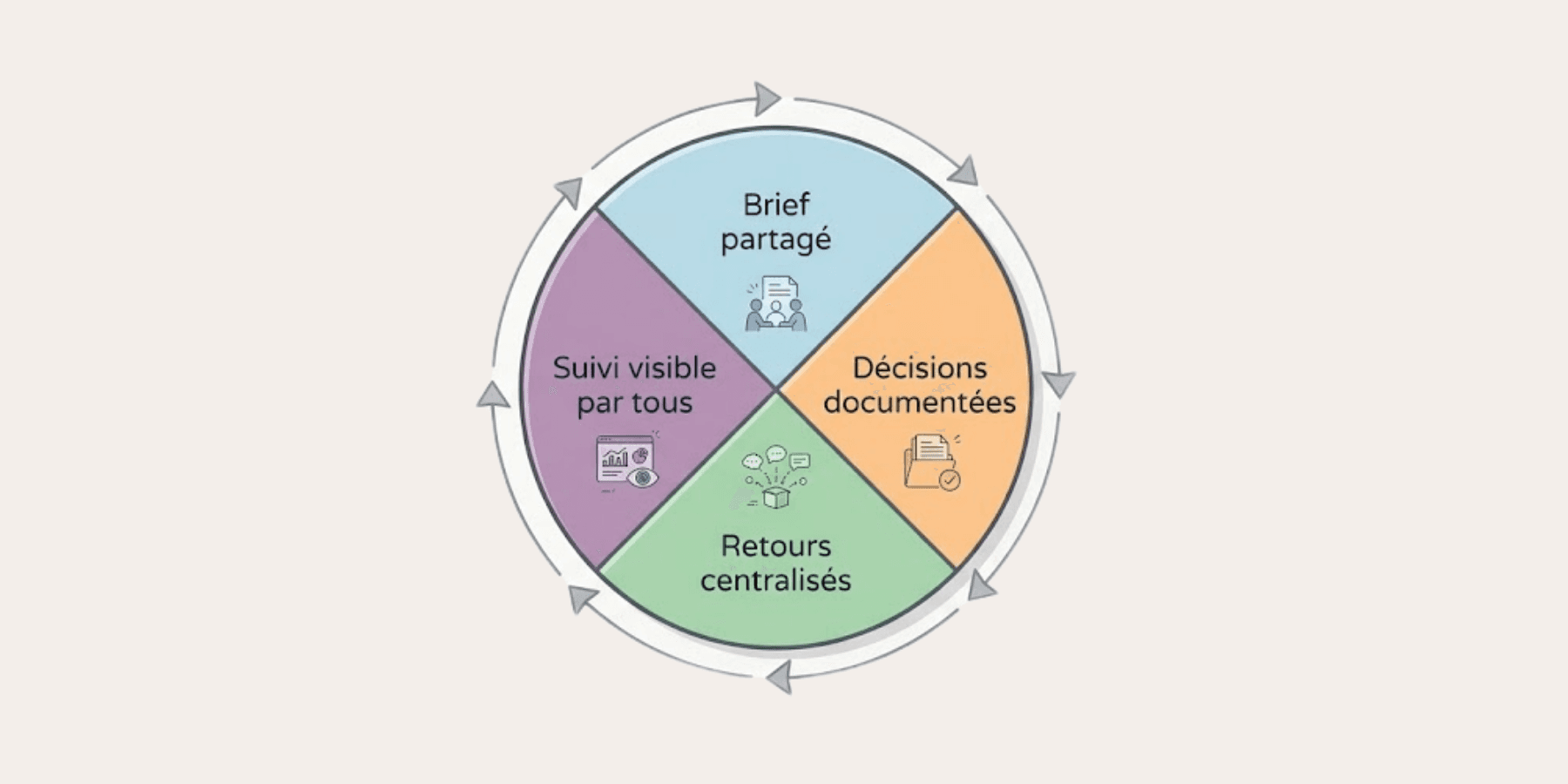
Structuring communication upfront, formalising briefs and centralising feedback allows us to drastically reduce these interruptions. The creative team has all the necessary information from the start and can focus on production without being constantly asked for clarifications.
Smartevo: centralising to communicate better
A shared environment for the whole team
Smartevo centralises all information required for production in a single environment accessible to all stakeholders: briefs, decisions, feedback and approvals are gathered in the same place, without being scattered across multiple tools.
This centralisation guarantees that every team member works with the same information, at the same time, without having to hassle their colleagues to get context they should have found directly in the tool.
Workflows that structure exchanges
Smartevo structures exchanges between stakeholders through predefined production workflows. Each step of the project automatically triggers the necessary communications: notification to the approver when content is ready, automatic reminder when feedback is overdue, status updates visible to the whole team.
This automation significantly reduces the time spent on manual follow-ups and sync meetings. Each stakeholder knows what to do and when, without having to ask the project manager for a status update.
Poorly organised internal communication isn't immediately obvious, but it slows down every project and drains teams. Distinguishing channels, documenting decisions and centralising exchanges are three concrete adjustments that transform how a team produces.
