Industry News
Step-by-step guide to writing a marketing brief

Step-by-step guide to writing a marketing brief
In marketing and communications teams, the success of a communications project almost always starts with a clear marketing brief. Yet in many organisations, projects begin with partial or scattered information. Learning to write a structured marketing brief helps align teams, improve collaboration and save time in content production.
Why the marketing brief is the foundation of a communications project
A marketing brief is a document that brings together all the information needed to launch a project.
It serves to explain the project objectives, expectations, constraints and context. This document then becomes an essential element in guiding marketing and creative teams.
Without a structured brief, requests are often interpreted differently by each stakeholder. This slows decision-making and can create unnecessary back-and-forth.
Analyses published by HubSpot show that the best marketing teams document their processes and strategy. This improves project consistency. It also strengthens the efficiency of campaigns.
The objectives of a marketing brief in a communications project
The objectives of a marketing brief are to clarify expectations and align stakeholders around a common framework.
A marketing brief makes it possible in particular to:
define the objectives of the project
specify the target audience
structure collaboration between the project manager and the creative team
facilitate decision-making
improve the quality of the deliverables
A structured brief thus becomes a genuine management tool for the communications project.
The key elements of an effective marketing brief
Project objectives
The objectives of a marketing brief must be clearly formulated. They may concern promoting a product or service, improving brand image or lead generation.
A marketing brief that is precise about objectives helps the creative team propose relevant solutions.
The target audience and personas
In a creative brief, defining the target audience is an essential element. This section describes the profiles targeted, their expectations and their behaviours. A well-constructed marketing brief therefore makes it possible to adapt the key message to the right audience.
The key message and positioning
The key message is another essential element of the marketing brief. It corresponds to the main idea that the campaign or content should convey.
In a creative brief, this message must be consistent with the brand image, the brand guidelines and the visual identity of the company.
Technical and organisational constraints
A marketing brief must also take certain technical constraints into account. This may include:
the content formats
the production schedule
the budget
the tools used by the communications agency or the internal team.
This information helps avoid mistakes when setting up the project.
How to write a marketing brief step by step
To write an effective marketing brief, it is recommended to follow a simple methodology.
1. Describe the project context
The first step in writing a brief is to explain the context.
This section presents the product or service, the market environment and the stakes of the communications project.
A structured brief thus allows each project manager to understand the request.
2. Define the project objectives
The project objectives must be measurable and precise.
They may concern awareness, engagement or lead generation.
In a marketing brief, these objectives guide the creative team's decisions.
3. Specify the expected deliverables
To write a creative brief, it is also necessary to specify the deliverables.
These may be videos, visuals, articles or campaigns on social media.
An example of a creative brief often includes a clear list of content to produce.
4. Identify constraints and deadlines
A marketing brief must indicate the deadlines and technical constraints.
This information enables the project manager to plan production.
A structured brief thus facilitates coordination between the internal teams and the communications agency.
5. Define performance indicators
The objectives of a marketing brief also include success indicators.
These may be the conversion rate, engagement or traffic generated.
In a brief example, these indicators make project evaluation easier.
Example of a marketing brief
Here is an example of a creative brief that could be used in a wide range of marketing and communications projects:
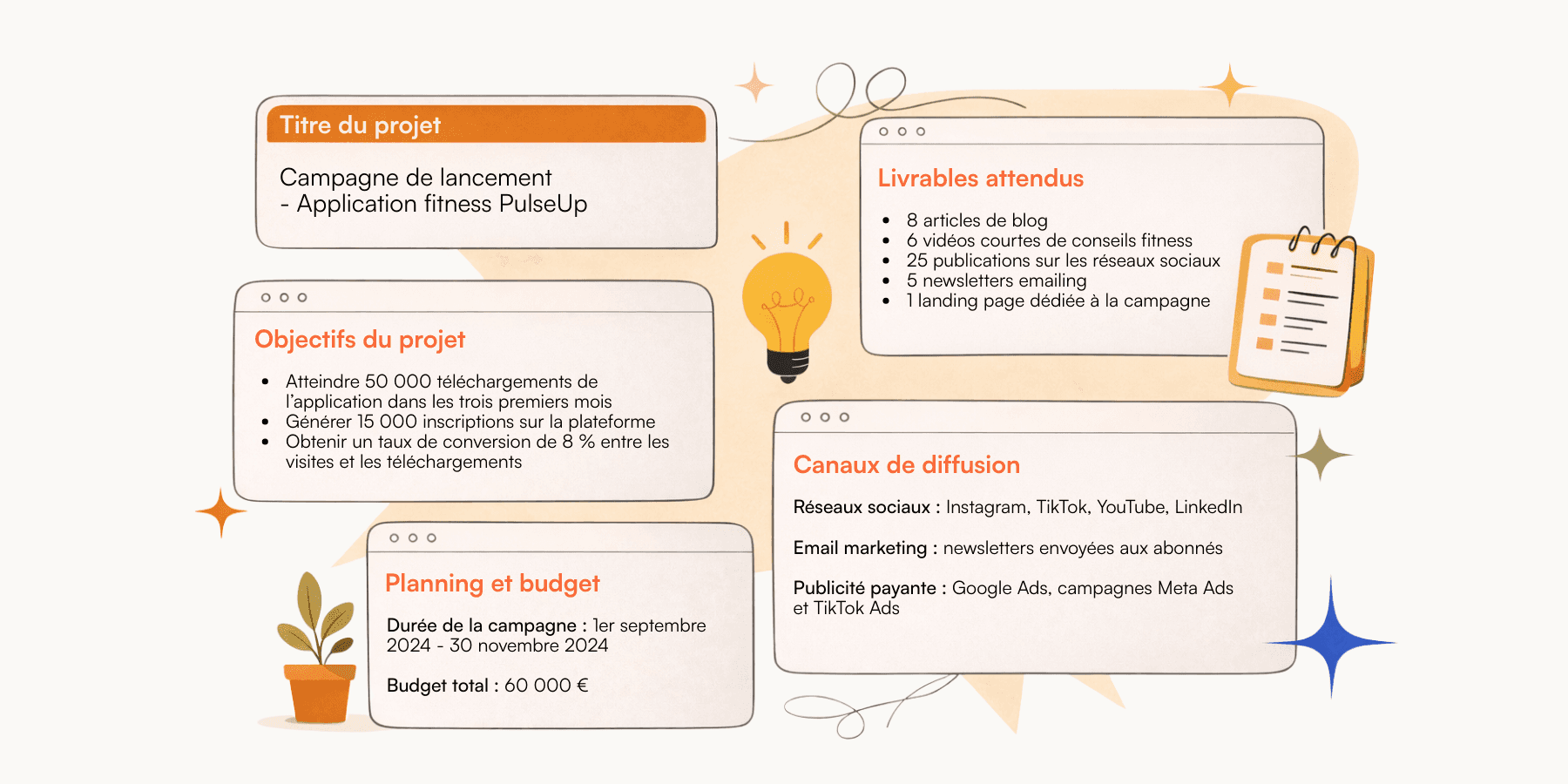
Project title
Launch campaign - PulseUp fitness app
Context
PulseUp is launching a new mobile app dedicated to fitness and wellbeing. The app offers personalised training programmes, performance tracking and nutritional advice.
The aim is to position the app as an accessible and motivating solution for people looking to get back into sport. The marketing campaign will need to build brand awareness and encourage app downloads.
Project objectives
Reach 50,000 app downloads in the first three months
Generate 15,000 sign-ups on the platform
Achieve a conversion rate of 8% between visits and downloads
Target audience
Demographic data
Adults aged 20 to 40, living mainly in urban areas.
Profile and behaviours
People wishing to improve their fitness, resume a sporting activity or follow a flexible training programme.
Usage behaviours
Regular users of mobile apps, active on social media and responsive to content related to wellbeing and health.
Campaign strategy
Content marketing
Creation of blog posts, practical guides and videos around sport, fitness and motivation.
Social media
Sponsored campaigns, collaborations with sports coaches and interactive posts (sports challenges, tips, testimonials).
Email marketing
Sending newsletters with fitness tips, training programmes and launch offers.
Expected deliverables
8 blog posts
6 short fitness advice videos
25 social media posts
5 email newsletters
1 landing page dedicated to the campaign
Schedule and budget
Campaign duration: 1 September 2024 - 30 November 2024
Total budget: €60,000
Key stages
1 September: launch of the campaign
15 October: interim performance analysis
30 November: campaign review
Brand voice and tone
Brand voice
Motivating, dynamic and accessible.
Editorial tone
Encouraging, positive and action-oriented.
Distribution channels
Social media: Instagram, TikTok, YouTube, LinkedIn
Email marketing: newsletters sent to subscribers
Paid advertising: Google Ads, Meta Ads and TikTok Ads
Structuring briefs to improve collaboration
In organisations where content production is intensifying, it becomes necessary to structure briefs.
Information often circulates between emails, documents and messaging apps. This dispersion complicates decision-making and slows projects.
Why use a template to write a marketing brief
In many companies, each project manager writes their marketing brief differently. This lack of a standard can complicate the management of a communications project.
Putting a structured brief template in place makes it possible to ensure that all the necessary information is present from the outset of the project.
When the key elements are clearly defined, the creative team can work more efficiently and propose solutions that are consistent with the visual identity and the brand image.
This approach also saves time and improves the quality of a marketing brief.
How Smartevo helps structure marketing briefs
In many companies, setting up a marketing brief process still relies on Word documents or shared files.
These formats make project tracking and collaboration between teams difficult.
The Smartevo platform makes it possible to set up structured brief templates directly in the tool.
Each project manager can therefore create a marketing brief from a standardised template.
These templates make it possible in particular to:
centralise the necessary information
structure the project objectives
integrate the brand guidelines and visual identity
track approvals from the creative team
This approach improves the quality of a brief and enables teams to save time in project management.
The benefits of marketing brief templates
The use of templates makes it easier to put a structured process in place.
A marketing brief template ensures that each project contains the necessary key elements.
This makes it possible in particular to:
improve collaboration between the project manager and the creative team
reduce back-and-forth
speed up decision-making
ensure brand image consistency
With suitable templates, it becomes easier to write an effective creative brief.

How to improve the quality of a marketing brief over time
To improve brief quality, certain best practices can be put in place. Standardising marketing brief templates helps avoid omissions and harmonise working methods.
It is also useful to centralise briefs in a single tool in order to facilitate collaboration. This organisation enables marketing teams to save time and produce more consistent content.
A marketing brief that is well structured is one of the pillars of a successful communications project. By clarifying the project objectives, constraints and deliverables from the outset, teams improve their efficiency and reduce unnecessary feedback. Thanks to brief templates and dedicated tools like Smartevo, it becomes easier to write a clear marketing brief. This brief is structured and really useful for creative teams.
