Industry News
Creative projects: maintaining brand consistency

Creative projects: maintaining brand consistency
At a time when content, whether videos, visuals or copy, is being rolled out across all communication channels, from digital to print, maintaining brand consistency has become a strategic issue. Every creative project shapes a company’s overall perception among its target audience and potential customers. Without a clear framework, the brand image can quickly fragment. Structuring processes and tools, by contrast, makes it possible to ensure lasting consistency and a strong brand image over the long term.
Why brand consistency has become a strategic issue
Brand consistency strengthens recognition
Strong brand consistency makes it easier for an audience to recognise a company. When visuals, messages and tone are used in a consistent way, the brand image becomes more recognisable across all communication channels, from the website to social media.
This continuity strengthens recall and creates a strong brand image in consumers’ minds. It also helps improve the customer experience at every touchpoint with the brand.
According to a McKinsey study, consistency across key customer journeys is a strong predictor of satisfaction and loyalty. Organisations that maintain a coherent identity over the long term strengthen their credibility and their conversion rate.
Editorial consistency improves credibility
Editorial consistency also plays a major role in how a brand is perceived. Stable communication, aligned with a clear editorial line, makes it possible to avoid contradictions between the marketing, communications and production teams.
This consistency helps improve brand image and strengthen customer trust around the products or services on offer. It sits at the heart of a solid and sustainable marketing strategy.

The challenges of brand consistency in managing creative projects
The multiplication of creative projects makes consistency harder
In many organisations, creative project management involves several teams: marketing, communications, design, audiovisual production or external agencies. Each campaign generates new content and multiplies approvals.
Without a common framework, these creative projects can quickly produce variations in tone, visuals or messages that weaken brand consistency. Alignment becomes difficult to maintain when content is not regularly updated.
In this context, it becomes essential to take into account all communication materials in order to ensure a consistent presence across all touchpoints with the audience.
Visual consistency becomes harder to maintain
When several teams work in parallel, maintaining visual consistency across materials becomes more complex. Logos, typefaces or colour palettes can evolve unconsciously from one project to the next.
Without clear and accessible brand guidelines, discrepancies multiply. The result is often a gradual dilution of the brand image, which weakens the company’s overall perception.
Maintaining brand visual consistency across all materials, from the website to advertising campaigns, then becomes a real organisational challenge.
Setting up an editorial line to guarantee brand consistency
Structure the editorial line and messages
The first step to maintaining brand consistency is to set up a clear editorial line. This defines the tone, values and key messages used in all communications.
This setup makes it possible to guarantee editorial consistency between marketing campaigns, social media posts and content produced for potential customers.
A well-defined editorial line also makes it possible to take into account the expectations of the target audience and to structure the content strategy over the long term.
Define the rules for visual brand consistency
Beyond messaging, organisations must formalise the rules of visual brand consistency. This includes the brand guidelines, colour palette, typefaces and logo usage.
These elements are essential benchmarks for producing content in a consistent way across all communication channels.
Resources such as those offered by Interbrand or Hubspot show that formalising these rules contributes directly to strengthening a strong, lasting brand image.
Organising creative project management to guarantee consistency
Centralise creative projects and approvals
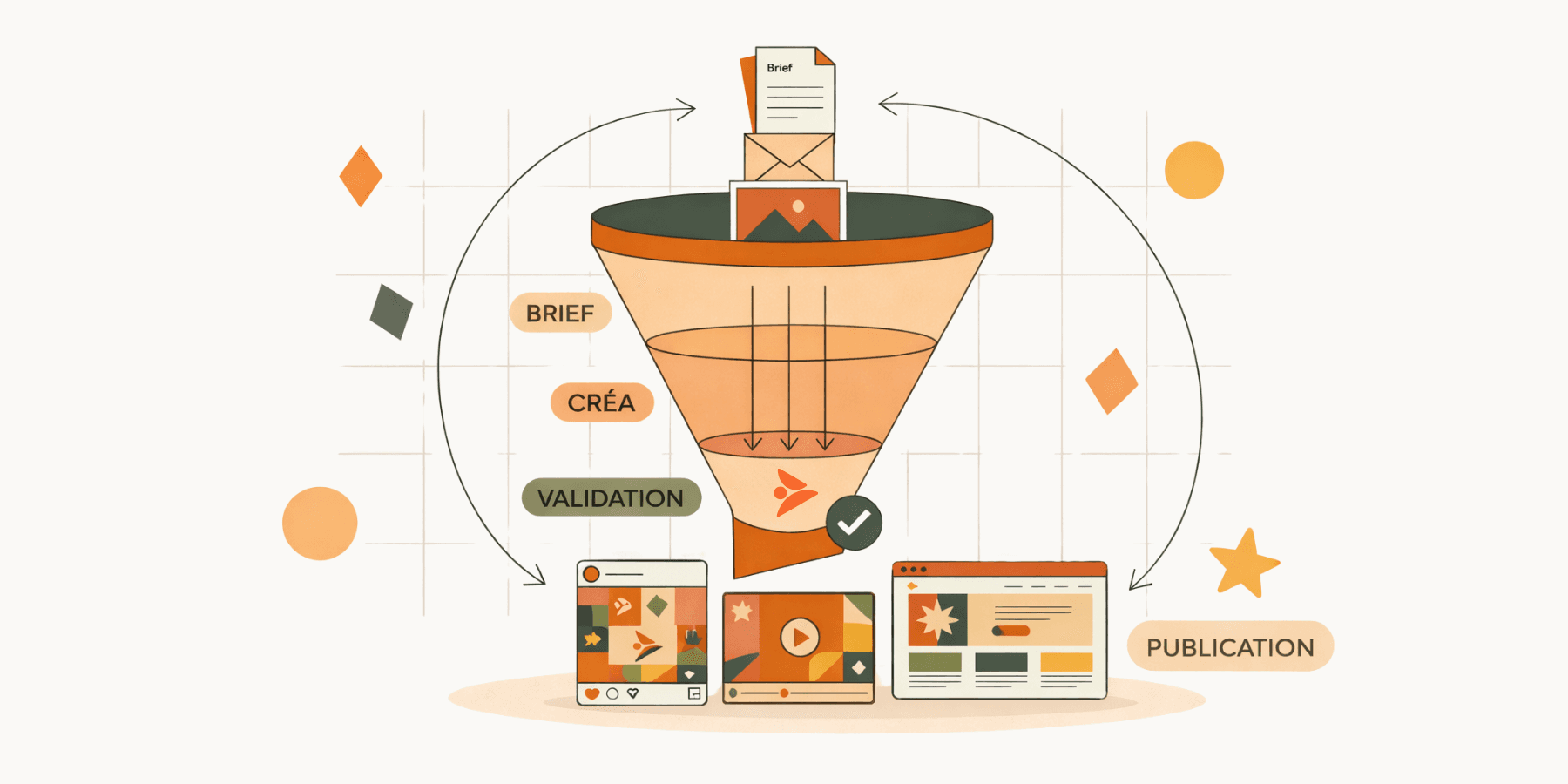
To maintain brand consistency, it is essential to structure creative project management. Centralising briefs, content versions and approvals makes it possible to avoid discrepancies between teams.
A clear organisation facilitates collaboration between the marketing, design and customer service teams, while ensuring an even distribution of messages across all touchpoints.
In this logic, dedicated platforms such as Smartevo make it possible to structure creative workflows and ensure precise monitoring of each project’s key stages.
Structure workflows to maintain consistency
The setting up of structured workflows helps guarantee visual consistency and editorial consistency throughout production. Each project stage can include checks linked to brand consistency.
This organisation improves collaboration between teams and reduces back-and-forth. It also helps secure approval of content related to the company’s products or services.
By structuring the key stages of creative production, organisations gain efficiency and strengthen the overall consistency of their marketing strategy.
Measuring and improving brand image over time
Track the impact of content on the brand image
Maintaining brand consistency also requires measuring the impact of campaigns. Performance analysis makes it possible to identify the content that truly strengthens the brand image.
Marketing teams can therefore adjust their actions and optimise their conversion rate while improving the customer experience.
This approach helps maintain a strong brand image that is consistent over the long term.
Evolve editorial consistency without losing identity
A brand must evolve to remain relevant. However, this evolution must preserve its editorial consistency and remain aligned with the company’s founding values.
Content must be regularly updated to reflect changes in the brand, while maintaining consistent communication across all communication channels.
This approach makes it possible to modernise communication while preserving a strong and lasting brand consistency.
Maintaining brand consistency across all campaigns and every creative project is not solely a matter of creativity. Above all, it is about organisation, methods and suitable tools. By structuring creative project management, defining a clear editorial line and centralising approvals, businesses can strengthen their strong brand image over the long term, improve the customer experience and optimise their marketing strategy over the long term.
