Industry News
Communication, marketing, media: the same creative challenge

Behind very different professions, communication, marketing, and media teams share a common challenge: organizing and steering creative projects without getting lost in dispersion. Tools change, formats vary, points of contact differ, but the organisational friction itself remains strangely similar from one sector to another.
Different professions, similar problems
Communication: steering projects at the crossroads of all professions
A communication team operates at the intersection of strategy, marketing, press relations, and creative production. It produces content for highly varied audiences, coordinates external service providers, and must maintain brand consistency across all media, whether it is a press release, a digital campaign, or an institutional event.
This cross-functionality is a strength, but it also generates significant organisational complexity. Creative projects in communication often involve many stakeholders with different working approaches, without a common framework always being defined to keep them moving forward together smoothly.
Marketing: a growing volume of content production
Marketing teams today produce considerable volumes of content: blog posts, newsletters, advertising campaigns, social media posts, landing pages, and sales collaterals. This high production pace makes coordination particularly critical: an incomplete brief or a flawed validation workflow immediately impacts the deadlines and quality of the deliverables.
Managing creative projects in marketing is all the more complex because it often involves back-and-forth exchanges between internal teams, agencies, and freelancers, each working with their own tools and habits, without always having a shared environment to centralise exchanges.
Media: short deadlines and multiple formats to coordinate
In media organisations, time constraints are omnipresent. Breaking news imposes often very short production deadlines, during which several formats must be produced simultaneously: articles, videos, podcasts, and social media content. This simultaneous nature of productions is one of the main sources of dispersion among media teams.
Added to this is the diversity of the profiles involved: journalists, videographers, graphic designers, and community managers. Making these profiles work together smoothly on the same creative project requires a clear organisational framework, without which each naturally tends to work in their own environment, to the detriment of overall consistency.
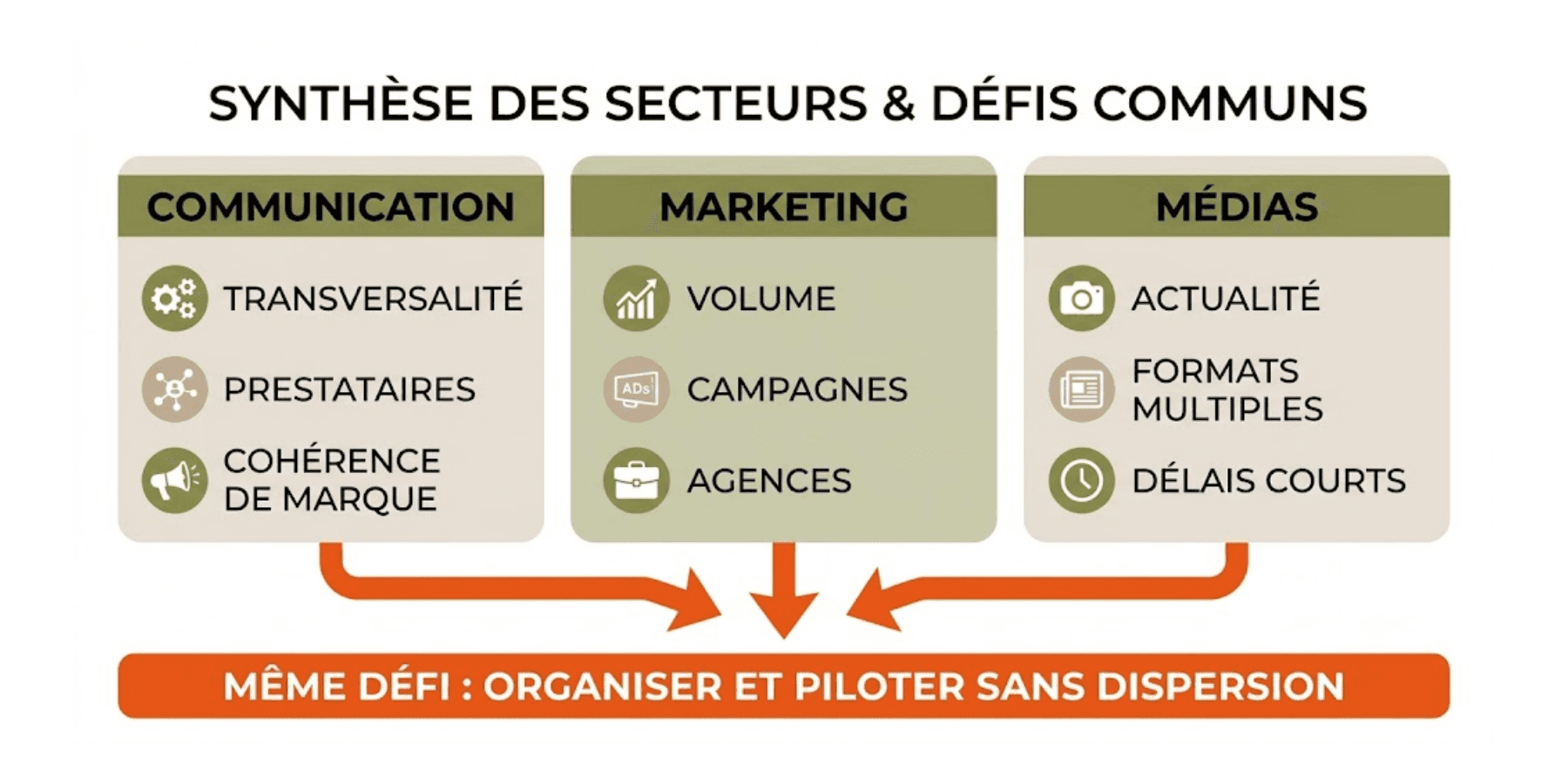
The common challenge: organising and steering creative projects without dispersion
Dispersion, the common enemy of all creative professions
Whether it is a marketing campaign, a communication plan, or an editorial production, dispersion always manifests in the same way: briefs that circulate poorly, feedback coming from everywhere, multiplying versions, and deadlines stretching out without anyone really understanding why. It is this organisational friction that costs creative teams the most.
This dispersion is not linked to the sector of activity or the type of content produced. It is linked to the lack of an organisational framework suited to creative team coordination. And it is precisely because it transcends sectors that the solutions to address it are also cross-functional.
Organising a creative project: the same fundamentals everywhere
Whatever the nature of the creative project, the same questions arise: who does what, by when, with what information, and according to what approval workflow? These fundamental questions of creative project management are identical whether you work in a communication agency, a B2B marketing team, or a press newsroom.
The answers may vary depending on the context, but the underlying needs are the same: a structured brief to align stakeholders, an annotation and approval process to secure quality, and progress tracking to steer creative projects without having to request updates from each stakeholder individually.
Centralisation as a cross-functional response
Faced with these common challenges, centralisation emerges as a cross-functional response. Centralising does not mean uniformising the practices of each profession: it means creating a shared environment where briefs, content, feedback, and approvals coexist, regardless of the specialty of the stakeholders involved.
This centralisation reduces coordination friction without forcing teams to abandon their tools or working methods. It simply creates a common point of reference that allows very different profiles to collaborate effectively on the same creative project.
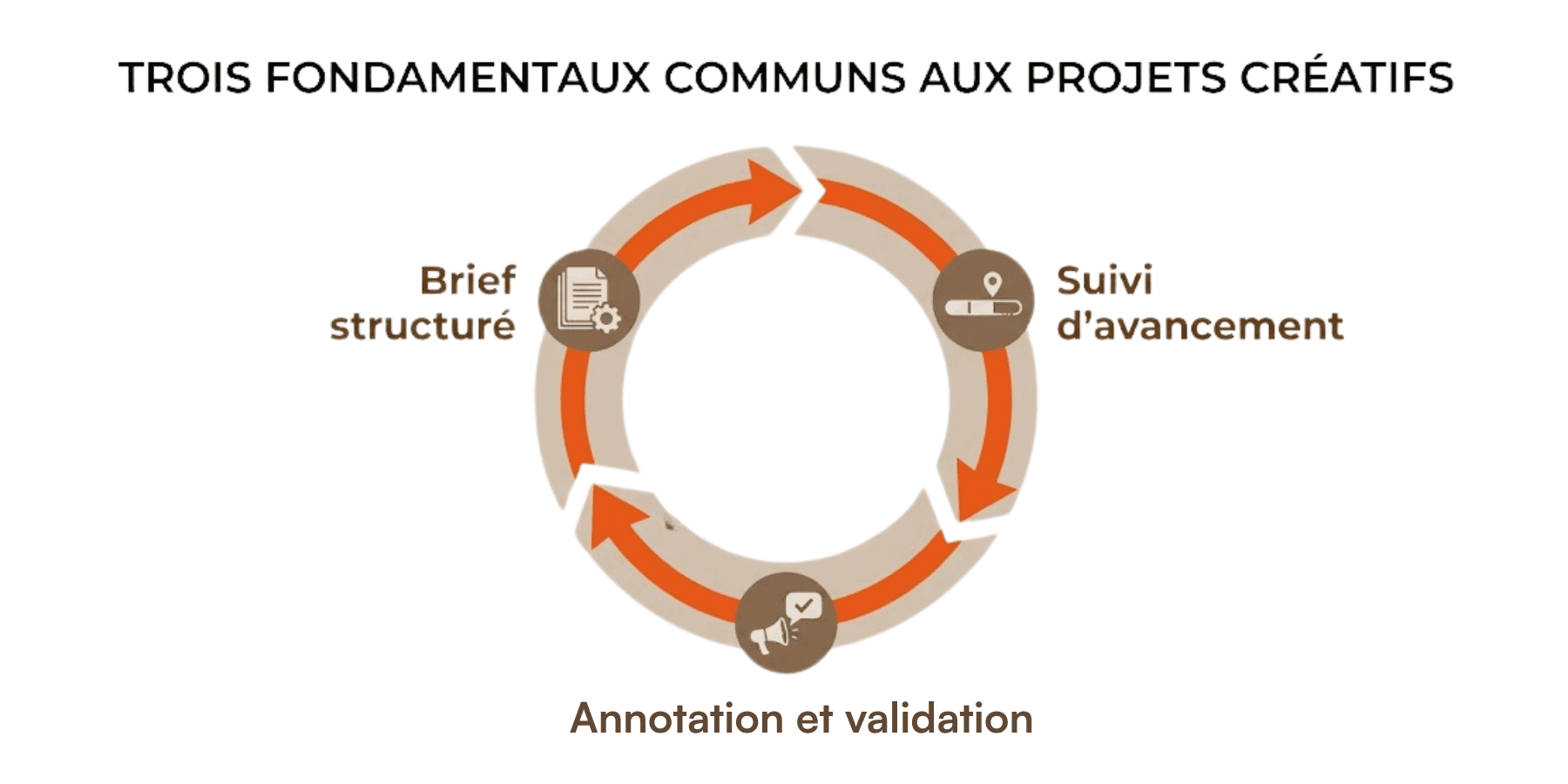
Smartevo: a platform designed for all creative professions
An environment adapted to the diversity of creative projects
Smartevo was designed to meet the needs of communication, marketing, and media teams steering creative projects in varied organisational contexts. The platform centralises briefs, projects, content, and reviews in a single and accessible environment for all stakeholders, both internal and external.
This versatility allows teams with very different profiles to adopt the same working framework, without the diversity of professions becoming an obstacle to the smoothness of collaboration on creative projects.
Simplifying the annotation and approval workflows for creative content
Smartevo simplifies annotation and approval workflows for creative content by centralising feedback directly on the relevant assets, with formalised and traceable approval routes. Each stakeholder knows at which stage they intervene, by when, and according to which criteria: this clarity of the process reduces unnecessary back-and-forth and accelerates production, regardless of the business sector or the type of content produced.
This is what makes Smartevo an answer to the common challenge facing all creative professions: not just another tool in the stack, but a shared organisational framework that allows each team to produce better, without getting lost in dispersion.
Communication, marketing, media: the professions are different, but the challenge is the same. Organising and steering creative projects without dispersion is the condition for teams to spend their time creating rather than coordinating.
