Industry News
Creative brief: the elements that are often forgotten

Creative brief: the elements that are often forgotten
The creative brief is often treated as a formality. It is written quickly between two meetings, a few elements are forgotten, and we assume the team will understand. Except that it is precisely these initial omissions that generate the most revisions, misunderstandings, and delays during production.
Why the creative brief is often incomplete
A step perceived as a formality
In many teams, the creative brief is drafted in a hurry because it is perceived as an administrative constraint rather than a working tool. There is a feeling of wasting time writing it when production could already have begun.
This perception is counterproductive. A well-constructed brief is not a constraint: it is the document that aligns all stakeholders before production even starts and avoids unnecessary back-and-forth later on.
The lack of a structuring template
Without a reference template, each brief is written differently depending on the person writing it and the project concerned. Some elements are present, others are not. The creative team never knows exactly what to expect from one project to another.
This lack of standardisation is one of the main causes of incompleteness. When there is no outline to follow, you inevitably forget essential information for the smooth running of the project.
The elements most often forgotten
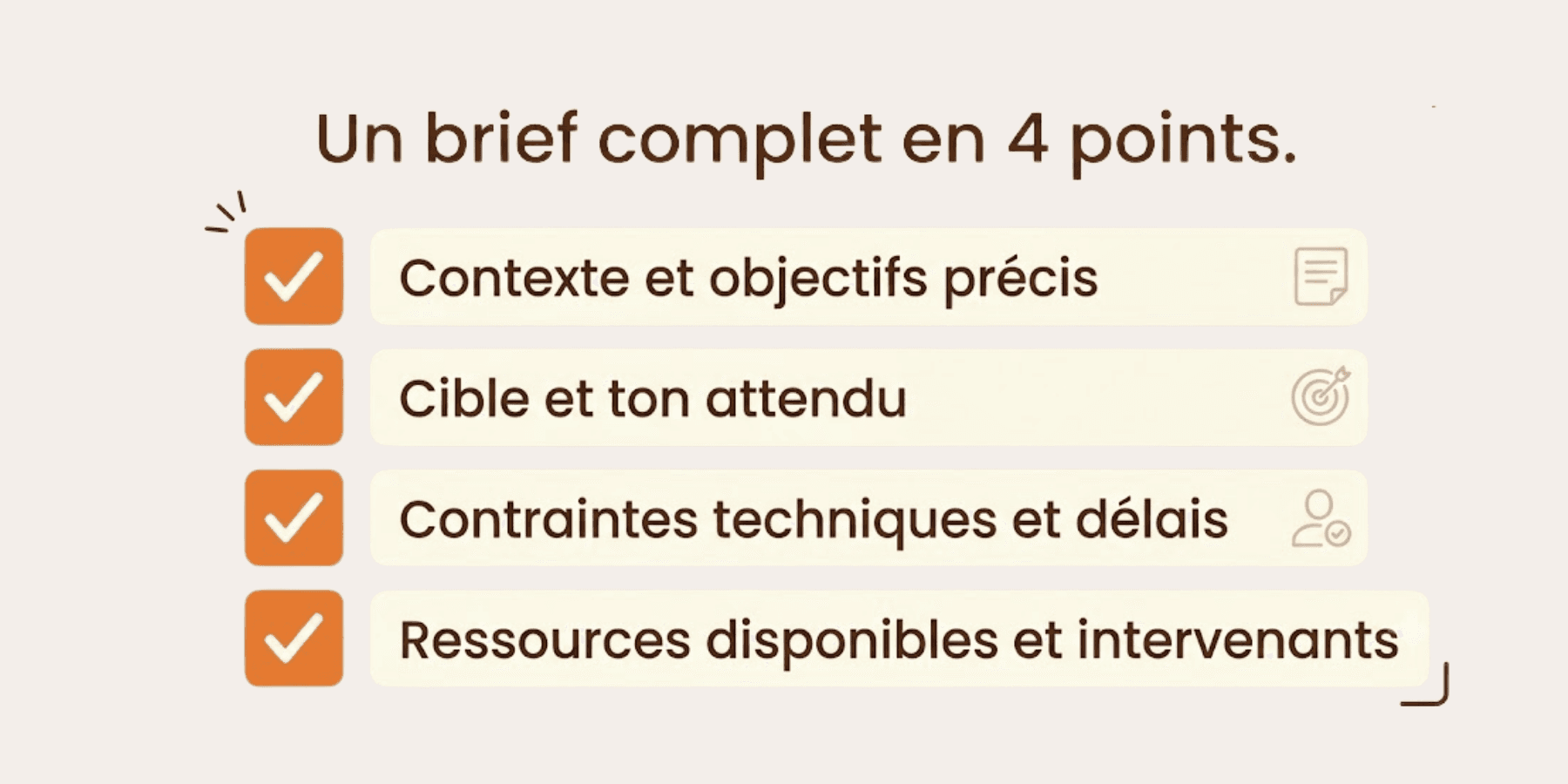
Context and precise objectives
Many briefs state what needs to be produced but not why. Yet without a clear context, the creative team cannot make the right editorial or visual choices. What problem is this content trying to solve? What concrete result is expected?
Vague objectives like "increase visibility" or "engage our audience" are not enough. You need precise and measurable objectives: generate leads, support a product launch, reduce the churn rate on a given segment.
The target audience and expected tone
Who is this content for? A B2B decision-maker does not expect the same tone as a community manager or a prospect in the discovery phase. Yet, the description of the target audience is one of the elements most often missing or too vague in briefs.
The expected tone is just as important. Corporate, educational, engaging, humorous: without clear guidance, each creative applies their own interpretation. The result is rarely aligned with the desired brand identity.
Technical constraints and deadlines
Format, dimensions, file size, planned variations, distribution channels: this technical information is often shared during production, when it is too late to integrate it without starting over. It should have been in the brief from the start.
Intermediate deadlines are also frequently forgotten. Informing only the final delivery date is not enough: you must specify when each stage must be delivered so that the project progresses in a coordinated manner.
Available resources and stakeholders
What resources can the team use? Are there existing visuals, brand identity elements, or reference texts? Who are the stakeholders involved and what is their role in the project?
This information seems obvious, but its absence forces the team to look for it during production. This is wasted time that could have been dedicated to creation.
What an incomplete brief really costs
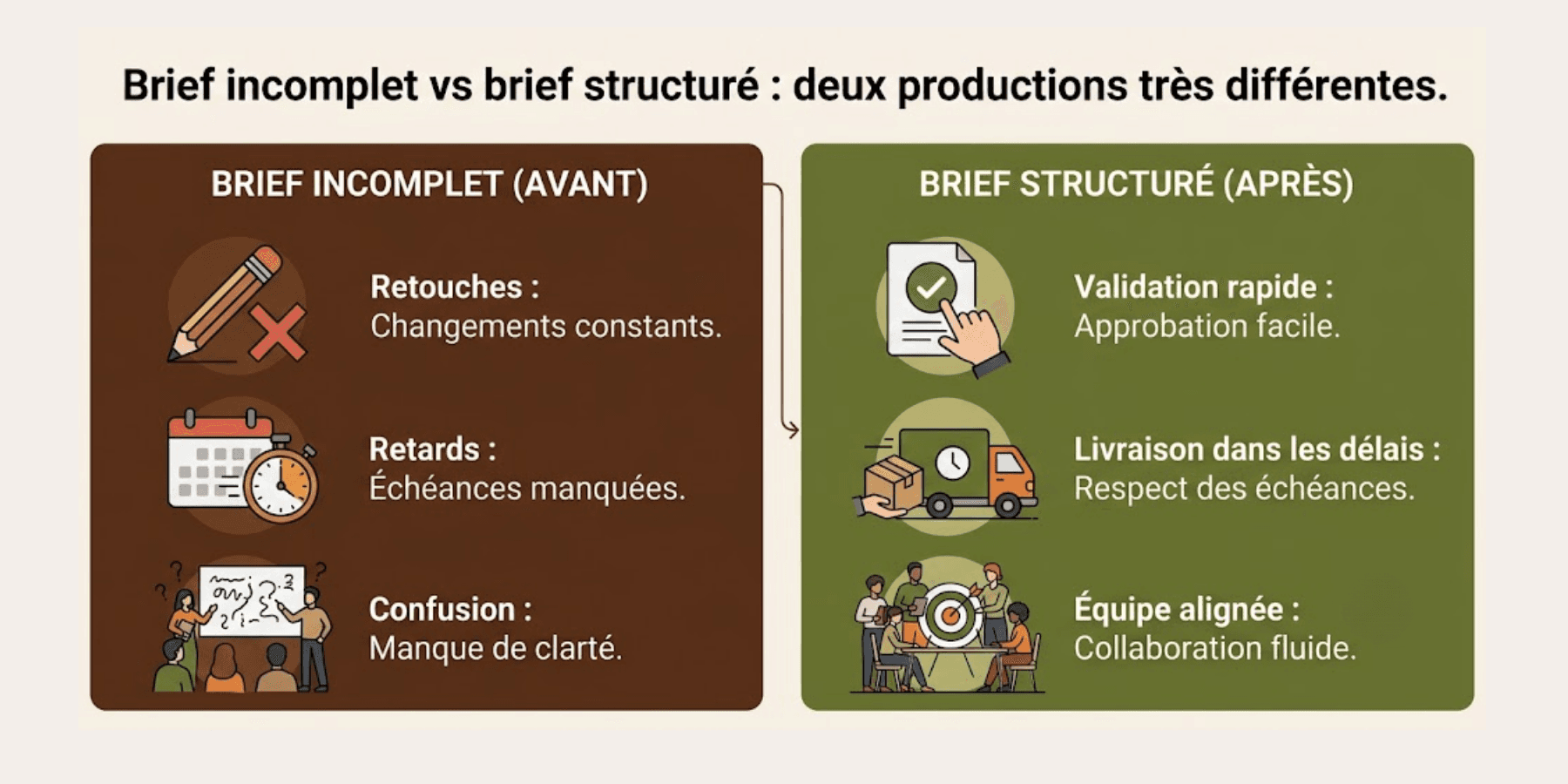
Cascade of revisions
Every missing element in the brief results sooner or later in a revision. A poorly defined angle generates a first version to be reworked. An unspecified tone leads to a complete rewrite. Technical constraints discovered too late impose a visual overhaul.
These revisions are not harmless: they take up time, energy, and damage the motivation of creative teams. According to Gartner's Marketing Technology Survey, 56% of CMOs cite poor briefs as one of the main barriers to marketing effectiveness.
A waste of time and motivation
Redoing the same work several times is exhausting. Creative teams that regularly receive incomplete briefs eventually lose confidence in the production process. They anticipate revisions rather than fully investing themselves in the first version.
This vicious cycle is avoidable. A rigorous brief from the start allows the team to focus on quality rather than corrections and to deliver content that meets expectations from the very first iteration.
How to build a solid creative brief
Standardise with a repeatable template
The most effective solution is to create a brief template with mandatory fields: context and objectives, target and tone, formats and technical constraints, stakeholders, and deadlines. This template must be used for all projects, without exception.
Standardisation does not stifle creativity, it unleashes it. When the framework is established, the creative team can focus their energy on what really matters: producing quality content rather than searching for missing information.
Approve the brief before launching production
A written brief is not necessarily an approved brief. Before starting production, it is essential to ensure that all stakeholders have read, understood, and approved the document. A ten-minute Q&A session can prevent days of revisions.
This collective approval ensures that everyone is heading in the same direction and that any potential disagreements are resolved before starting, not during production.
Smartevo: the brief at the heart of the project
Centralise and structure briefs
Smartevo allows you to create brief templates adapted to the needs of each type of project. Mandatory fields are defined upfront, information is centralised in a single environment, and each stakeholder can access it at any time.
This centralisation ensures that the brief remains the single source of truth throughout the project: no more versions scattered across emails or shared documents, and no more information lost along the way.
Link the brief to the production workflow
With Smartevo, the brief is not an isolated document: it is directly linked to the production workflow. Tasks, stakeholders, and approval processes flow naturally from the initial brief, without re-delivery or loss of information.
An incomplete creative brief is never harmless. It is the missing upfront information that generates revisions, delays, and tension during production. Standardising, completing, and approving the brief before launching: this is the first step toward efficient production.
