Industry News
Creative brief and workflow: boosting productivity

Marketing and communication teams are managing an increasing number of projects today. However, an incomplete brief or an ill-defined workflow is often enough to slow down production. Structuring these two elements saves time, improves the quality of work and streamlines projects.
What is a creative brief?
Why do projects get delayed?
Delays are not always related to the creation process itself. They often appear at the very beginning of the project when objectives are poorly defined or expectations are not clearly expressed.
Teams then spend time clarifying requests, looking for information or redoing deliverables that do not meet the initial needs.
In many organisations, information is scattered across multiple emails, documents or meetings. This dispersion slows down project kickoff and increases the risk of error.
The more teams have to search for the necessary information, the longer the deadlines become.
Definition of the creative brief
The creative brief is a document that helps formalise a request before starting a project. It gathers all the information required to complete a creative project.
Specifically, it groups objectives, target audience, key messages, expected formats, available resources and potential constraints.
Its goal is to align all stakeholders around a shared vision and avoid misunderstandings right from the project launch.
Why is the brief essential?
Without a structured brief, each participant interprets the request in their own way.
Creative teams then have to request additional information, which creates back-and-forth loops, slows down production and increases the risk of error.
A well-built brief also helps to better allocate responsibilities and provide a clear framework for the project.
It also contributes to improving the quality of work by providing everyone with a precise view of expectations.
The brief is the starting point of the workflow
A creative brief does not just serve to launch a project. It forms the foundation upon which the entire workflow will rely.
When information is complete from the start, teams can produce faster, collaborate more effectively and limit unnecessary revisions.
The workflow then becomes smoother, as each participant knows precisely what they need to do.
The key elements of a good creative brief
Project objectives
The brief must clearly explain why the project exists and what results are expected.
Precise project objectives facilitate decision-making throughout the project and make it easier to evaluate its success. They also serve as a reference to measure the results obtained after publication.
The target audience
Identifying the precise target audience helps teams produce more relevant content.
This step also allows them to adapt the tone, messages and communication formats.
A good understanding of the audience improves the overall efficiency of the produced content.
Expected deliverables, deadlines and resources
The brief must detail the content to be produced as well as the associated constraints: formats, dimensions, variations, distribution channels or mobilised resources. It must also specify deadlines to enable teams to organise themselves effectively.
This visibility facilitates the distribution of the workload, improves time management and secures publication dates. Clear planning limits urgent situations, reduces the risk of misunderstandings and contributes to better project management.
Why are creative briefs often ineffective?
Incomplete information from the raw start
Many projects start with rushed requests, without a real working framework.
Teams then have to search for the required information from different stakeholders before they can start production. This situation slows down the project from its very first stages.
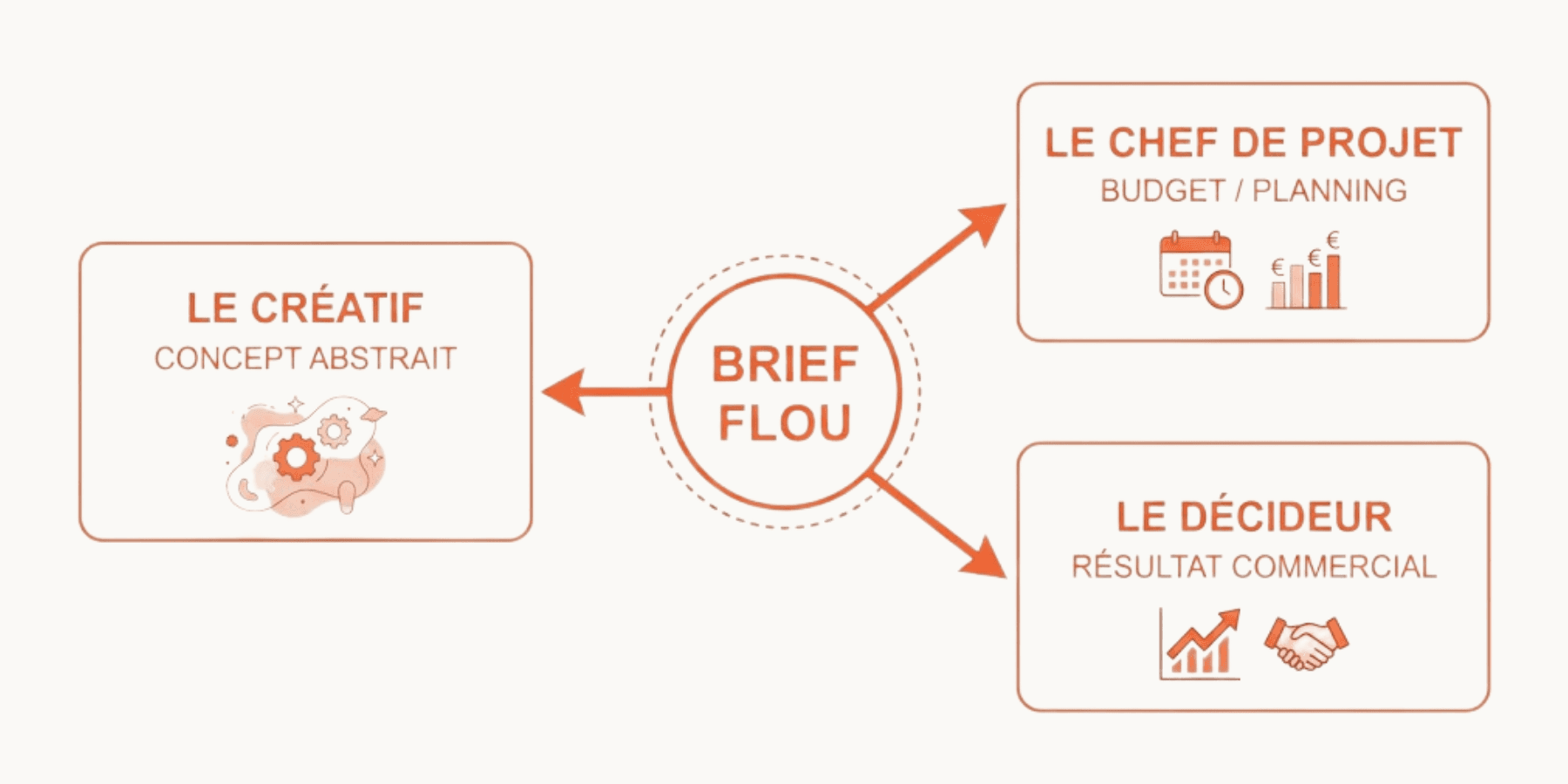
Sometimes misaligned expectations
Creatives, project managers and decision-makers do not always share the same vision of the expected result.
This lack of alignment often generates additional corrections and extends delivery times. Teams then spend more time correcting than creating.
Why is the brief alone no longer enough?
Projects involve many stakeholders
Today, a project often mobilises marketing, communication, creative and management teams, and sometimes external partners.
Even with an excellent brief, co-ordination becomes difficult if the workflow is not clearly defined.
Project managers then play a central role in coordinating teams and ensuring that each step progresses in accordance with the set objectives.
Approvals often slow down projects
Feedback sometimes arrives via email, instant messaging or during meetings.
This dispersion complicates the tracking of corrections and extends approval timelines.
Content can then remain stuck for several days before receiving a response.
Bottlenecks slow down projects
Even when a creative brief is well structured, some projects get delayed because of organisational roadblocks.
Late approvals, hard-to-find files or conflicting feedback considerably slow down project progress and reduce team productivity.
Poor communication creates errors
Scattered exchanges across emails, meetings and instant messaging complicate request tracking.
Creative teams then spend more time searching for information than producing high-value content.
This situation directly impacts the quality of work and team satisfaction.
What is a workflow?
Definition of workflow
A workflow corresponds to the set of steps that move a project forward from its creation to its delivery.
It specifies who intervenes, at what moment and according to which validation rules.
Each actor thus knows their role in the progress of the project.
The benefits of a structured workflow
A well-defined workflow improves visibility over projects.
Teams know what they need to do, managers can track progress and decisions are made faster.
This organisation also promotes better time management by limiting interruptions, reminders and redundant tasks.
Teams can thus focus more on high-value-added activities.
Better visibility over projects
A structured workflow makes it possible to track project progress in real time.
Managers have a clear view of current tasks, pending approvals and upcoming deadlines.
This visibility also helps project managers better allocate resources and anticipate potential delays.
Easiest processes to improve
When the different steps of the workflow are formalised, it becomes easier to identify bottlenecks.
Teams can then adjust their working methods in a continuous improvement approach.
Processes become more efficient over time.
Why do social media networks increase project complexity?
Producing more content
Companies today must create content for numerous channels: website, newsletters, campaigns, videos and social media.
This multiplication of formats mechanically increases the workload of teams. Brands must also feed several social media platforms simultaneously. This increase in production volume makes coordination more demanding.
Adapting content for each channel
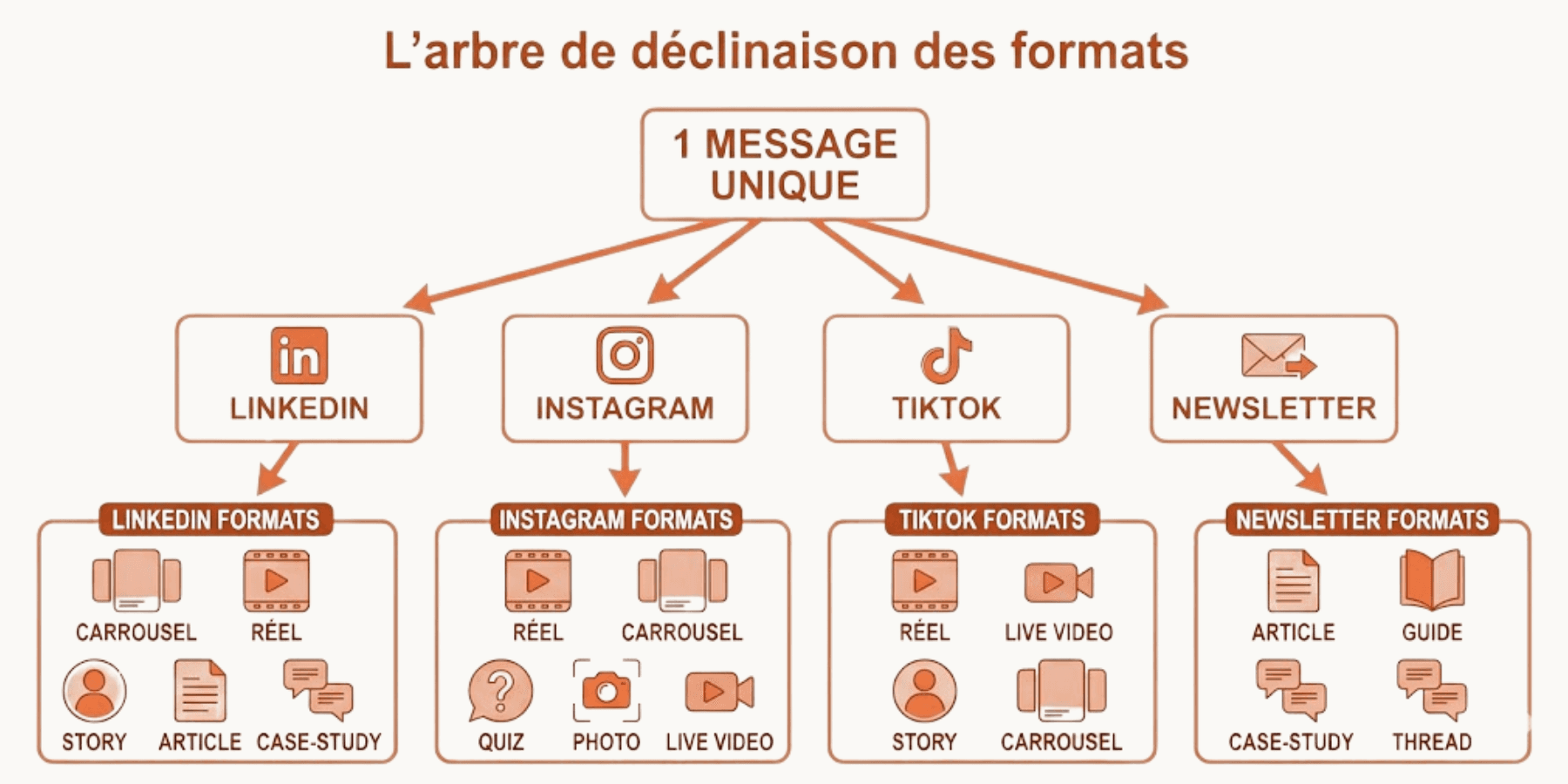
The same message must often be adapted for LinkedIn, Instagram, Facebook or TikTok.
Teams must therefore manage multiple versions of the same content while maintaining overall consistency.
How do the brief and workflow improve productivity?
Reducing back-and-forth loops
When expectations are clearly defined in the brief and steps are structured in the workflow, corrections decrease.
Teams save time and devote more working hours to producing content rather than clarifying requests.
Fluidifying collaboration and speeding up approvals
A shared working framework facilitates exchanges between the different stakeholders by making information more accessible and decisions quicker to make. This organisation improves the quality of work by limiting misunderstandings and loss of information.
Approval paths also allow to clearly identify approvers and track each step of the process. Content thus progresses faster towards its final publication, deadlines are better controlled and teams become more reactive.
Reducing administrative burden
A structured workflow also helps limit repetitive tasks related to chase-ups, tracking approvals or searching for information.
Teams can thus spend more time on creation and strategy.
Best practices for building an effective workflow
Mapping project steps
The first step consists of precisely identifying all phases of the project: brief, creation, approval, corrections and delivery.
This mapping allows the process to be visualised as a whole and helps better allocate responsibilities.
Standardising certain tasks
The most efficient workflows rely on repeatable processes.
Brief templates, project statuses or approval paths help prevent oversights and improve consistency across projects.
Centralising information
All content, comments and approvals must be grouped in a single space.
This centralisation reduces the loss of information and facilitates collaboration between internal teams and external partners.
Structuring creative feedback
Feedback must be precise, contextualised and easily accessible.
Annotations directly on the content help limit ambiguity and accelerate corrections.
Measuring workflow effectiveness
Tracking production timelines
Analysing timelines helps identify steps that slow down projects.
Teams can then adjust their organisation to save time on future productions.
Evaluating work quality
A high-performing workflow does not only target speed.
It also contributes to improving work quality thanks to better coordination and more structured approvals.
Automation supporting productivity
Reducing repetitive tasks
Chase-ups, status changes or notifications can be automated.
This automation allows teams to dedicate more working time to missions with higher added value.
Facilitating project management
Automation improves visibility over project progress and limits oversights.
Teams gain efficiency while maintaining better control over their processes.
How does Smartevo help teams boost productivity?
Structuring briefs
Smartevo allows to create brief templates adapted to the needs of marketing and communication teams.
Requests are more complete, more consistent and easier to process.
Teams thus have all the necessary information right from the project launch.
Organising workflows
Teams can define their steps, statuses and approval paths directly in the platform.
Each project thus follows a clear and shared process.
Centralising content and approvals
Smartevo allows teams to find briefs, content, annotations and approvals in the same place.
Information remains accessible throughout the project, which improves visibility and limits errors.
Streamlining creative workflows
Thanks to customisable workflows, each organisation can adapt its operations to its own needs.
Teams gain efficiency while retaining the flexibility required for content creation.
Reducing production timelines
By centralising exchanges and approvals, Smartevo limits time wasted switching between tools.
Projects progress more quickly and teams have better visibility over their priorities.
This organisation saves time while improving work quality and the overall performance of marketing and communication teams.
An effective creative brief is not limited to describing a request. Combined with a structured workflow, it saves time, improves work quality and streamlines project management. By centralising information, approvals and content, marketing and communication teams become more productive and better organised.
