Industry News
Creative team: how to reduce back-and-forth

Creative team: how to reduce back-and-forth
In most creative teams, back-and-forth cycles are seen as inevitable. We produce, we correct, we re-correct, sometimes indefinitely. Yet, it is not that creatives lack talent or that clients lack good will. It is the processes that are lacking: poorly defined expectations, scattered feedback, and endless review cycles that could have been avoided.
Why back-and-forth cycles accumulate
Poorly defined expectations from the start
The majority of back-and-forth cycles originate in the brief. When expectations are not clearly formulated beforehand, each stakeholder develops their own interpretation. The creative produces something consistent with their reading of the brief, the approver expects something else, and the corrections keep coming.
This is not a skills problem: it is a framing problem. Precise and shared expectations from the start mechanically reduce the number of review cycles on each project.
Scattered and contradictory feedback
An email from the marketing manager, a voice comment in a meeting, an annotation on a printed PDF, a message in instant messaging: when feedback arrives through different channels, the creative team finds itself putting together a puzzle of sometimes contradictory instructions.
This fragmentation of feedback is one of the most common causes of unnecessary revisions. Without a single source of truth, some requests are forgotten, others misunderstood, and the content has to be reworked multiple times to integrate all the corrections.
The real cost of back-and-forth
Wasted production time
Each back-and-forth cycle mobilises the time of several people: that of the creative who retakes their work, that of the approver who will reread the new version, and that of the project manager who coordinates the exchanges. According to Ziflow, 52% of marketing teams review content between three and five times before considering it final.
This cumulative time spent on reviews is that much less time dedicated to creating new content. Over a whole year, back-and-forth cycles represent a considerable volume of work that could be greatly reduced with the right processes.
A progressive demotivation of creative teams
Redoing the same work several times without understanding why is exhausting. Creative teams that go through endless review cycles eventually lose confidence in their work and in the validation process. They invest less in the first version because they anticipate corrections anyway.
This demotivation has a direct impact on the quality of deliverables. A creative who knows that their work will be reworked anyway does not produce at the same level as a creative whose feedback process is clear and structured.
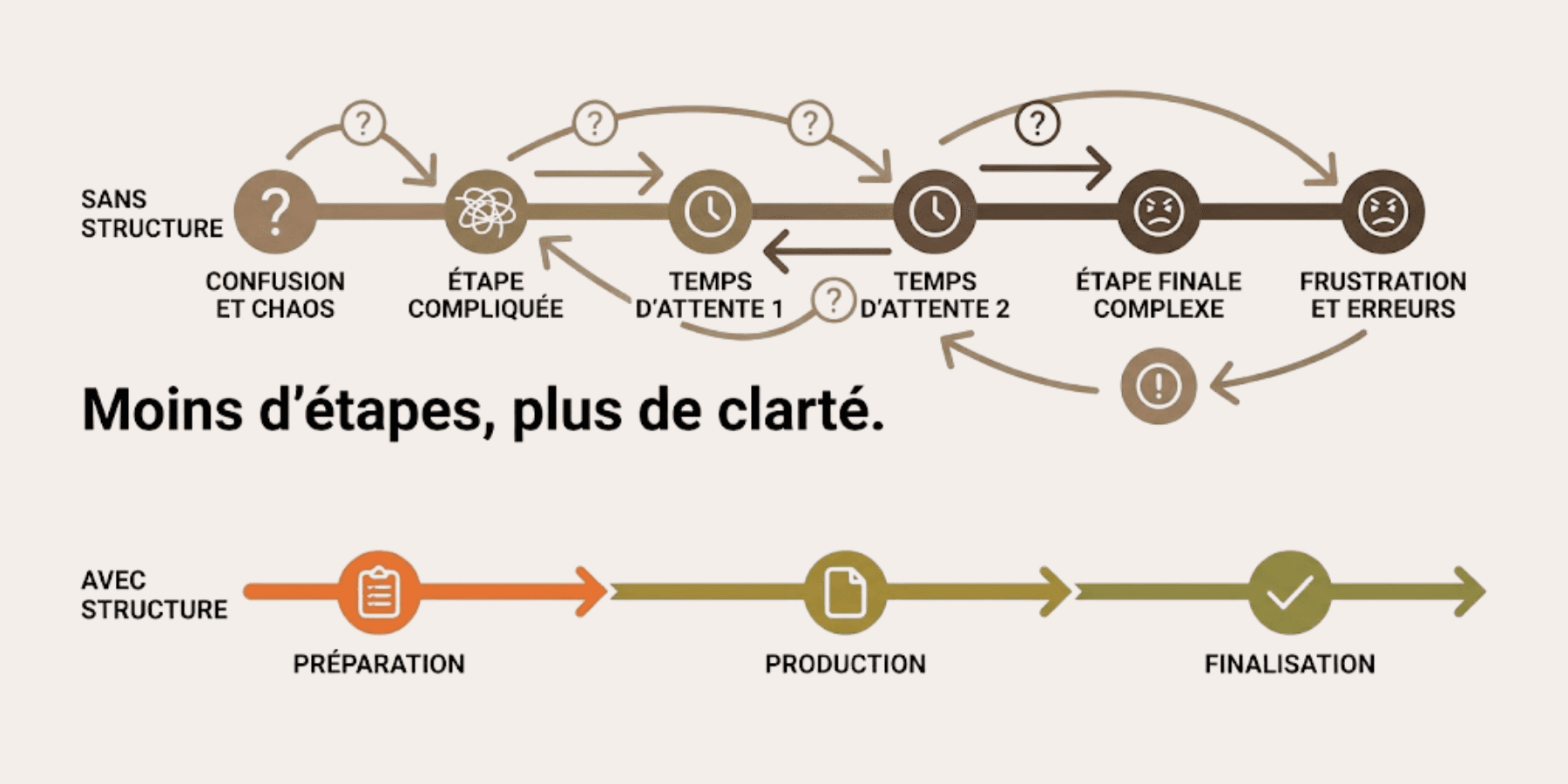
The levers to reduce back-and-forth
Frame expectations before starting
The first lever is the brief. A complete brief with precise objectives, a defined target audience, an expected tone, and clear technical constraints considerably reduces the number of corrections on first drafts. What is clarified upfront does not need to be corrected along the way.
It is also useful to share visual or editorial references before launching production. Showing examples of what we are looking for, and what we are not looking for, allows us to align expectations unambiguously.
Centralise feedback on a single channel
Imposing a single place for all comments is one of the simplest and most effective adjustments. Regardless of the role of the person providing the feedback: all comments must arrive at the same place, in the same format, and at the same time.
This centralisation eliminates contradictions, reduces omissions, and allows the creative team to process all feedback in a single pass rather than juggling between multiple sources of scattered information.
Limit the number of approvers
The more approvers there are, the higher the risk of contradictory feedback. Each person involved in the validation brings their own sensitivity, their own priorities, and sometimes their own contradictions with other feedback.
Defining beforehand who validates what and in what order helps to streamline the process. A lead approver who consolidates feedback before passing it on to the creative team considerably reduces the complexity of review cycles.
Structuring the feedback process
Defining what actionable feedback is
Good feedback is not a subjective appreciation. "I don't like it" or "it's not what I wanted" do not help the creative team understand what needs to change and why. Actionable feedback specifies what is causing the problem, why, and what is expected instead.
Training approvers to formulate precise and constructive feedback is an investment that pays off quickly. Less time spent interpreting vague comments, fewer intermediate versions, and deliverables that meet expectations by the second iteration.
Formalising review cycles
How many review cycles are planned for this project? At what point should feedback be sent? These questions must be answered before production starts, not along the way.
Formalising the number of allowed review cycles helps to make approvers accountable: they know they have two opportunities to formulate their feedback and that they must consolidate it before sending it. This constraint improves the quality of feedback and reduces superfluous back-and-forth.

Smartevo: streamlining creative collaboration
Centralising annotations and feedback
Smartevo centralises all feedback and annotations in a single environment, directly on the content in question. Each comment is contextualised, timestamped, and assigned to its author, which eliminates ambiguity and makes it easier for the creative team to process corrections.
This centralisation ensures that no feedback is lost along the way and that the creative team has a complete and consistent view of all modification requests.
Tracking review progress in real time
Smartevo allows you to track the progress of each review cycle in real time. Statuses are updated at every stage: awaiting feedback, in progress of correction, awaiting final validation. Each stakeholder has precise visibility on the project's progress without having to ask the creative team for an update.
Back-and-forth cycles are not inevitable: they are the symptom of an insufficiently structured process. Framing expectations, centralising feedback, and formalising review cycles: these are three simple adjustments that profounding change how a creative team works.
