Industry News
Content recycling: "doing better with less"

Content recycling: "doing better with less"
Content overproduction saturates the web and exhausts marketing teams without guaranteeing better results. To work more efficiently, businesses must learn to make better use of what they already produce. Content recycling then becomes a key driver for "doing better with less" and sustainably improving content performance.
Why is content recycling becoming essential?
Content overproduction exhausts teams
Content overproduction pushes many businesses to operate like a true content factory. Teams churn out blog posts, content and newsletters without always taking the time to make use of what already exists.
This approach ends up draining resources and reducing the overall quality of digital content. Adopting a "less is more" approach, by contrast, makes it possible to do better with less and focus efforts on more sustainable, higher-performing content.
Content production is reaching its limits
Marketing teams now have to produce ever more content: blog posts, videos, white papers, newsletters, LinkedIn posts and email campaigns.
This multiplication of formats increases the workload and often pushes teams to produce under pressure. Yet creating more and more does not necessarily guarantee better results.
In many businesses, content is published once and then forgotten, even though it could still generate visibility and traffic.
Why does doing better with less become a priority?
Faced with pressure on budgets and resources, businesses are now looking to do better with less.
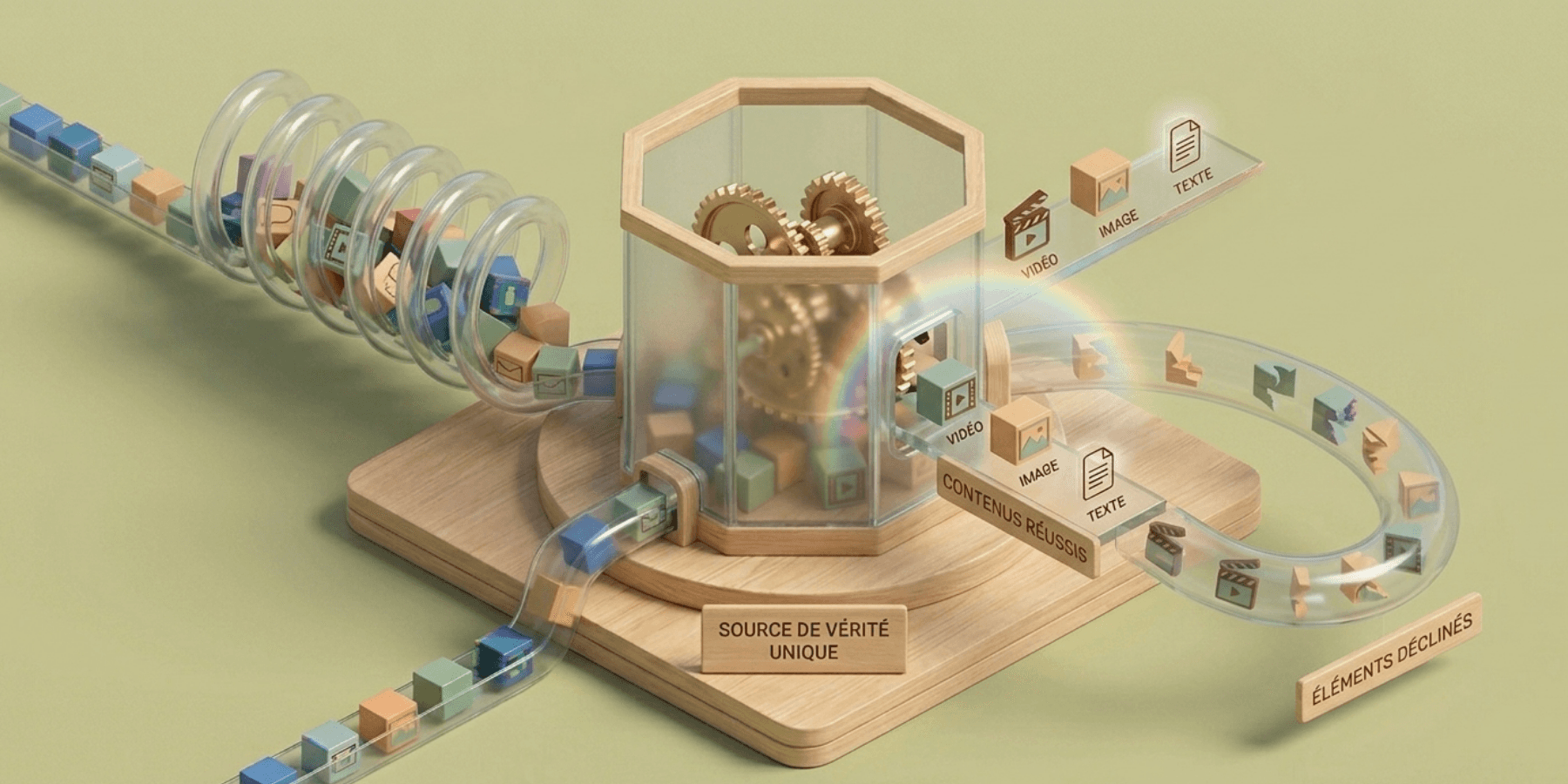
The aim is no longer to produce more, but to make better use of existing content. A blog post can become a social media post or a section in a newsletter, for example.
This approach helps reduce production costs while extending the lifespan of content. It also helps teams save time and put in place a more sustainable content strategy.
Turning content into long-term assets
Every piece of content produced represents an investment of time, budget and expertise. Recycling makes it possible to turn this existing material into long-term assets capable of feeding multiple communication channels.
This approach helps teams build on content that has already been approved, while ensuring greater editorial consistency. Each type of content can therefore be designed as a resource that can be reused over the long term. Businesses can then make a better return on their production efforts and limit the pressure linked to the constant creation of new content.

How to recycle content effectively
Repurpose content into multiple formats
Content recycling is not just about republishing old content. It is about turning the same topic into several types of content tailored to different target audiences and different distribution channels. Content recycling means adapting the same idea into multiple formats.
A white paper can become several blog posts, a video can be cut into snippets for social media and a webinar can be turned into a newsletter. This adaptation makes it possible to reach several audiences without starting from scratch each time.
Adapt the message to each channel
Recycling content does not mean copying and pasting. Each format must be adapted to the distribution channel, the expected tone and the audience's level of attention.
A LinkedIn post will not be structured in the same way as an SEO article or a video. This adaptation keeps the message relevant while improving engagement. A social media post, an SEO article or a video do not meet the same expectations and must follow a consistent editorial line.
Identify the content that deserves a second life
Not all content needs to be recycled. Teams must first identify content that is already performing well: pages that generate traffic, well-ranked articles, case studies, webinars or posts that attract a lot of engagement.
These are often the pieces of content with the greatest potential for reuse. By relying on performance data, businesses can focus their efforts on the most useful and most profitable content.
Why recycling improves search engine optimisation
Update existing content
Search engine optimisation does not depend solely on novelty. Updating an already well-ranked article can be more effective than publishing new content.
Businesses can enrich the information, add recent figures, improve keywords or rework meta descriptions. This update helps keep the content relevant in search results. It also helps improve its SEO and the site's search engine optimisation over the long term.
Strengthen internal linking
Recycling also makes it possible to create more links between content. By creating multiple formats around the same topic, teams can strengthen internal linking between pages, guide users to other content and improve the site's overall structure.
This approach also helps improve visibility on search engines. By strengthening internal linking between each web page, businesses also improve their search engine results and their search engine optimisation.
Respond to new search intentions
Internet users' searches evolve regularly. Content published two years ago may need to be reworked to answer new questions, new uses or new search trends.
Recycling content therefore makes it possible to stay relevant without starting from scratch. This content optimisation also makes it easier to meet the new expectations of search engines and changes in search results. It helps businesses maintain visibility despite the constant evolution of search behaviour.
How to organise a content recycling strategy
Build a reusable editorial calendar
The editorial calendar is essential for structuring a content recycling strategy. It makes it possible to anticipate future updates, social media planning and distribution of content across multiple channels.
Content recycling requires real organisation. Teams must be able to anticipate which themes will be repurposed, which content will be updated and when each format will be published.
A clear editorial calendar makes it easier to allocate efforts and ensures a regular presence across all channels.
Structure content from the outset
To make recycling easier, content should be designed from the start as reusable resources.
An article can be built around several key ideas, quotes, key figures or subsections that can easily be reused in other formats.
This approach then simplifies the transformation of content over time. Web content writing then becomes more efficient, because each piece of content can be more easily adapted into several formats.
Track content performance
Recycling should also be based on data. Teams can track traffic, time spent on a page, number of clicks, engagement on social media or conversions generated.
These indicators make it possible to identify content that deserves to be reworked or redistributed. Teams can in particular rely on Google Analytics to measure traffic, conversions or the results achieved by an SEO article.
Why does Smartevo help industrialise content recycling?
Centralise content and versions
Smartevo helps teams centralise all their content, briefs, approvals and comments in a single space.
This centralisation makes it easier to identify content to recycle and avoids wasting time searching for older versions or already produced assets.
Teams can therefore find their case studies, blog posts or relevant content more easily. They thus have a clear library that is easy to use.
Structure multi-channel adaptations
Smartevo makes it easier to organise content adaptations across multiple formats and channels.
Teams can plan future publications, track approvals, assign tasks and structure the different stages of distribution.
This organisation makes it easier to manage campaigns and reduce the hidden costs linked to back-and-forths and oversights. It also helps better manage content types, approvals and future updates.
The example of a more sustainable approach to content
With Smartevo, businesses no longer produce only one-off content. They put in place a more sustainable approach where every piece of content can be enriched, repurposed, updated and reused over time.
This approach helps teams save time, improve their search engine optimisation and do better with less. Smartevo thus helps businesses move away from a disorganised content factory model to build a more effective content marketing strategy.
Content recycling is becoming essential for businesses that want to produce more efficiently without increasing their resources. By reusing existing content, marketing teams save time, reduce costs and improve the overall performance of their content strategy.
