Industry News
Proofing vs proofreading: understand everything quickly

Proofing vs proofreading: everything you need to know quickly
In marketing teams, the production of marketing content goes through several stages before publication. Yet confusion often persists between proofing and proofreading. These two concepts, translated into French as content validation and proofreading, meet different needs.
Proofing vs proofreading: definitions and differences
Definition of proofreading
Proofreading consists of checking content before publication in order to correct errors. This stage covers spelling, grammar and syntax in different types of content such as blog articles, white papers or press releases.
The definition of proofreading is based on improving the quality of writing. It helps produce reliable marketing content suitable for websites, while meeting audience needs.
Definition of proofing (content validation)
Proofing refers to content validation in a collaborative setting. It is a key stage in approving content before it is shared on social media or published on social networks.
Validation involves several people from marketing teams. It helps implement a coherent content marketing strategy and ensures that each piece of content is aligned with the objectives of the business sector.
Difference between proofing and proofreading
The difference between proofing and proofreading lies in their role in the process. Proofreading focuses on correction, whereas proofing is a stage of overall validation.
Proofing is part of a clear workflow involving several marketing teams. It helps structure the validation of marketing content and avoid errors before publication.
Why do people confuse proofing and proofreading?
A confusion linked to creative processes
In creative projects, the stages of proofreading and validation are often mixed together. This makes it difficult to understand the difference between proofing and proofreading.
Without a clear process in place, marketing teams tend to group these stages together, which complicates project management and content quality.
Different roles within marketing teams
Proofreading is usually carried out by specialists in content writing. Proofing, on the other hand, involves several people with technical and marketing expertise.
Marketing teams may also call on external experts or agencies to structure these stages and improve content validation in their projects.
The evolution of marketing content
Marketing content is becoming more diverse: blog articles, white papers, posts on social networks, videos or website content. This evolution makes processes more complex.
Proofing becomes essential for managing these different types of content and ensuring overall consistency on social media and other channels.
Proofreading: an essential but limited stage
Correcting writing errors
Proofreading makes it possible to correct mistakes and improve content quality. It is essential in content writing to ensure a professional standard.
This stage is particularly important for marketing content aimed at lead generation, where credibility is a key performance factor.
Improving content quality
Proofreading helps optimise tone, structure and the clarity of messages. It contributes to improving the user experience on websites and digital materials.
In a digital marketing strategy, this stage helps produce content suited to users' expectations and improves conversion rates.
The limits of proofreading
Proofreading does not make it possible to validate a piece of content as a whole. It does not take strategic issues or the overall consistency of marketing content into account.
Without validation, content may be correct but ineffective. It is therefore necessary to complement this stage with a proofing process.
Proofing: the backbone of content validation
Centralising feedback
Proofing makes it possible to centralise feedback in a single tool. This avoids information being spread across emails or documents.
This organisation allows marketing teams to save time and improve project management within their workflows.
Structuring approvals
Proofing makes it possible to set up a clear workflow to structure approvals. Each stage is defined and tracked.
This setup helps secure content validation and improve quality before publication.
Improving collaboration
Proofing makes collaboration between marketing teams easier. It allows feedback to be shared directly on the content.
This approach improves team efficiency and makes it possible to implement smoother, more effective processes.
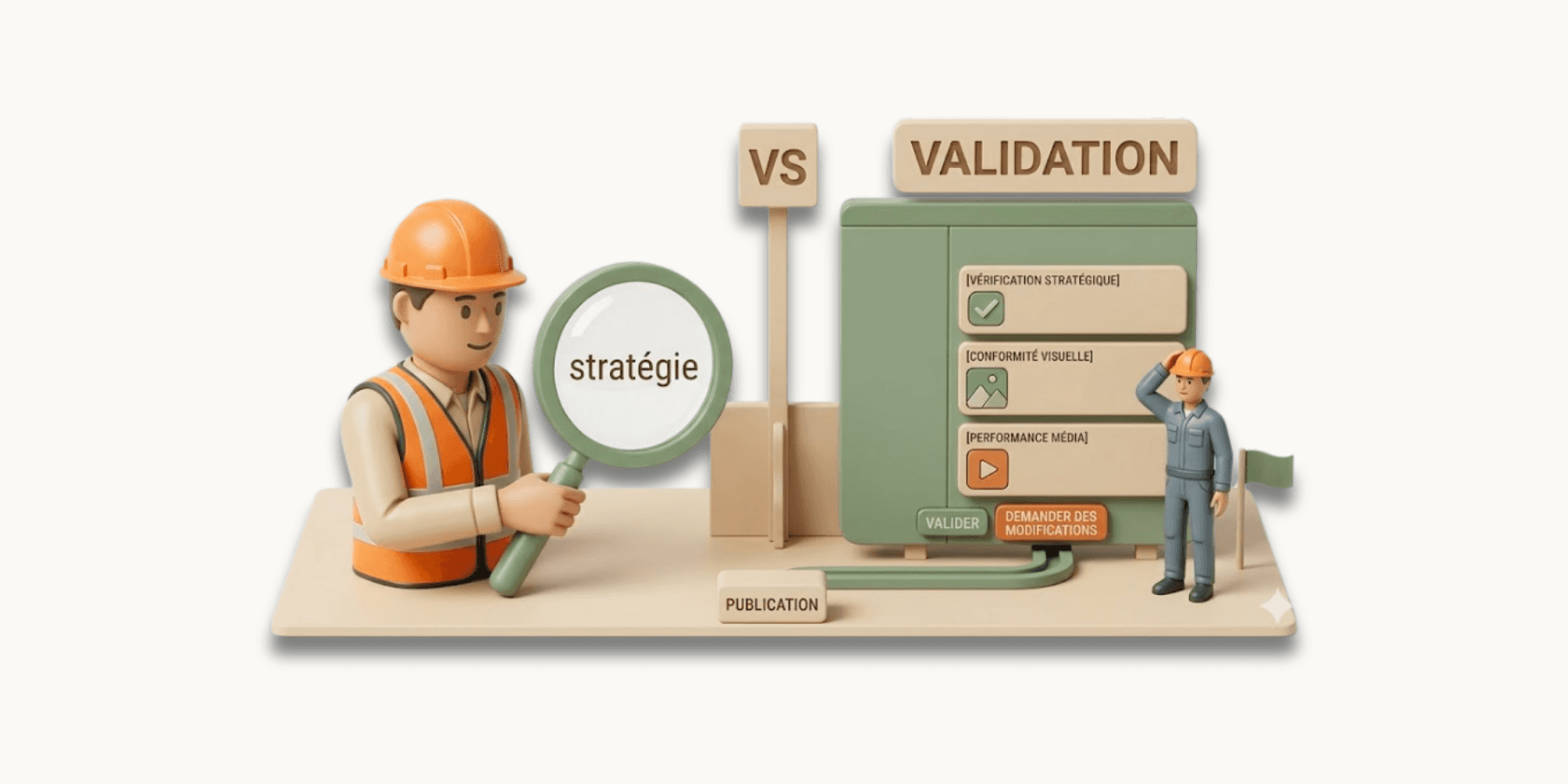
Proofing vs proofreading in creative projects
When to use proofreading
Proofreading takes place at the end of production to correct errors before publication. It is suited to written content such as blog articles or press releases.
This stage improves content quality and ensures readability before distribution. It also helps strengthen the credibility of marketing content and provide a better user experience.
When to use proofing
Proofing takes place at different stages of the project to validate content. It is essential for content distributed on social media or websites.
It helps structure content validation and ensure consistency with the marketing strategy.
Why the two are complementary
Proofreading and proofing are complementary within a clear workflow. One corrects, the other validates and structures decision-making.
Combining them makes it possible to produce effective marketing content, suited to users' needs and optimised for lead generation.
How to structure proofing and proofreading effectively
Set up a clear workflow
Setting up a clear workflow makes it possible to distinguish between proofreading and proofing stages. This improves process clarity.
This organisation allows marketing teams to better structure their projects and optimise project management.

Centralising feedback
Centralising feedback helps simplify decision-making and avoid errors. It improves the quality of marketing content.
Real-time management also makes it possible to track updated content and improve workflows.
Define roles
Defining roles helps clarify responsibilities in the process. Each person involved knows when to act.
This organisation meets the needs of marketing teams and improves overall performance in the long term.
Smartevo: a tool for managing proofing
Centralise content
Smartevo makes it possible to centralise marketing content in a single tool. Teams can track projects in real time.
This makes project management easier and helps structure approval workflows effectively. Teams have better visibility of content progress and can track each stage more easily.
Facilitating collaborative validation
The platform makes it possible to centralise feedback and structure approvals. Teams can collaborate effectively.
Proofing becomes simpler and makes it possible to implement processes suited to the challenges of digital marketing.
Improving team performance
Smartevo helps save time and reduce errors in content validation. Teams become more efficient.
Businesses can thus reduce the need to call on dispersed approvals and improve lead generation as well as conversion rates.
Understanding the difference between proofing and proofreading makes it possible to structure marketing projects effectively. By combining proofreading and content validation, marketing teams can improve the quality, consistency and performance of their marketing content. Tools like Smartevo make it possible to implement these processes and optimise workflows sustainably.
