Industry News
How is artificial intelligence transforming digital marketing software?
How is artificial intelligence transforming digital marketing software?
Digital marketing has grown significantly in recent years, pushing project managers to rely on software to centralise and optimise their campaigns. With the arrival of AI, these tools are evolving and becoming capable of simplifying teams’ work at every stage of their projects.
What is digital marketing software?
Definition and main objectives
A software for digital marketing is a tool that helps teams organise and manage their marketing and communications campaigns. It brings together information, projects and content in one place. It also makes it possible to plan actions and easily track tasks related to projects.
The main objective of this software is to make teams’ work simpler and smoother. It is used to structure projects, reduce manual tasks and facilitate day-to-day collaboration. It also provides better visibility into progress, helping people make good decisions more quickly.
The key functions: automation, tracking, approval and coordination
Digital marketing software automates many repetitive tasks, such as task creation or reminders. They offer clear tracking of tasks and projects. This visibility avoids unnecessary back-and-forth and information loss. Teams thus gain in fluidity and responsiveness.
These tools include approval workflows that organise work among the various stakeholders. Feedback and versions are centralised, which reduces errors and duplicates. Each stage is tracked, facilitating rapid decision-making. Collaboration becomes simpler and more structured.
The importance of centralising content and communications
According to Corexta, organisational efficiency increases when content, exchanges and tools are centralised in a single workspace. This approach reduces the time spent searching for information and coordination errors, offering essential transparency that improves collaboration and team peace of mind.
Moreover, according to Les Echos, employees receive an average of 290 emails per week. That is why the centralisation of exchanges, documents and approvals is essential: no more unnecessary back-and-forth, information flows smoothly without overloading teams.
The limits of traditional tools
Marketing software has supported teams for years, but it struggles to keep pace today. Designed as execution tools, they allow storage and organisation, without truly structuring projects. When volumes increase, exchanges multiply and overall visibility deteriorates.
At the same time, these tools make little use of the data they collect. Information is displayed, but rarely analysed or translated into useful recommendations. Management therefore remains reactive and relies heavily on teams. Artificial intelligence paves the way for a more proactive and guided approach.
The contribution of artificial intelligence in marketing software
Creating briefs
Artificial intelligence brings real value right from brief creation, which is often time-consuming and a source of back-and-forth. It helps structure the request, clarify objectives and ensure nothing essential is forgotten. The brief becomes more complete and easier to read for all teams.
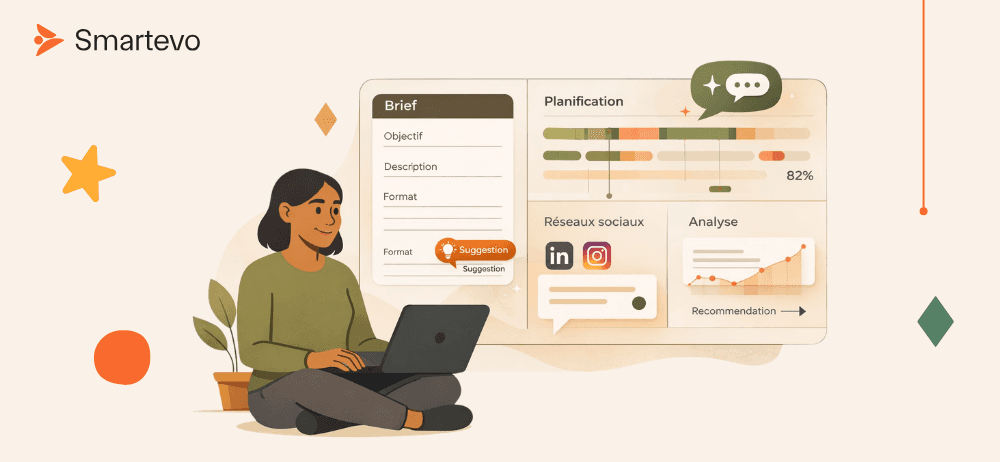
An AI assistant like Smartevo’s helps teams write and structure their marketing briefs. It makes it easier to formulate the objective, description and expected formats, while suggesting recommendations tailored to the activity. Generative AI also offers translation options.
Optimising planning
Artificial intelligence improves the planning of marketing projects by making it easier to organise tasks and meet deadlines. It helps organise tasks over time and distribute workloads. Teams can thus adjust their priorities more easily. Planning becomes more reliable and smoother.
AI analyses project progress and identifies potential bottlenecks. It can suggest schedule adjustments or alert users in the event of overload. Project managers then have decision support in real time. This enables them to manage their actions with greater peace of mind.
Generating metadata for social networks
Artificial intelligence makes it easier to generate metadata for distributing content on social networks. It helps write descriptions, suggest relevant hashtags and define the tone to adopt depending on the message. Teams save time while ensuring better editorial consistency.
An AI assistant like Smartevo automatically adapts captions and hashtags to the specifics of each social network. LinkedIn, Instagram and TikTok do not have the same codes or expectations. AI adjusts content to these differences, without any extra effort for teams.
Analysis of statistics and recommendations
Artificial intelligence makes it possible to analyse statistics related to a website’s performance. It identifies trends, the content that works best and areas for improvement. Teams thus have a clearer reading of their results. Analysis becomes more accessible on a daily basis.
Based on these data, AI can formulate concrete recommendations to guide next actions. It suggests campaign ideas, formats to prioritise or avenues for optimisation.
The benefits
Faster publishing
Integrating artificial intelligence reduces the number of intermediate steps in content production. Briefs and proposals are clearer and better structured from the outset. Teams therefore avoid successive corrections and endless approvals. Production gains in fluidity and speed.
By automating certain tasks and structuring processes better, marketing software makes it possible to improve efficiency. Production becomes more linear, without unnecessary interruptions. Deadlines are shortened and teams become more responsive. Publishing thus takes place at a more sustained and controlled pace.
Time saved
According to a study by the Boston Consulting Group, artificial intelligence could enable one in two workers to gain more than one hour per day on their professional tasks. This gain mainly concerns organisation, information search and coordination.
By automating part of workflows, AI reduces the time spent on manual and repetitive actions. Teams spend less time on organisation and tracking, and focus more on substance. Mental load decreases and deadlines shorten.
Communication effectiveness
By centralising content, comments and approvals, marketing software limits the dispersion of exchanges. All information is accessible in one place, without multiplying emails or messages. Teams
know where to exchange and where to find key elements.
Artificial intelligence helps reinforce the consistency of messages distributed across all channels. It helps formulate clear content, aligned and adapted to the context. Misunderstandings decrease and back-and-forth is reduced.
Better visibility over projects
Artificial intelligence offers better visibility over all ongoing marketing projects. It makes it possible to monitor overall progress, quickly identify priorities and spot bottlenecks. Managers have a clear, up-to-date and shared view. Management becomes simpler and more structured.
By consolidating information in one place, marketing software makes it easier to step back. Decisions are no longer made project by project, but with an overall view. Teams can better anticipate workloads and adjust actions.
Artificial intelligence helps make digital marketing software more structuring and more effective. Smartevo is part of this new generation of solutions designed for marketing and communications teams. A concrete response to today’s coordination and management challenges.
