Industry News
The keys to effective content creation

Producing content has become essential for marketing and communication teams. However, effective content creation does not rely solely on inspiration. A clear method, good organisation, and a fine understanding of one's audience remain the keys to achieving better results.
Why has content creation become essential?
Content at the heart of digital marketing
Today, content plays a role at every stage of the customer journey. Before contacting a company, a prospect often consults several resources in order to gather information, compare available solutions, and assess the credibility of a brand.
The creation of content thus makes it possible to improve the visibility of a business, develop its reputation, and strengthen its expertise. It serves as a sustainable lever for attracting new prospects and building loyalty among existing audiences.
Content marketing is now at the heart of many digital strategies. It makes it possible to promote products and services while providing useful information to prospects before they make a decision.
More demanding audiences
Internet users are exposed to a considerable amount of information every day. Their attention span is limited and businesses must now compete to capture just a few seconds of interest.
To stand out, it is no longer enough to publish regularly. Content must be useful, relevant, and tailored to the real needs of the target audience in order to create genuine engagement.
Starting by understanding your audience
Identifying your target audience
Effective content creation always starts with a good knowledge of your audience. Before producing content, it is essential to understand who it is addressed to and what the needs of the targeted people are.
Teams must identify the expectations, pain points, and consumption habits of their target audience. This understanding allows for the creation of more relevant content that is better suited to market needs.
Building personas
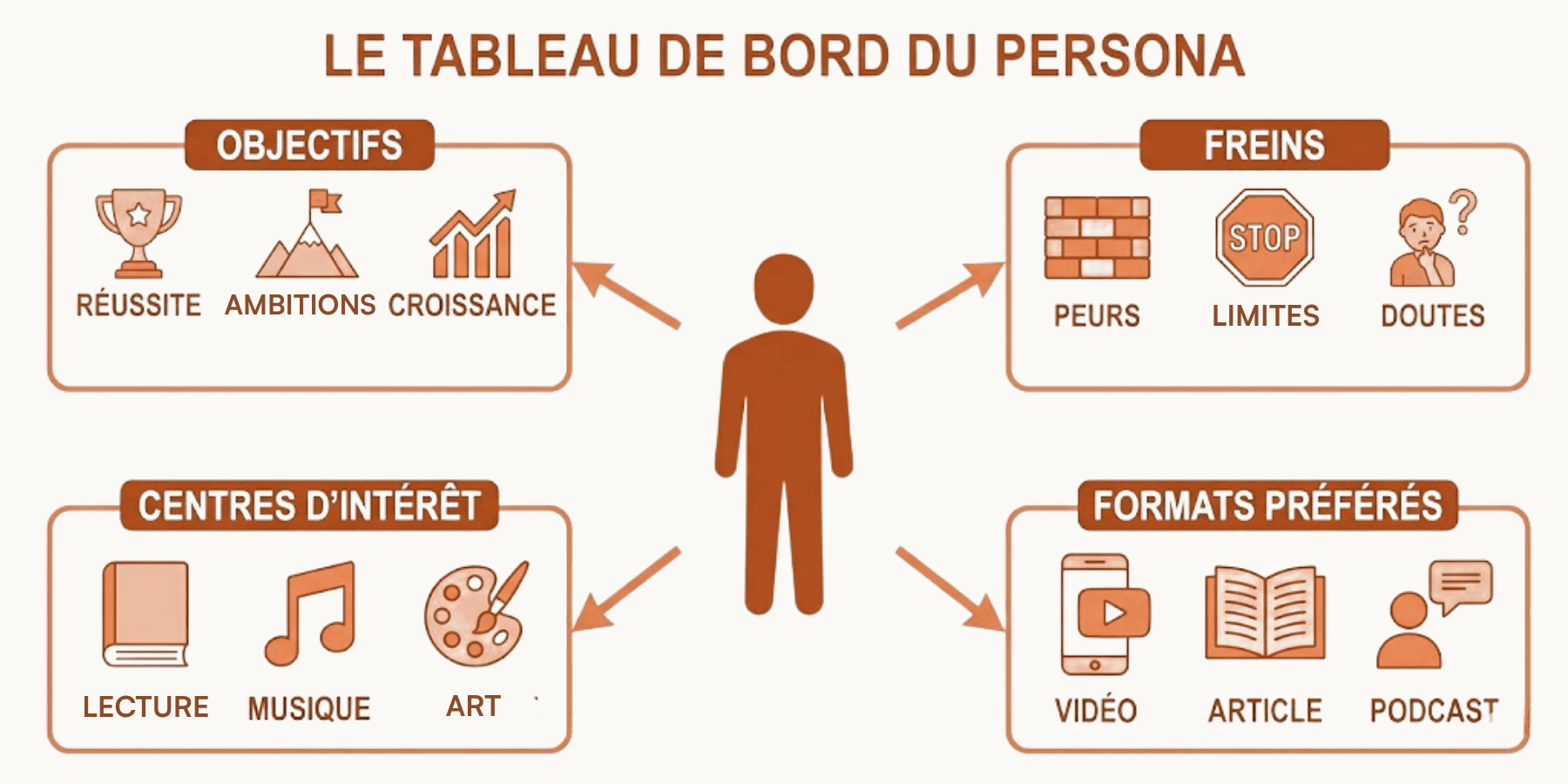
Personas represent the typical profiles of the users or targeted customers. They gather information such as objectives, barriers, areas of interest, or content consumption habits.
This approach facilitates decision-making throughout the creation process. Teams have a clearer vision of their audience and can adapt their messages accordingly.
This process is often based on market research, customer feedback, or the analysis of existing performance. This information helps to better understand the expectations of the target audience.
Responding to concrete needs
The best-performing content generally answers a specific question or problem. It provides a useful answer rather than simply promoting the company's products or services.
The objective is to guide the audience in their reflection or decision-making. This approach helps to strengthen trust and the credibility of the brand.
Defining clear objectives
Giving direction to your strategy
Every piece of content must meet a clearly identified objective. Some companies look to develop their visibility while others wish to generate leads, build customer loyalty, or reinforce their expertise.
Defining these objectives from the start facilitates editorial choices. This provides teams with a clear direction to guide their content production.
Content must also integrate into a global marketing strategy in order to support business objectives and the various marketing actions carried out by the company.
Measuring the results obtained
To evaluate the effectiveness of content, it is necessary to track certain performance indicators. Traffic, time spent on a page, engagement, or conversions make it possible to analyse the results obtained.
This data helps teams to understand what actually works. It also allows them to adjust the content strategy and optimise future actions.
Structuring creation from the brief
Formalising the request
The brief constitutes the foundation of any content project. It helps specify the objectives, the key messages, the target audience, the expected formats, as well as the completion deadlines.
The more complete the brief, the smoother the production will be. Teams immediately have the necessary information to start their work under good conditions.
Aligning the teams
Content creation often involves several stakeholders: marketing managers, copywriters, graphic designers, videographers, or community managers. Everyone must precisely understand the expectations of the project.
The brief allows for sharing a common vision and minimising misunderstandings. This step improves collaboration throughout production.
Reducing back-and-forth communication
An imprecise request generally leads to additional corrections and exchanges. Teams then lose time clarifying expectations or correcting misunderstood elements.
A structured brief limits these situations. Content is more quickly aligned with the objectives defined at the start, and approvals become smoother.
Organising your content production
Building an editorial calendar
The editorial calendar allows for planning content over several weeks or months. It offers a global view of the topics to be covered and the publication dates to be respected.
This organisation facilitates anticipation and reduces last-minute production periods. Teams thus have better visibility over their workload.
The editorial calendar also facilitates the coordination of marketing campaigns and guarantees better consistency among the different published pieces of content.
Maintaining a regular publication schedule
Consistency plays an important role in the performance of a content strategy. Audiences get used to a publication schedule and gradually develop consumption habits.
Regular publishing also improves visibility on search engines, the company website, and social media. It contributes to maintaining a continuous presence with prospects and customers.
Distributing responsibilities
When several people participate in content creation, it is important to clearly define everyone's roles. This organisation avoids duplication and uncertainties.
Teams know precisely who produces, who approves, and who publishes the content. Projects thus progress in a smoother and more efficient manner.
This visibility also facilitates the management of marketing campaigns and the coordination of the various marketing actions carried out by the teams.
Diversifying content formats
Blog posts
Blog posts remain one of the most essential formats for developing online visibility. They allow for covering a topic in depth while improving natural search engine optimisation (SEO).
They also contribute to demonstrating the company's expertise and answering the questions that internet users ask themselves throughout their journey.
Video content
Video currently occupies an important place in content strategies. It facilitates the understanding of complex topics and often generates more engagement than text-only formats.
It also allows for diversifying messaging and reaching audiences who consume less written content.
Social media and visual content
Social media networks allow for distributing content to different audiences. Each platform has its own practices and requires specific adaptations in terms of format and tone.
Social media now occupies a central role in content distribution. It allows for quickly reaching different audiences while strengthening brand visibility.
Visuals, infographics, or carousels facilitate the delivery of messages and improve engagement. They constitute an excellent complement to written content.
Reusing and repurposing your content
Giving multiple lives to the same content
Creating content takes time and resources. It is therefore highly relevant to adapt it into several formats to maximise its impact and reach.
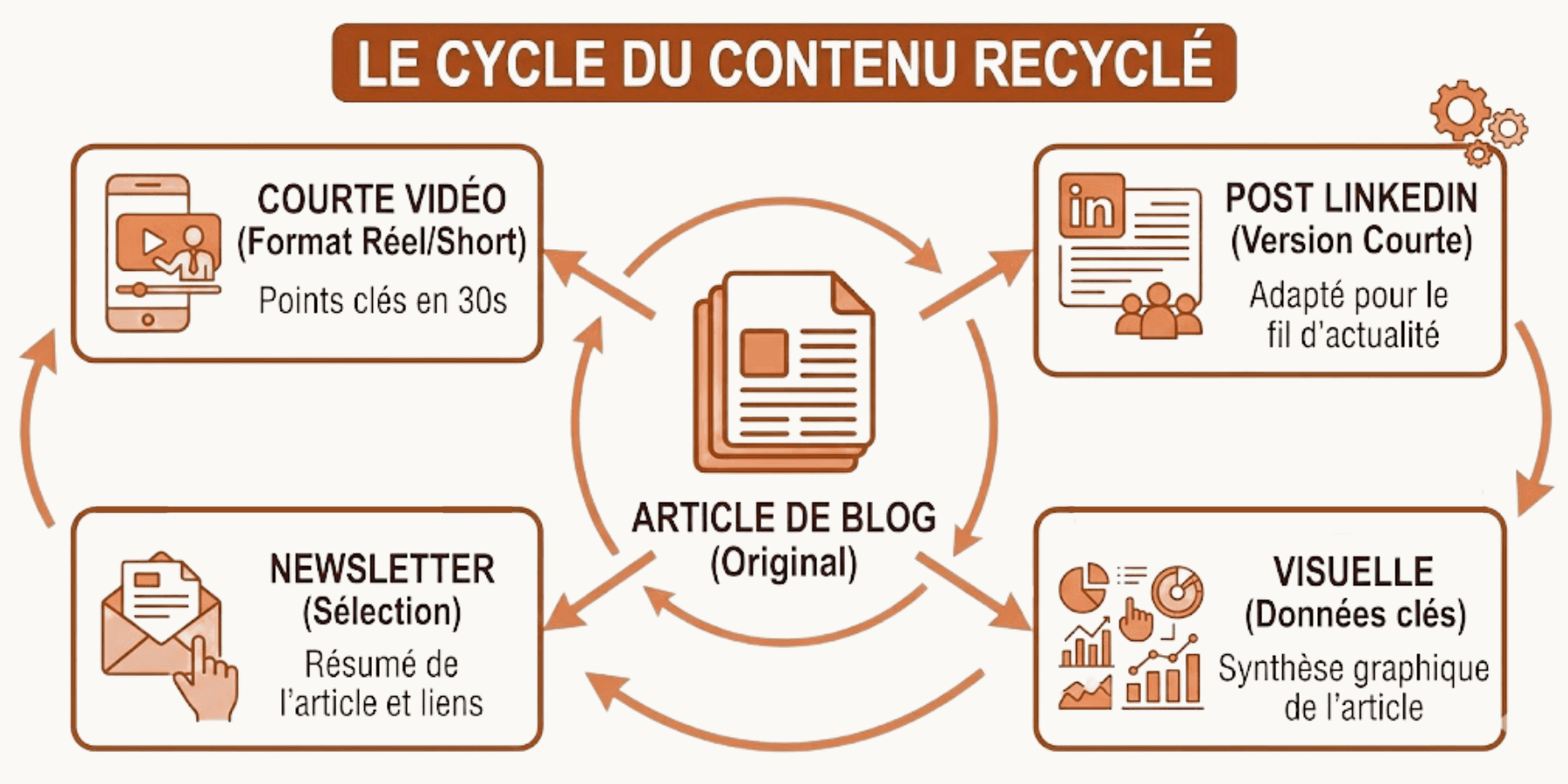
A blog post, for example, can be transformed into a LinkedIn post, a newsletter, an infographic, or a short video. This approach allows for reaching different audiences while optimising production efforts.
Extending the lifespan of content
Repurposing content makes it possible to continue generating visibility weeks or months after its creation. This also avoids starting from scratch for every new publication.
This approach contributes to improving the profitability of the content produced. Teams save time while maintaining editorial consistency.
Producing quality content
Focusing on added value
The best-performing content is that which provides genuine utility to its audience. It answers concrete questions, offers practical advice, or shares specific expertise.
This approach naturally fosters engagement and improves the perception of the company among its readers or subscribers.
Using storytelling
Storytelling helps to make content more engaging and easier to remember. Stories facilitate the understanding of messages and create a stronger connection with the audience.
This technique can be used in many formats, whether it is articles, videos, or social media posts.
Facilitating readability
Readability plays an essential role in the user experience. Short paragraphs, explicit headings, and a clear structure improve understanding of the content.
Readers find the information they are looking for more quickly and generally stay longer on the page.
Optimising your content for SEO
Understanding search intent
Search engine optimisation does not simply consist of stuffing keywords into text. Content must first and foremost respond to user expectations and the questions they ask.
Understanding search intent allows for producing more relevant content. This approach improves both user experience and SEO performance.
Working with keywords
Keyword research helps identify the topics searched for by internet users. This helps teams to build content aligned with market needs.
Keywords should be integrated naturally into headings, subheadings, and paragraphs. The goal remains to maintain a smooth and enjoyable reading experience.
Structuring your content
A good structure facilitates reading and indexing by search engines. Heading tags, internal links, and metadata play an important role in this optimisation.
Well-structured content also allows readers to quickly find the desired information. It thus improves the overall reading experience.
Measuring performance to progress
Analysing results
Performance analysis helps to identify the content that generates the most traffic, engagement, or conversions. This data helps teams understand what actually works.
This process allows for making decisions based on concrete results. It contributes to gradually improving the editorial strategy.
Adjusting your strategy
Audience expectations are constantly evolving. The formats, topics, and distribution channels that work today will not necessarily be the same tomorrow.
An effective content strategy is therefore based on a logic of continuous improvement. Data makes it possible to regularly adjust priorities and the actions taken.
How does Smartevo facilitate content creation?
Structuring briefs
Smartevo helps teams to formalise their requests using customisable brief templates. Projects start with clear objectives and centralised information.
This approach reduces misunderstandings right from the start. Teams have a common framework to produce their content more efficiently.
Organising production
The platform allows for planning projects, tracking their progress, and coordinating the various stakeholders in a single space. Managers have complete visibility over current actions.
Teams thus gain in efficiency and peace of mind. Everyone knows where to find the necessary information and what their priorities are.
Streamlining approvals
Annotations, comments, and approval workflows are grouped directly within the projects. Exchanges are faster and content progresses more easily towards its publication.
This centralisation reduces information loss and limits errors related to handling different versions of the same content.
Using AI to speed up your processes
Smartevo's AI assistant helps teams write their briefs, generate metadata, suggests optimisations, and analyses performance.
Repetitive tasks are reduced and teams can dedicate more time to value creation.
Effective content creation relies on a balance between strategy, organisation, and creativity. By structuring projects, approvals, and publications, marketing and communication teams gain in efficiency while producing higher-performing content.
